
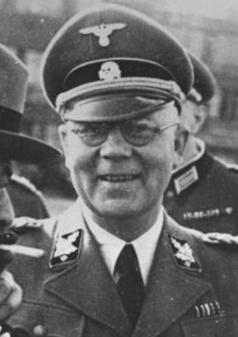
Carl Oberg
Carl Oberg was a German SS and Police general and high ranking German Waffen-SS Army and Police Commander. Born January 27, 1897, in Hamburg. Died June 3, 1965, in Flensburg. Awards include Iron Cross, War Merit Cross and Honour Cross of the World War 1914/1918.
Facts
16 facts · 2 confirmed by two sources · 3 cited · 11 from one source
Where this comes from
Papalocal keeps its own record. It started from these sources; what each one said is kept here as it was copied, so a change on their side never changes this page by itself. Tap one to read its version.
What Wikidata says · copied November 18, 2026 · revision 2569147170
- Described as
- German SS and Police general and high ranking German Waffen-SS Army and Police Commander
- Other names
- Carl Albrecht Oberg
- Born
- January 27, 1897 · 1 reference
- Died
- June 3, 1965 · 1 reference
- Born in
- Hamburg · 1 reference
- Died in
- Flensburg
- Citizen of
- German Empire; Nazi Germany; West Germany
- Occupation
- military personnel; Holocaust perpetrator · 1 reference
- Political party
- Nazi Party (1931–) · 1 reference
- Member of
- Schutzstaffel · 1 reference
- Awards
- Iron Cross · 1 reference; War Merit Cross · 1 reference; Honour Cross of the World War 1914/1918 · 1 reference
- Military branch
- Imperial German Army · 1 reference
- Military rank
- general
- Wikipedias with a page
- 21
Wikidata item Q61815 (wikidata.org/wiki/Q61815), public domain (CC0). Copied November 18, 2026.
What Wikipedia says · copied November 18, 2026 · revision 1379863100
Carl Albrecht Oberg (27 January 1897 – 3 June 1965) was a German SS functionary during the Nazi era. He served as Senior SS and Police Leader (HSSPF) in occupied France, from May 1942 to November 1944, during the Second World War, Oberg came to be known as the Butcher of Paris. From May 1942, under orders from Reinhard Heydrich, Oberg ordered the execution of hundreds of hostages and the roundup and deportation of over 40,000 Jews from France to extermination camps.
Arrested by American military police in Tyrol in July 1945, Oberg was sentenced to death by both British and French courts, before being handed over to the French. In 1958 his death sentence was commuted to life imprisonment and later reduced to 20 years at hard labour. Oberg was eventually released on 28 November 1962 and pardoned by President Charles de Gaulle. He died in West Germany on 3 June 1965.
- Born, in its opening lines
- January 27, 1897
- Died, in its opening lines
- June 3, 1965
From the Wikipedia article “Carl Oberg” (en.wikipedia.org/wiki/Carl_Oberg), by its contributors, under CC BY-SA 4.0 (creativecommons.org/licenses/by-sa/4.0/). Copied November 18, 2026; not changed.
Confirmed Two sources agree. Cited One source, and it names where it got it. One source One source, without a reference of its own. Sources disagree The sources disagree. We show the best-supported value and keep theirs below.
