
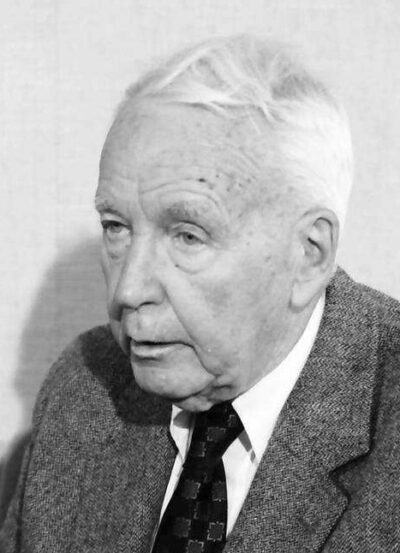
Charles Brenton Huggins
Charles Brenton Huggins was an American physiologist. Born September 22, 1901, in Halifax. Died January 12, 1997, in Chicago. Educated at Harvard Medical School and Acadia University. Awards include Nobel Prize in Physiology or Medicine, Pour le Mérite for Sciences and Arts order and Canada Gairdner International Award.
Facts
32 facts · 2 confirmed by two sources · 8 cited · 22 from one source
Where this comes from
Papalocal keeps its own record. It started from these sources; what each one said is kept here as it was copied, so a change on their side never changes this page by itself. Tap one to read its version.
What Wikidata says · copied November 13, 2026 · revision 2563199600
- Described as
- American physiologist (1901-1997)
- Other names
- Charles Huggins
- Born
- September 22, 1901 · 10 references
- Died
- January 12, 1997 · 10 references
- Born in
- Halifax
- Died in
- Chicago · 1 reference
- Citizen of
- Canada; United States
- Occupation
- physiologist; oncologist; university teacher; surgeon · 2 references; physician · 2 references
- Worked for
- University of Chicago; University of Michigan · 1 reference
- Education
- Harvard Medical School; Acadia University
- Member of
- American Academy of Arts and Sciences; American Philosophical Society (1962–) · 1 reference; National Academy of Sciences (1949–)
- Awards
- Nobel Prize in Physiology or Medicine (1966) · 2 references; Pour le Mérite for Sciences and Arts order; Canada Gairdner International Award (1966); Lasker-DeBakey Clinical Medical Research Award (1963) · 1 reference; Canadian Medical Hall of Fame (2003) · 1 reference; Honorary doctor of the University of Bologna; honorary doctor of the University of Aberdeen; Grand Officer of the Order of the Sun of Peru; Honorary Fellow of the Royal College of Surgeons (1959) · 1 reference; Cameron Prize of the University of Edinburgh; Amory Prize (1947)
- Field
- physiology · 1 reference; oncology · 1 reference
- Spouse
- Melba Moore
- Wikipedias with a page
- 51
Wikidata item Q155371 (wikidata.org/wiki/Q155371), public domain (CC0). Copied November 13, 2026.
What Wikipedia says · copied November 13, 2026 · revision 1384273126
Charles Brenton Huggins (September 22, 1901 – January 12, 1997) was a Canadian-American surgeon and physiologist known for his work on prostate function, prostate cancer, and breast cancer. Born in Halifax in 1901, Huggins moved to the United States for medical school. He was one of the founding staff members of the University of Chicago Medical School, where he remained for the duration of his professional research career. Huggins's work on how sex hormones influence prostate function ultimately led to his discovery of hormone therapies to treat prostate cancer. For this finding, he was awarded the 1966 Nobel Prize for Physiology or Medicine. In addition to his work on prostate cancer, Huggins explored the relationship between hormones and breast cancer, developed an animal model for breast cancer, and developed chromogenic substrates that are widely used for biochemical analyses. Huggins continued to perform research into his 90s; he died in Chicago in 1997.
- Born, in its opening lines
- September 22, 1901
- Died, in its opening lines
- January 12, 1997
From the Wikipedia article “Charles Brenton Huggins” (en.wikipedia.org/wiki/Charles_Brenton_Huggins), by its contributors, under CC BY-SA 4.0 (creativecommons.org/licenses/by-sa/4.0/). Copied November 13, 2026; not changed.
Confirmed Two sources agree. Cited One source, and it names where it got it. One source One source, without a reference of its own. Sources disagree The sources disagree. We show the best-supported value and keep theirs below.
