
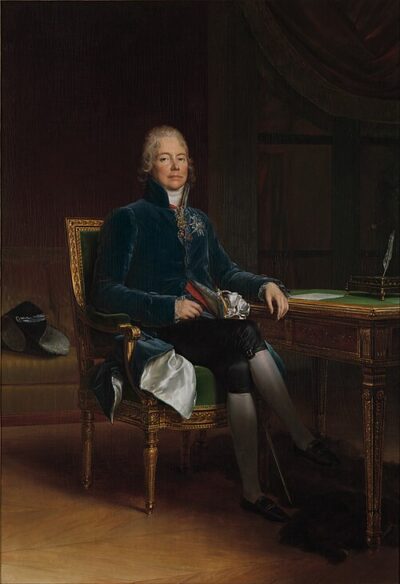
Charles-Maurice de Talleyrand-Périgord
Charles-Maurice de Talleyrand-Périgord was a French diplomat. Born February 2, 1754, in Paris. Died May 17, 1839, in Paris. Positions held include member of the French National Assembly (1789–1791), ambassador and head of government of France (1815). Educated at Lycée Saint-Louis. Awards include Grand Cross of the Legion of Honour, Knight of the Order of the Holy Spirit and Knight of the Order of Saint Michael.
Facts
48 facts · 1 confirmed by two sources · 10 cited · 36 from one source · 1 where the sources disagree
What’s different
- Died: we show May 17, 1839 (Sources disagree). Wikipedia says May 17, 1838
Where this comes from
Papalocal keeps its own record. It started from these sources; what each one said is kept here as it was copied, so a change on their side never changes this page by itself. Tap one to read its version.
What Wikidata says · copied November 16, 2026 · revision 2562769407
- Described as
- French diplomat (1754-1838)
- Other names
- Charles Maurice de Talleyrand-Périgord, Talleyrand, Charles Maurice de Talleyrand-Perigord, Charles-Maurice de Talleyrand-Perigord, Charles Maurice Talleyrand de Périgord, Prince of Benevento
- Born
- February 2, 1754 · 3 references
- Died
- May 17, 1839 · 13 references
- Born in
- Paris · 2 references
- Died in
- Paris · 1 reference
- Buried in
- Château de Valençay
- Citizen of
- France
- Occupation
- politician · 1 reference; diplomat · 1 reference; Catholic priest (1779–1802) · 1 reference; writer · 1 reference; Catholic bishop (1789–) · 1 reference
- Positions held
- member of the French National Assembly (1789–1791); ambassador; head of government of France (1815); Minister of Foreign Affairs (1815); Pair of France; constitutional bishop; Roman Catholic Bishop of Autun (1788–1791) · 2 references; deputy to the Estates-General of 1789 (1789–)
- Political party
- independent politician; Society of 1789
- Education
- Lycée Saint-Louis
- Member of
- Académie des Inscriptions et Belles-Lettres (1795–1838) · 1 reference; Académie des Sciences Morales et Politiques; Travellers Club
- Awards
- Grand Cross of the Legion of Honour; Knight of the Order of the Holy Spirit; Knight of the Order of Saint Michael; Knight of the Order of the Golden Fleece (1814); Knight of the Order of St. Alexander Nevsky; Order of the Black Eagle; Order of Saint Anna, 1st class; Order of St. Andrew; Knight of the Order of the Elephant (1815); Order of Saint Stephen of Hungary; Order of Leopold; Order of the Red Eagle; Order of Saint Hubert; Order of the Rue Crown; Order of Ludwig I
- Spouse
- Catherine Grand · 1 reference
- Children
- Charles Joseph, comte de Flahaut; Pauline de Talleyrand-Périgord; Charlotte de Talleyrand-Périgord
- Father
- Charles-Daniel de Talleyrand-Périgord · 1 reference
- Mother
- Alexandrine Victoire Eléonore Damas · 1 reference
- Siblings
- Archambaud de Talleyrand-Périgord
- Religion
- Catholic Church · 1 reference
- Wikipedias with a page
- 95
Wikidata item Q160499 (wikidata.org/wiki/Q160499), public domain (CC0). Copied November 16, 2026.
What Wikipedia says · copied November 16, 2026 · revision 1385536624
Charles-Maurice de Talleyrand-Périgord (; French: [ʃaʁl mɔʁis də tal(ɛ)ʁɑ̃ peʁiɡɔʁ, moʁ-]; 2 February 1754 – 17 May 1838), 1st Prince of Benevento, then Prince of Talleyrand, was a French secularized clergyman, statesman, and leading diplomat. After studying theology, he became Agent-General of the Clergy in 1780. In 1789, just before the French Revolution, he became Bishop of Autun. He worked at the highest levels of successive French governments, most commonly as foreign minister or in some other diplomatic capacity. He served as the French representative to the Congress of Vienna. His career spanned the regimes of Louis XVI, the years of the French Revolution, Napoleon, Louis XVIII, Charles X, and Louis Philippe I. Those Talleyrand served often distrusted him but found him extremely useful. The name "Talleyrand" has become a byword for crafty and cynical diplomacy.
Talleyrand was Napoleon's chief diplomat during the years when French military victories brought one European state after another under French hegemony. Most of the time, he worked for peace so as to consolidate France's gains. He succeeded in obtaining peace with Austria through the 1801 Treaty of Lunéville and with Britain in the 1802 Treaty of Amiens. He could not prevent the renewal of war in 1803 but by 1805 he opposed his emperor's renewed wars against Austria, Prussia, and Russia. He resigned as foreign minister in August 1807, but retained the trust of Napoleon. He conspired to undermine the emperor's plans through secret dealings with Tsar Alexander I of Russia and the Austrian minister Klemens von Metternich. Talleyrand sought a negotiated secure peace so as to perpetuate the gains of the French Revolution. Napoleon rejected peace; when he fell in 1814, Talleyrand supported the Bourbon Restoration decided by the Allies. He played a major role at the Congress of Vienna in 1814–1815, where he negotiated a favorable settlement for France and played a role in unwinding the Napoleonic Wars.
Talleyrand polarizes opinion. Some regard him as one of the most versatile, skilled, and influential diplomats in European history, with a clear-eyed and realistic view of the French national interest. Others, on the other hand, see him as a serial turncoat seeking only his own advantage, betraying the ancien régime, the French Revolution, and Napoleon in turn for his own gain.
- Born, in its opening lines
- February 2, 1754
- Died, in its opening lines
- May 17, 1838
From the Wikipedia article “Charles Maurice de Talleyrand-Périgord” (en.wikipedia.org/wiki/Charles_Maurice_de_Talleyrand-Périgord), by its contributors, under CC BY-SA 4.0 (creativecommons.org/licenses/by-sa/4.0/). Copied November 16, 2026; not changed.
Confirmed Two sources agree. Cited One source, and it names where it got it. One source One source, without a reference of its own. Sources disagree The sources disagree. We show the best-supported value and keep theirs below.
