
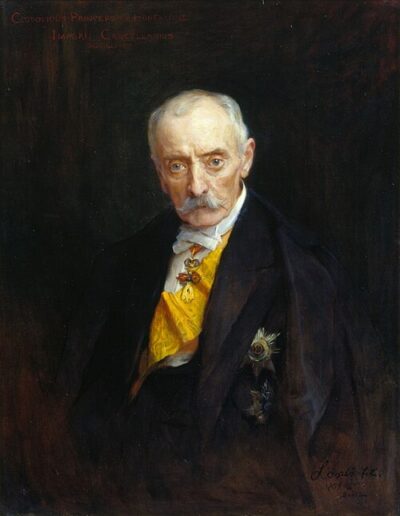
Chlodwig, 3rd Prince of Hohenlohe-Schillingsfürst
Chlodwig, 3rd Prince of Hohenlohe-Schillingsfürst was a German chancellor. Born March 31, 1819, in Rotenburg an der Fulda. Died July 6, 1901, in Bad Ragaz. Positions held include Minister President of Prussia, member of the Reichstag of the German Empire and Imperial chancellor (1894–1900). Educated at University of Göttingen. Awards include Order of the Black Eagle, Order of St. Andrew and Honorary doctorate from the Julius Maximilians University of Würzburg.
Facts
37 facts · 2 confirmed by two sources · 7 cited · 28 from one source
Where this comes from
Papalocal keeps its own record. It started from these sources; what each one said is kept here as it was copied, so a change on their side never changes this page by itself. Tap one to read its version.
What Wikidata says · copied November 16, 2026 · revision 2568909540
- Described as
- German chancellor (1819–1901)
- Born
- March 31, 1819 · 7 references
- Died
- July 6, 1901 · 8 references
- Born in
- Rotenburg an der Fulda · 1 reference
- Died in
- Bad Ragaz · 1 reference
- Name at birth
- Chlodwig Carl Viktor zu Hohenlohe-Schillingsfürst
- Citizen of
- Kingdom of Prussia
- Occupation
- politician · 1 reference; diplomat
- Positions held
- Minister President of Prussia; member of the Reichstag of the German Empire; Imperial chancellor (1894–1900); Minister-President of Bavaria (1866–1870); Chancellor of Germany (1894–1900); Member of the Customs Parliament; ambassador; Federal Minister for Foreign Affairs (1880) · 1 reference
- Political party
- Imperial Liberal Party
- Education
- University of Göttingen
- Member of
- Royal Prussian Academy of Sciences
- Awards
- Order of the Black Eagle; Order of St. Andrew; Honorary doctorate from the Julius Maximilians University of Würzburg; Order of Saint Stephen of Hungary · 1 reference; Knight of the Order of the Golden Fleece; Knight of the Order of the Most Holy Annunciation (1897); Knight Grand Cross of the Order of Saints Maurice and Lazarus (1897); Knight grand cross of the order of the crown of Italy (1897)
- Spouse
- Marie Prinzessin zu Sayn-Wittgenstein-Berleburg (1847–) · 1 reference
- Children
- Philipp Ernst, 4th Prince of Hohenlohe-Schillingsfürst · 1 reference; Moritz, 5th Prince of Hohenlohe-Schillingsfürst · 1 reference; Alexander zu Hohenlohe-Schillingsfürst · 1 reference
- Father
- Franz Josef, 1st Prince of Hohenlohe-Schillingsfürst
- Mother
- Princess Constanze of Hohenlohe-Langenburg · 1 reference
- Siblings
- Victor I, Duke of Ratibor; Gustav Adolf, Cardinal Prince of Hohenlohe-Schillingfürst; Prince Konstantin zu Hohenlohe-Schillingsfürst
- Religion
- Catholic Church
- Wikipedias with a page
- 48
Wikidata item Q77166 (wikidata.org/wiki/Q77166), public domain (CC0). Copied November 16, 2026.
What Wikipedia says · copied November 16, 2026 · revision 1364287827
Chlodwig Carl Viktor, Prince of Hohenlohe-Schillingsfürst, Prince of Ratibor and Corvey (German: Chlodwig Carl Viktor Fürst zu Hohenlohe-Schillingsfürst, Prinz von Ratibor und von Corvey) (31 March 1819 – 6 July 1901), usually referred to as the Prince of Hohenlohe, was a German statesman, who served as the imperial chancellor of the German Empire and minister-president of Prussia from 1894 to 1900.
A member of the princely house of Hohenlohe, Chlodwig served in the Prussian civil service until 1845, when he succeeded as Prince of Hohenlohe-Schillingsfürst and became a member of the Bavarian Reichsrat. In 1866, on the recommendation of the composer Richard Wagner, Hohenlohe was appointed minister-president of Bavaria, and came to be regarded as the second most important statesman in Germany after Otto von Bismarck. His pro-Prussian stance and opposition to ultramontanism ultimately led to his downfall. He was forced to resign in 1870 but remained a highly influential figure. In 1871, he was elected to the Reichstag and made its vice president. Hohenlohe was among the most prominent liberal politicians of his time in Germany; he was also a strenuous supporter of Bismark's anti-papal Kulturkampf measures. In 1873, Bismarck appointed him German ambassador in Paris. He was recalled to Berlin seven years later and served briefly as foreign secretary. In 1885, he was appointed governor of Alsace–Lorraine.
In 1894, Emperor Wilhelm II dismissed Leo von Caprivi and appointed Hohenlohe imperial chancellor. Then advanced in age, he rarely appeared in parliament and granted great independence to his secretaries of state, such as foreign secretary Bernhard von Bülow. His power further diminished as a result of Wilhelm's assertiveness. Hohenlohe resigned the chancellorship in 1900 and was succeeded by Bülow. He died a year later at the age of 82.
- Born, in its opening lines
- March 31, 1819
- Died, in its opening lines
- July 6, 1901
From the Wikipedia article “Chlodwig, Prince of Hohenlohe-Schillingsfürst” (en.wikipedia.org/wiki/Chlodwig,_Prince_of_Hohenlohe-Schillingsfürst), by its contributors, under CC BY-SA 4.0 (creativecommons.org/licenses/by-sa/4.0/). Copied November 16, 2026; not changed.
Confirmed Two sources agree. Cited One source, and it names where it got it. One source One source, without a reference of its own. Sources disagree The sources disagree. We show the best-supported value and keep theirs below.
