
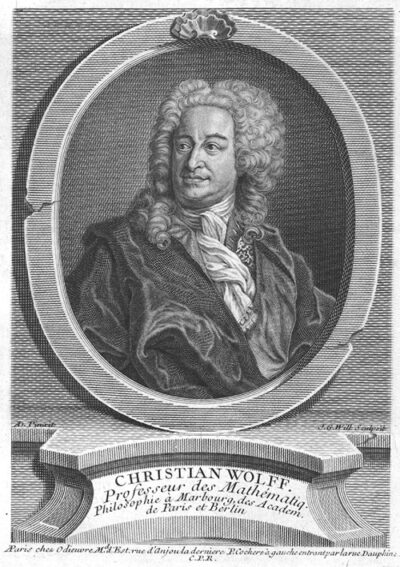
Christian Wolff
Christian Wolff was a German philosopher. Born January 24, 1679, in Wrocław. Died April 9, 1754, in Halle (Saale). Positions held include professor. Educated at University of Jena and Leipzig University. Awards include Fellow of the Royal Society.
Facts
29 facts · 2 confirmed by two sources · 11 cited · 16 from one source
Where this comes from
Papalocal keeps its own record. It started from these sources; what each one said is kept here as it was copied, so a change on their side never changes this page by itself. Tap one to read its version.
What Wikidata says · copied November 16, 2026 · revision 2568901250
- Described as
- German philosopher (1679–1754)
- Other names
- Christian von Wolff, Johann Christian von Wolff
- Born
- January 24, 1679 · 8 references
- Died
- April 9, 1754 · 11 references
- Born in
- Wrocław · 3 references
- Died in
- Halle (Saale) · 1 reference
- Citizen of
- Kingdom of Prussia
- Occupation
- jurist · 1 reference; mathematician · 2 references; philosopher · 1 reference; university teacher · 1 reference
- Positions held
- professor
- Worked for
- Leipzig University; University of Marburg (1723–1740) · 1 reference; Martin Luther University Halle-Wittenberg (1706–) · 1 reference
- Education
- University of Jena (1699–); Leipzig University · 1 reference
- Member of
- Royal Society of London (1710–) · 1 reference; Royal Prussian Academy of Sciences (1711–) · 1 reference; French Academy of Sciences; Russian Academy of Sciences; Saint Petersburg Academy of Sciences
- Awards
- Fellow of the Royal Society
- Field
- mathematics · 1 reference; philosophy · 1 reference; jurisprudence; metaphysics; philosophical logic; educational system · 1 reference
- Children
- Ferdinand von Wolff · 1 reference
- Religion
- Lutheranism
- Wikipedias with a page
- 61
Wikidata item Q76510 (wikidata.org/wiki/Q76510), public domain (CC0). Copied November 16, 2026.
What Wikipedia says · copied November 16, 2026 · revision 1353428494
Christian Wolff (; German: [vɔlf]; less correctly Wolf; also known as Wolfius; ennobled as Christian von Wolff in 1745; 24 January 1679 – 9 April 1754) was a German philosopher. Wolff is characterized as one of the most eminent German philosophers between Leibniz and Kant. His life work spanned almost every scholarly subject of his time, displayed and unfolded according to his demonstrative-deductive, mathematical method, which some deem the peak of Enlightenment rationality in Germany.
Wolff wrote in German as his primary language of scholarly instruction and research, although he did translate his works into Latin for his transnational European audience. A founding father of, among other fields, economics and public administration as academic disciplines, he concentrated especially in these fields, giving advice on practical matters to people in government, and stressing the professional nature of university education.
- Born, in its opening lines
- January 24, 1679
- Died, in its opening lines
- April 9, 1754
From the Wikipedia article “Christian Wolff (philosopher)” (en.wikipedia.org/wiki/Christian_Wolff_(philosopher)), by its contributors, under CC BY-SA 4.0 (creativecommons.org/licenses/by-sa/4.0/). Copied November 16, 2026; not changed.
Confirmed Two sources agree. Cited One source, and it names where it got it. One source One source, without a reference of its own. Sources disagree The sources disagree. We show the best-supported value and keep theirs below.
