
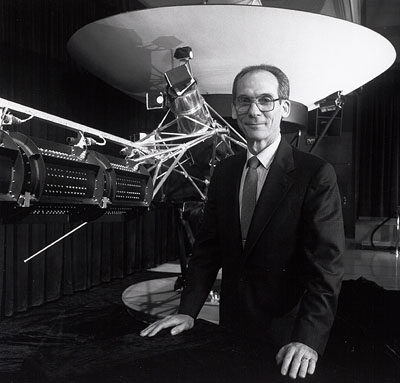
Edward C. Stone
Edward C. Stone was an American space scientist. Born January 23, 1936, in Knoxville. Died June 9, 2024, in Pasadena. Educated at Southeastern Community College and University of Chicago. Awards include Fellow of the American Physical Society, NASA Exceptional Scientific Achievement Medal (2 times) and Richtmyer Memorial Lecture Award.
Facts
44 facts · 2 confirmed by two sources · 38 cited · 4 from one source
Where this comes from
Papalocal keeps its own record. It started from these sources; what each one said is kept here as it was copied, so a change on their side never changes this page by itself. Tap one to read its version.
What Wikidata says · copied November 18, 2026 · revision 2527578953
- Described as
- American space scientist (1936–2024)
- Other names
- Edward Stone, Edward C Stone, E. C. Stone, E.C. Stone, E C Stone, EC Stone, E. Stone, Edward Carroll Stone Jr.
- Born
- January 23, 1936 · 5 references
- Died
- June 9, 2024 · 2 references
- Born in
- Knoxville · 3 references
- Died in
- Pasadena · 1 reference
- Name at birth
- Edward Carroll Stone Jr · 3 references
- Citizen of
- United States
- Occupation
- physicist · 1 reference; research fellow (1964–1966) · 1 reference; senior research fellow (1967) · 1 reference; assistant professor (1967–1971) · 1 reference; project scientist (1972–2022) · 2 references; professor (1976–2022) · 1 reference; director (1991–2001) · 3 references
- Worked for
- California Institute of Technology (1964–) · 1 reference; Jet Propulsion Laboratory (1991–2001) · 2 references; TMT International Observatory (2014–2022) · 2 references
- Education
- Southeastern Community College (–1956) · 1 reference; University of Chicago (1956–1963) · 2 references
- Member of
- American Geophysical Union (1960–) · 1 reference; National Academy of Sciences (1984–) · 2 references; American Philosophical Society (1993–) · 2 references; American Astronomical Society · 1 reference; California Council on Science and Technology · 1 reference; Committee on Space Research · 1 reference; International Academy of Astronautics · 2 references; International Astronautical Federation · 1 reference; Japan Academy (2022–) · 1 reference; International Astronomical Union
- Awards
- Fellow of the American Physical Society (1975) · 1 reference; NASA Exceptional Scientific Achievement Medal (2 times) (1980, 2006) · 1 reference; Richtmyer Memorial Lecture Award (1980) · 1 reference; NASA Distinguished Service Medal (3 times) (1981, 1998, 2001) · 1 reference; Fellow of the American Geophysical Union (1983) · 1 reference; NASA Distinguished Public Service Medal (2 times) (1985, 2014) · 1 reference; NASA Outstanding Leadership Medal (2 times) (1986, 1995) · 1 reference; Golden Plate Award · 2 references; National Medal of Science (1991) · 3 references; Fellow of the American Institute of Aeronautics and Astronautics (1992) · 1 reference; Magellanic Premium (1992) · 1 reference; honorary doctor of Harvard University (1992) · 1 reference; honorary degree (2 times) (1992, 1998) · 2 references; honorary doctor of the University of Chicago (1992) · 1 reference; Space Flight Award (1996) · 1 reference
- Website
- https://sites.srl.caltech.edu/~ecs/
- Wikipedias with a page
- 17
Wikidata item Q1291839 (wikidata.org/wiki/Q1291839), public domain (CC0). Copied November 18, 2026.
What Wikipedia says · copied November 18, 2026 · revision 1375958594
Edward Carroll Stone Jr. (January 23, 1936 – June 9, 2024) was an American space physicist, professor of physics at the California Institute of Technology, and director of the NASA Jet Propulsion Laboratory (JPL) from 1991 to 2001. He was the project scientist of the Voyager program, which sent two spacecraft to the outer Solar System's giant planets and became the first spacecraft to enter interstellar space.
Stone led the Voyager mission for 50 years, from 1972 until his retirement in 2022, overseeing the spacecraft's encounters with Jupiter (1979), Saturn (1980–1981), Uranus (1986) and Neptune (1989). Under his leadership, the mission discovered active volcanism on Jupiter's moon Io, new moons and ring systems. The Voyagers continued beyond the planets to cross the heliopause and enter the interstellar medium, with Voyager 1 becoming the first spacecraft to leave the Solar System in 2012, followed by Voyager 2 in 2018. The Voyager mission became the longest-running NASA mission, with Stone being its face and advocate.
As JPL director, Stone oversaw the successful launches of Mars Pathfinder with the first Mars rover Sojourner, Mars Global Surveyor, Cassini–Huygens and other missions during NASA's "faster, better, cheaper" era. Throughout his career, he served as principal investigator on nine NASA spacecraft missions, including SAMPEX, the Advanced Composition Explorer and scientific instruments on the Galileo and STEREO missions.
Stone's contributions to space science earned him the National Medal of Science (1991), the NASA Distinguished Public Service Medal (2013), and the Shaw Prize in Astronomy (2019). He was elected to the National Academy of Sciences in 1984 and played key roles in establishing major astronomical facilities, including overseeing the creation of the Laser Interferometer Gravitational-Wave Observatory (LIGO) during his tenure as chair of Caltech's Division of Physics, Mathematics and Astronomy, and supervising the construction of the W. M. Keck Observatory.
- Born, in its opening lines
- January 23, 1936
- Died, in its opening lines
- June 9, 2024
From the Wikipedia article “Edward C. Stone” (en.wikipedia.org/wiki/Edward_C._Stone), by its contributors, under CC BY-SA 4.0 (creativecommons.org/licenses/by-sa/4.0/). Copied November 18, 2026; not changed.
Confirmed Two sources agree. Cited One source, and it names where it got it. One source One source, without a reference of its own. Sources disagree The sources disagree. We show the best-supported value and keep theirs below.
