
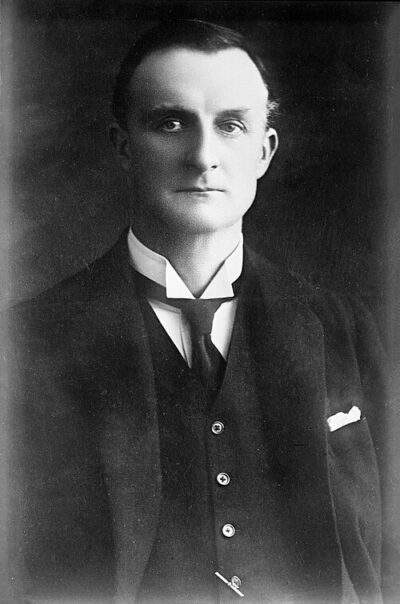
Edward Grey, 1st Viscount Grey of Fallodon
Edward Grey, 1st Viscount Grey of Fallodon was a British Liberal statesman. Born April 25, 1862, in Fallodon. Died September 7, 1933, in Fallodon. Positions held include Secretary of State for Foreign and Commonwealth Affairs (1905–1916), Parliamentary Under-Secretary of State for Foreign Affairs (1892–1895) and Member of the Privy Council of the United Kingdom. Educated at Balliol College and Winchester College. Awards include Fellow of the Zoological Society of London and Order of the Garter.
Facts
41 facts · 2 confirmed by two sources · 18 cited · 21 from one source
Where this comes from
Papalocal keeps its own record. It started from these sources; what each one said is kept here as it was copied, so a change on their side never changes this page by itself. Tap one to read its version.
What Wikidata says · copied November 16, 2026 · revision 2567353602
- Described as
- British Liberal statesman (1862-1933)
- Other names
- Sir Edward Grey, Bt, Sir Edward Grey
- Born
- April 25, 1862 · 5 references
- Died
- September 7, 1933 · 6 references
- Born in
- Fallodon
- Died in
- Fallodon · 1 reference
- Citizen of
- United Kingdom; United Kingdom of Great Britain and Ireland
- Occupation
- politician · 2 references; diplomat; ornithologist · 1 reference; real tennis player; aristocrat; ambassador · 1 reference; author · 1 reference; member of parliament · 1 reference
- Positions held
- Secretary of State for Foreign and Commonwealth Affairs (1905–1916); Parliamentary Under-Secretary of State for Foreign Affairs (1892–1895); Member of the Privy Council of the United Kingdom; member of the 30th Parliament of the United Kingdom (1910–1916); member of the 29th Parliament of the United Kingdom (1910) · 1 reference; member of the 28th Parliament of the United Kingdom (1906–1910) · 1 reference; member of the 27th Parliament of the United Kingdom (1900–1906) · 1 reference; member of the 26th Parliament of the United Kingdom (1895–1900) · 1 reference; member of the 25th Parliament of the United Kingdom (1892–1895) · 1 reference; member of the 24th Parliament of the United Kingdom (1886–1892) · 1 reference; member of the 23rd Parliament of the United Kingdom (1885–1886) · 1 reference; ambassador; member of the House of Lords; Chancellor of the University of Oxford (1928–1933)
- Political party
- Liberal Party
- Education
- Balliol College; Winchester College; Temple Grove School
- Member of
- Royal Society of London (1914–); Zoological Society of London; Freemasonry · 1 reference
- Awards
- Fellow of the Zoological Society of London; Order of the Garter (1912) · 1 reference
- Spouse
- Pamela Wyndham (1922–) · 2 references; Dorothy Widdrington (1885–) · 3 references
- Father
- George Henry Grey · 2 references
- Mother
- Harriet Jane Pearson · 2 references
- Wikipedias with a page
- 46
Wikidata item Q335187 (wikidata.org/wiki/Q335187), public domain (CC0). Copied November 16, 2026.
What Wikipedia says · copied November 16, 2026 · revision 1384533086
Edward Grey, 1st Viscount Grey of Fallodon (25 April 1862 – 7 September 1933), better known as Sir Edward Grey, was a British statesman and Liberal Party politician who was the main force behind British foreign policy in the era of the First World War.
A proponent of social reform who adhered to the "New Liberalism", he served as Foreign Secretary from 1905 to 1916, the longest continuous tenure of any holder of that office. He renewed the 1902 Anglo-Japanese Alliance in 1911. The centrepiece of his policy was the defence of France against German aggression, while avoiding a binding alliance with Paris. He supported France in the Moroccan crises of 1905 and 1911. Another major achievement was the Anglo-Russian Convention of 1907. He resolved an outstanding conflict with Germany over the Baghdad railway in 1913. His most important action came in the July Crisis in 1914, when he led Britain into World War I against Germany. He convinced the Liberal cabinet that Britain had an obligation and was honour-bound to defend France, and prevent Germany from controlling Western Europe. Once the war began, there was little role for his diplomacy; he lost office in December 1916. By 1919 he was a leading British supporter of the League of Nations.
Grey is remembered for his "the lamps are going out" remark on 3 August 1914 on the outbreak of the First World War. He signed the Sykes-Picot Agreement on 16 May 1916. He was ennobled in 1916, prior to which he was the 3rd Baronet Grey of Fallodon, and was Ambassador to the United States between 1919 and 1920 and Leader of the Liberal Party in the House of Lords between 1923 and 1924.
- Born, in its opening lines
- April 25, 1862
- Died, in its opening lines
- September 7, 1933
From the Wikipedia article “Edward Grey, 1st Viscount Grey of Fallodon” (en.wikipedia.org/wiki/Edward_Grey,_1st_Viscount_Grey_of_Fallodon), by its contributors, under CC BY-SA 4.0 (creativecommons.org/licenses/by-sa/4.0/). Copied November 16, 2026; not changed.
Confirmed Two sources agree. Cited One source, and it names where it got it. One source One source, without a reference of its own. Sources disagree The sources disagree. We show the best-supported value and keep theirs below.
