
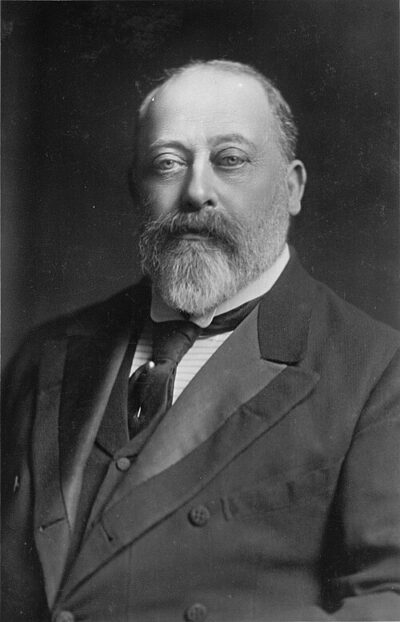
Edward VII
Edward VII was a King of the United Kingdom from 1901 to 1910. Born November 9, 1841, in Buckingham Palace. Died May 6, 1910, in Buckingham Palace. Positions held include monarch of the United Kingdom of Great Britain and Ireland (1901–1910), Emperor of India (1901–1910) and Lord High Steward of Scotland (1841–1901). Educated at University of Edinburgh and Christ Church. Awards include Knight of the Order of the Golden Fleece, Order of the Black Eagle and Knight Grand Cross of the Order of the Bath.
Facts
66 facts · 2 confirmed by two sources · 19 cited · 44 from one source · 1 where the sources disagree
What’s different
- Cause of death: we show bronchitis (Sources disagree). Wikidata also lists myocardial infarction
Where this comes from
Papalocal keeps its own record. It started from these sources; what each one said is kept here as it was copied, so a change on their side never changes this page by itself. Tap one to read its version.
What Wikidata says · copied November 16, 2026 · revision 2570082444
- Described as
- King of the United Kingdom from 1901 to 1910
- Other names
- Albert Edward Saxe-Coburg-Gotha, King Edward VII, Bertie, Albert Saxe-Coburg-Gotha, Edward VII, King of the United Kingdom of Great Britain and Ireland and of the British Dominions and Emperor of India, Edward, Prince of Wales, Albert Edward, Prince of Wales, Albert Edward, Edward VII of the United Kingdom
- Born
- November 9, 1841 · 10 references
- Died
- May 6, 1910 · 10 references
- Born in
- Buckingham Palace
- Died in
- Buckingham Palace · 2 references
- Buried in
- St George's Chapel, Windsor · 1 reference
- Cause of death
- bronchitis; myocardial infarction
- Name at birth
- Albert Edward
- Citizen of
- United Kingdom of Great Britain and Ireland · 3 references
- Occupation
- aristocrat; art collector · 1 reference; monarch; politician · 1 reference
- Positions held
- monarch of the United Kingdom of Great Britain and Ireland (1901–1910); Emperor of India (1901–1910); Lord High Steward of Scotland (1841–1901); Prince of Wales (1841–1901); member of the House of Lords; Member of the Privy Council of Ireland; Member of the Privy Council of the United Kingdom; monarch of Canada (1901–1910)
- Education
- University of Edinburgh; Christ Church; Trinity College · 1 reference
- Member of
- Bullingdon Club; Royal Society of London; Edward VII of the United Kingdom and Queen Alexandra; Order of the Garter
- Instrument
- bagpipe
- Awards
- Knight of the Order of the Golden Fleece; Order of the Black Eagle; Knight Grand Cross of the Order of the Bath (1865); Knight Grand Cross of the Royal Victorian Order (1896); Knight Grand Cross of the Order of St Michael and St George (1877); Knight Grand Cross with Collar of the Order of Saint Olav; Grand Cordon of the Supreme Order of the Chrysanthemum; Order of St. Andrew; Albert Medal (1901) · 1 reference; Knight of the Garter (1858); Order of the Thistle; Order of St Patrick; Order of the Star of India; Order of the Indian Empire; Order of Saint John
- Spouse
- Alexandra of Denmark (1863–1910) · 3 references
- Children
- Prince Albert Victor, Duke of Clarence and Avondale · 2 references; George V · 2 references; Louise, Princess Royal · 2 references; Princess Victoria of the United Kingdom · 1 reference; Maud of Wales · 1 reference; Prince Alexander John of Wales · 2 references
- Father
- Prince Albert of Saxe-Coburg and Gotha · 2 references
- Mother
- Victoria · 2 references
- Siblings
- Victoria, Princess Royal · 1 reference; Princess Alice of the United Kingdom · 1 reference; Alfred, Duke of Saxe-Coburg and Gotha · 1 reference; Princess Helena of the United Kingdom; Princess Louise, Duchess of Argyll · 1 reference; Prince Arthur, Duke of Connaught and Strathearn · 1 reference; Prince Leopold, Duke of Albany; Princess Beatrice of the United Kingdom
- Religion
- Protestantism; Church of England · 1 reference
- Military branch
- British Army
- Military rank
- field marshal
- Lived in
- Buckingham Palace
- Nickname
- Bertie
- Wikipedias with a page
- 108
Wikidata item Q20875 (wikidata.org/wiki/Q20875), public domain (CC0). Copied November 16, 2026.
What Wikipedia says · copied November 16, 2026 · revision 1385084141
Edward VII (Albert Edward; 9 November 1841 – 6 May 1910) was King of the United Kingdom and the British Dominions, and Emperor of India, from 22 January 1901 until his death in 1910.
The second child and eldest son of Queen Victoria and Prince Albert of Saxe-Coburg and Gotha, Edward, nicknamed "Bertie", was Prince of Wales and heir apparent to the British throne for almost 60 years. During his mother's long reign, he was largely excluded from political influence and came to personify the leisured elite. He married Princess Alexandra of Denmark in 1863; the couple had six children. As Prince of Wales, Edward travelled throughout Britain performing ceremonial public duties and represented Britain on visits abroad. His tours of North America in 1860 and of the Indian subcontinent in 1875 proved popular successes. Despite this public approval, his reputation as a playboy prince soured his relationship with his mother.
Edward inherited the throne on his mother's death in 1901. He proved to be an effective constitutional monarch whose reign strengthened the popularity of the British monarchy. He played a role in the modernisation of the British Home Fleet and the reorganisation of the British Army after the Second Boer War of 1899 to 1902. He re-instituted traditional ceremonies as public displays and broadened the range of people with whom royalty socialised. He fostered good relations between Britain and other European countries, especially France, for which he was popularly called "Peacemaker", but his relationship with his nephew, German Emperor Wilhelm II, was poor.
The Edwardian era, which covered Edward's reign and was named after him, coincided with the start of a new century and heralded significant changes in technology and society, including steam turbine propulsion and the rise of socialism. Edward died in the midst of a constitutional crisis that was resolved by the Parliament Act 1911, which restricted the power of the unelected House of Lords. Edward was succeeded as king by his only surviving son, George V.
- Born, in its opening lines
- November 9, 1841
- Died, in its opening lines
- May 6, 1910
From the Wikipedia article “Edward VII” (en.wikipedia.org/wiki/Edward_VII), by its contributors, under CC BY-SA 4.0 (creativecommons.org/licenses/by-sa/4.0/). Copied November 16, 2026; not changed.
Confirmed Two sources agree. Cited One source, and it names where it got it. One source One source, without a reference of its own. Sources disagree The sources disagree. We show the best-supported value and keep theirs below.
