
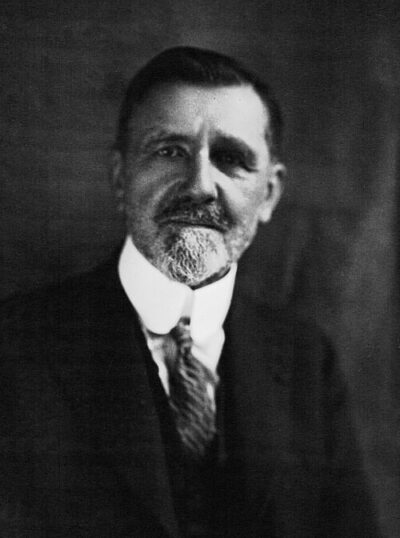
Émile Borel
Émile Borel was a French mathematician and politician. Born January 7, 1871, in Saint-Affrique. Died February 3, 1956, in 14th arrondissement of Paris. Positions held include Deputy of the French Third Republic (1924–1936), Minister of the French Navy (1925) and president (1932–1936). Known for Heine–Borel theorem, Borel algebra and Borel summation. Educated at École Normale Supérieure and Lycée Louis-le-Grand. Awards include Grand Cross of the Legion of Honour, Croix de guerre 1939–1945 and Honorary Member of the World Esperanto Association.
Facts
57 facts · 2 confirmed by two sources · 25 cited · 30 from one source
Where this comes from
Papalocal keeps its own record. It started from these sources; what each one said is kept here as it was copied, so a change on their side never changes this page by itself. Tap one to read its version.
What Wikidata says · copied November 16, 2026 · revision 2567716374
- Described as
- French mathematician and politician (1871-1956)
- Other names
- Emile Borel, Felix Edouard Justin Emile Borel
- Born
- January 7, 1871 · 11 references
- Died
- February 3, 1956 · 11 references
- Born in
- Saint-Affrique · 4 references
- Died in
- 14th arrondissement of Paris · 2 references
- Name at birth
- Félix Edouard Justin Émile Borel · 1 reference
- Citizen of
- France
- Occupation
- mathematician · 2 references; politician; university teacher; French resistance fighter; Esperantist; researcher · 1 reference; physicist · 1 reference
- Positions held
- Deputy of the French Third Republic (1924–1936) · 1 reference; Minister of the French Navy (1925); president (1932–1936); president of the French Academy of Sciences (1934) · 1 reference
- Political party
- Radical-Socialist and Radical Republican Party · 1 reference
- Worked for
- University of Paris (1909–1941) · 1 reference; University of Lille (1893–1897) · 2 references; Collège de France (1899–1902) · 1 reference; École Normale Supérieure (1897–1909) · 1 reference
- Education
- École Normale Supérieure (1889–1892) · 1 reference; Lycée Louis-le-Grand (–1889) · 1 reference
- Member of
- French Academy of Sciences; Saint Petersburg Academy of Sciences; Royal Swedish Academy of Sciences; Romanian Academy; Accademia Nazionale dei Lincei (1918–) · 1 reference; Russian Academy of Sciences; Academy of Sciences of Turin (1922–) · 1 reference
- Known for
- Heine–Borel theorem; Borel algebra; Borel summation; Borel–Cantelli lemma; Borel measure; Borel hierarchy; Borel–Kolmogorov paradox; Borel–Carathéodory theorem; Borel conjecture; Borel subgroup
- Awards
- Grand Cross of the Legion of Honour; Croix de guerre 1939–1945; Honorary Member of the World Esperanto Association; Resistance Medal; CNRS Gold medal (1954) · 2 references; Poncelet Prize (1901) · 1 reference; Grand prix des sciences mathématiques (1898) · 1 reference; Cours Peccot (1899) · 1 reference; honorary doctor of Sofia University; Petit d'Ormoy, Carriere, Thebault Award (1905) · 1 reference
- Field
- probability theory; mathematics; measure theory · 1 reference; game theory · 1 reference; politics · 1 reference
- Spouse
- Camille Marbo · 1 reference
- Wikipedias with a page
- 56
Wikidata item Q154356 (wikidata.org/wiki/Q154356), public domain (CC0). Copied November 16, 2026.
What Wikipedia says · copied November 16, 2026 · revision 1380801509
Félix Édouard Justin Émile Borel (French: [bɔʁɛl]; 7 January 1871 – 3 February 1956) was a French mathematician and politician. As a mathematician, he was known for his founding work in the areas of measure theory and probability.
- Born, in its opening lines
- January 7, 1871
- Died, in its opening lines
- February 3, 1956
From the Wikipedia article “Émile Borel” (en.wikipedia.org/wiki/Émile_Borel), by its contributors, under CC BY-SA 4.0 (creativecommons.org/licenses/by-sa/4.0/). Copied November 16, 2026; not changed.
Confirmed Two sources agree. Cited One source, and it names where it got it. One source One source, without a reference of its own. Sources disagree The sources disagree. We show the best-supported value and keep theirs below.
