
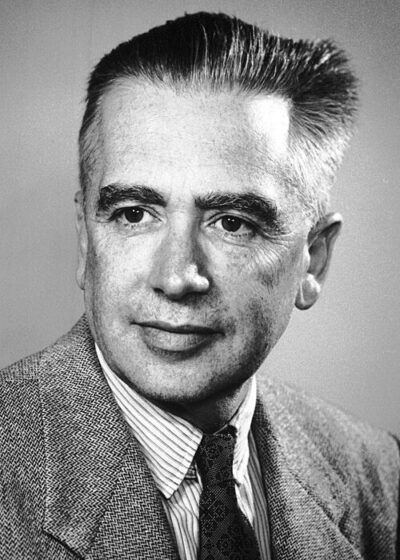
Emilio G. Segrè
Emilio G. Segrè was an Italian physicist and Nobel laureate. Born February 1, 1905, in Tivoli. Died April 22, 1989, in Lafayette. Educated at Sapienza University of Rome. Awards include Guggenheim Fellowship, Nobel Prize in Physics and August Wilhelm von Hofmann Medal.
Facts
38 facts · 2 confirmed by two sources · 11 cited · 25 from one source
Where this comes from
Papalocal keeps its own record. It started from these sources; what each one said is kept here as it was copied, so a change on their side never changes this page by itself. Tap one to read its version.
What Wikidata says · copied November 13, 2026 · revision 2565556956
- Described as
- Italian physicist and Nobel laureate
- Other names
- Emilio Gino Segrè, Emilio Segrè, Emilio G. Segre, Emilio Gino Segre, Emilio Segre
- Born
- February 1, 1905 · 4 references
- Died
- April 22, 1989 · 8 references
- Born in
- Tivoli · 1 reference
- Died in
- Lafayette · 1 reference
- Buried in
- Lafayette Cemetery · 1 reference
- Cause of death
- myocardial infarction
- Name at birth
- Emilio Gino Segrè
- Citizen of
- United States (1944–); Kingdom of Italy (–1946)
- Occupation
- physicist · 2 references; university teacher; nuclear physicist; writer · 1 reference
- Worked for
- University of California, Berkeley; University of Palermo; Sapienza University of Rome · 1 reference; Federal University of Rio de Janeiro · 1 reference
- Education
- Sapienza University of Rome
- Member of
- Heidelberg Academy of Sciences and Humanities (1950–) · 1 reference; American Academy of Arts and Sciences; American Physical Society · 1 reference; Accademia Nazionale delle Scienze detta dei XL; International Academy of the History of Science; National Academy of Sciences; Accademia delle Arti del Disegno; American Philosophical Society (1963–); Accademia Nazionale dei Lincei (1958–) · 1 reference
- Awards
- Guggenheim Fellowship (1958) · 1 reference; Nobel Prize in Physics (1959) · 2 references; August Wilhelm von Hofmann Medal (1953) · 1 reference; Richtmyer Memorial Lecture Award (1957) · 1 reference; Fellow of the American Physical Society
- Field
- physics
- Spouse
- Elfriede Spiro
- Children
- Claudio Segrè · 1 reference
- Siblings
- Angelo Segrè
- Religion
- Judaism · 1 reference
- Lived in
- United States (1938–1989)
- Wikipedias with a page
- 79
Wikidata item Q173028 (wikidata.org/wiki/Q173028), public domain (CC0). Copied November 13, 2026.
What Wikipedia says · copied November 13, 2026 · revision 1373553002
Emilio Gino Segrè ( sə-GRAY; Italian: [eˈmiːljo ˈdʒiːno seˈgrɛ]; 1 February 1905 – 22 April 1989) was an Italian-American nuclear physicist and radiochemist who discovered the elements technetium and astatine, and the antiproton, a subatomic antiparticle, for which he was awarded the Nobel Prize in Physics in 1959, along with Owen Chamberlain.
Born in Tivoli, near Rome, Segrè studied engineering at the University of Rome La Sapienza before taking up physics in 1927. Segrè was appointed assistant professor of physics at the University of Rome in 1932 and worked there until 1936, becoming one of the Via Panisperna boys. From 1936 to 1938 he was director of the Physics Laboratory at the University of Palermo. After a visit to Ernest O. Lawrence's Berkeley Radiation Laboratory, he was sent a molybdenum strip from the laboratory's cyclotron accelerator in 1937, which was emitting anomalous forms of radioactivity. Using careful chemical and theoretical analysis, Segrè was able to prove that some of the radiation was being produced by a previously unknown element, named technetium, the first artificially synthesized chemical element that does not occur in nature.
In 1938 and while Segrè was visiting the Berkeley Radiation laboratory, Benito Mussolini's fascist government passed antisemitic laws barring Jews from university positions. As a Jew, Segrè was rendered an indefinite émigré. At the Berkeley Radiation Lab, Lawrence offered him an underpaid job as a research assistant. There, Segrè helped discover the element astatine and the isotope plutonium-239, which was later used to make the Fat Man nuclear bomb dropped on Nagasaki. From 1943 to 1946 he worked at the Los Alamos National Laboratory as a group leader for the Manhattan Project. He found in April 1944 that Thin Man, the proposed plutonium gun-type nuclear weapon, would not work due to the presence of plutonium-240 impurities. In 1944, he became a naturalized citizen of the United States. On his return to Berkeley in 1946, he became a professor of physics and of history of science, serving until 1972. Segrè and Owen Chamberlain co-headed a research group at the Lawrence Radiation Laboratory that discovered the antiproton, for which the two shared the 1959 Nobel Prize in Physics.
Segrè was an active photographer who took many pictures documenting events and people in the history of modern science, which were donated to the American Institute of Physics after his death. The American Institute of Physics named its photographic archive of physics history in his honor.
- Born, in its opening lines
- February 1, 1905
- Died, in its opening lines
- April 22, 1989
From the Wikipedia article “Emilio Segrè” (en.wikipedia.org/wiki/Emilio_Segrè), by its contributors, under CC BY-SA 4.0 (creativecommons.org/licenses/by-sa/4.0/). Copied November 13, 2026; not changed.
Confirmed Two sources agree. Cited One source, and it names where it got it. One source One source, without a reference of its own. Sources disagree The sources disagree. We show the best-supported value and keep theirs below.
