
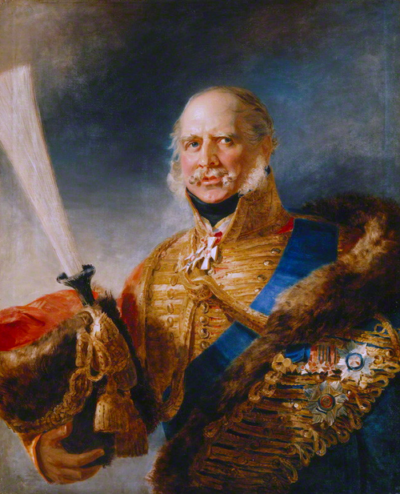
Ernest Augustus, King of Hanover
Ernest Augustus, King of Hanover was a King of Hanover from 1837 to 1851. Born June 5, 1771, in Buckingham Palace. Died November 18, 1851, in Hanover. Positions held include Member of the Privy Council of the United Kingdom, King of Hanover (1837–) and member of the House of Lords (1799–). Educated at University of Göttingen. Awards include Knight Grand Cross of the Order of the Bath, Order of St. Andrew and Knight Grand Cross of the Military Order of William.
Facts
47 facts · 2 confirmed by two sources · 13 cited · 32 from one source
Where this comes from
Papalocal keeps its own record. It started from these sources; what each one said is kept here as it was copied, so a change on their side never changes this page by itself. Tap one to read its version.
What Wikidata says · copied November 16, 2026 · revision 2565529901
- Described as
- King of Hanover from 1837 to 1851
- Other names
- Ernest Augustus King of Hanover, Ernest Augustus of Hanover, King Ernest Augustus II of Hanover, King Ernst August II of Hanover, Ernest Augustus II of Hanover, Ernest Augustus II, Ernst August II of Hanover
- Born
- June 5, 1771 · 6 references
- Died
- November 18, 1851 · 7 references
- Born in
- Buckingham Palace · 1 reference
- Died in
- Hanover · 2 references
- Buried in
- Welf family mausoleum · 1 reference
- Name at birth
- Prinz Ernst August, Herzog von Braunschweig-Lüneburg
- Citizen of
- United Kingdom of Great Britain and Ireland; Kingdom of Hanover
- Occupation
- military personnel; politician · 1 reference
- Positions held
- Member of the Privy Council of the United Kingdom; King of Hanover (1837–); member of the House of Lords (1799–)
- Education
- University of Göttingen
- Member of
- Orange Order; Royal Society of London (1828–) · 1 reference
- Awards
- Knight Grand Cross of the Order of the Bath; Order of St. Andrew; Knight Grand Cross of the Military Order of William (1849); Knight of the Garter (1786); Order of St Patrick; Order of the Red Eagle 2nd Class; Knight Grand Cross of the Order of Saint Stephen of Hungary; Knight Grand Cross in the Order of the Netherlands Lion (1825) · 1 reference; Royal Fellow of the Royal Society (1828) · 1 reference; Knight of the Order of the Elephant (1838)
- Spouse
- Frederica of Mecklenburg-Strelitz (1815–) · 1 reference
- Children
- Georg V of Hanover · 1 reference; George FitzErnest · 1 reference; Frederica Hanover · 1 reference; stillborn daughter Hanover · 1 reference; Georgina Nugent
- Father
- George III of Great Britain · 1 reference
- Mother
- Charlotte of Mecklenburg-Strelitz · 1 reference
- Siblings
- Charlotte, Princess Royal; Princess Elizabeth of the United Kingdom; Princess Mary of the United Kingdom; Princess Augusta Sophia of the United Kingdom; Princess Sophia of the United Kingdom; Princess Amelia of the United Kingdom; George IV of the United Kingdom; William IV; Prince Edward, Duke of Kent and Strathearn; Prince Octavius of Great Britain
- Religion
- Protestantism
- Military branch
- British Army
- Military rank
- field marshal
- Wikipedias with a page
- 48
Wikidata item Q162302 (wikidata.org/wiki/Q162302), public domain (CC0). Copied November 16, 2026.
What Wikipedia says · copied November 16, 2026 · revision 1379812488
Ernest Augustus (German: Ernst August; 5 June 1771 – 18 November 1851) was King of Hanover from 20 June 1837 until his death in 1851. As the fifth son of George III of the United Kingdom and Hanover, he initially seemed unlikely to become a monarch, but none of his older brothers had a legitimate son. When his brother William IV, who ruled both kingdoms, died in 1837, his niece Victoria inherited the British throne under British succession law, while Ernest succeeded in Hanover under Salic law, which barred women from the succession. This ended the personal union between Britain and Hanover that had begun in 1714. During Victoria's reign, he was heir presumptive to the British throne until the birth of his great-niece Victoria, Princess Royal, in 1840.
Ernest was born in London but was sent to Hanover in his adolescence for his education and military training. While serving with Hanoverian forces near Tournai against Revolutionary France, he received a disfiguring facial wound. He was created Duke of Cumberland and Teviotdale in 1799. Although his mother, Queen Charlotte, disapproved of his marriage in 1815 to her twice-widowed niece, Frederica of Mecklenburg-Strelitz, it proved happy. The eldest son of George III, the Prince of Wales (later George IV), had one child, Charlotte, who was expected to become the British queen, but she died in 1817, giving Ernest some prospect of succeeding to the British and Hanoverian thrones. However, his elder brother Prince Edward, Duke of Kent and Strathearn, fathered the eventual British heir, Victoria, in 1819 shortly before the birth of Ernest's only child, George.
Ernest was an active member of the House of Lords, where he maintained an extremely conservative record. There were persistent allegations (reportedly spread by his political foes) that he had murdered his valet, had fathered a son by his sister Sophia, and intended to take the British throne by murdering Victoria. Following the death of William IV, Ernest became Hanover's first resident ruler since George I. He had a generally successful fourteen-year reign but excited controversy near its start when he voided the liberal constitution granted before his reign and dismissed the Göttingen Seven, including the Brothers Grimm, from their professorial positions for protesting. In 1848, he put down an attempted revolution. Hanover joined the German customs union in 1850 despite Ernest's reluctance. Ernest died the next year and was succeeded by his son, George V.
- Born, in its opening lines
- June 5, 1771
- Died, in its opening lines
- November 18, 1851
From the Wikipedia article “Ernest Augustus, King of Hanover” (en.wikipedia.org/wiki/Ernest_Augustus,_King_of_Hanover), by its contributors, under CC BY-SA 4.0 (creativecommons.org/licenses/by-sa/4.0/). Copied November 16, 2026; not changed.
Confirmed Two sources agree. Cited One source, and it names where it got it. One source One source, without a reference of its own. Sources disagree The sources disagree. We show the best-supported value and keep theirs below.
