
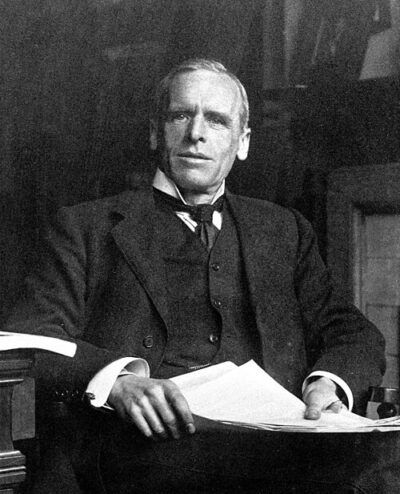
Ernest Starling
Ernest Starling was a British physiologist. Born April 17, 1866, in London. Died May 2, 1927, in Kingston. Educated at University of London. Awards include Fellow of the Royal Society, Royal Medal and Croonian Medal and Lecture.
Facts
20 facts · 2 confirmed by two sources · 4 cited · 14 from one source
Where this comes from
Papalocal keeps its own record. It started from these sources; what each one said is kept here as it was copied, so a change on their side never changes this page by itself. Tap one to read its version.
What Wikidata says · copied November 17, 2026 · revision 2567400900
- Described as
- British physiologist (1866–1927)
- Other names
- Ernest Henry Starling, Ernest H. Starling
- Born
- April 17, 1866 · 8 references
- Died
- May 2, 1927 · 8 references
- Born in
- London · 2 references
- Died in
- Kingston · 1 reference
- Citizen of
- United Kingdom
- Occupation
- physiologist · 1 reference; physician · 1 reference
- Worked for
- University College London
- Education
- University of London
- Member of
- Royal Society of London (1899–); German Academy of Sciences Leopoldina; Royal Academy of Medicine of Belgium; Accademia Nazionale dei Lincei (1923–) · 1 reference
- Awards
- Fellow of the Royal Society; Royal Medal (1913); Croonian Medal and Lecture (1904); Baly Medal (1907); Harveian Oration (1923); honorary doctorate from the University of Strasbourg (1923) · 2 references
- Field
- physiology
- Wikipedias with a page
- 26
Wikidata item Q739275 (wikidata.org/wiki/Q739275), public domain (CC0). Copied November 17, 2026.
What Wikipedia says · copied November 17, 2026 · revision 1386275258
Ernest Henry Starling (17 April 1866 – 2 May 1927) was a British physiologist who contributed many fundamental ideas to the subject. These ideas were important parts of the British contribution to physiology, which at that time led the world.
He made at least four significant contributions: 1. In the capillary, water is forced out through the pores in the wall by hydrostatic pressure and driven in by the osmotic pressure of plasma proteins (or oncotic pressure). These opposing forces approximately balance; which is known as Starling's Principle. 2. The discovery of the hormone secretin—with his brother-in-law William Bayliss—and the introduction of the word hormone. 3. The analysis of the heart's activity as a pump, which is known as the Frank–Starling law. 4. Several fundamental observations on the action of the kidneys. These include evidence for the existence of vasopressin, the anti-diuretic hormone. He also wrote the leading textbook of physiology in English, which ran through 20 editions.
- Born, in its opening lines
- April 17, 1866
- Died, in its opening lines
- May 2, 1927
From the Wikipedia article “Ernest Starling” (en.wikipedia.org/wiki/Ernest_Starling), by its contributors, under CC BY-SA 4.0 (creativecommons.org/licenses/by-sa/4.0/). Copied November 17, 2026; not changed.
Confirmed Two sources agree. Cited One source, and it names where it got it. One source One source, without a reference of its own. Sources disagree The sources disagree. We show the best-supported value and keep theirs below.
