
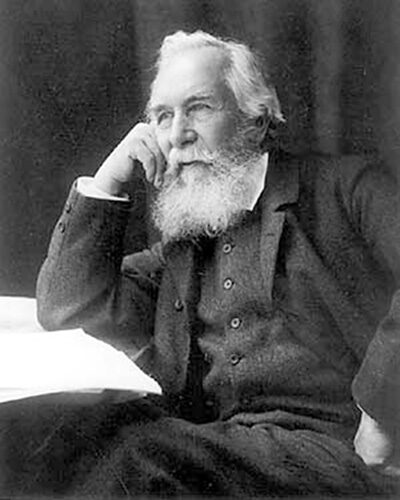
Ernst Haeckel
Ernst Haeckel was a German zoologist. Born February 16, 1834, in Potsdam. Died August 9, 1919, in Jena. Positions held include rector of the University of Jena (2 times) (1876–1885). Educated at Frederick William University Berlin and Humboldt-Universität zu Berlin. Awards include Darwin Medal, Cothenius Medal and Darwin–Wallace Medal.
Facts
40 facts · 2 confirmed by two sources · 19 cited · 19 from one source
Where this comes from
Papalocal keeps its own record. It started from these sources; what each one said is kept here as it was copied, so a change on their side never changes this page by itself. Tap one to read its version.
What Wikidata says · copied November 16, 2026 · revision 2568734755
- Described as
- German zoologist (1834-1919)
- Other names
- Ernst Heinrich Haeckel, Ernst Häckel, Ernst Heinrich Philipp August Haeckel, Häckel, Haeckel
- Born
- February 16, 1834 · 17 references
- Died
- August 9, 1919 · 14 references
- Born in
- Potsdam · 2 references
- Died in
- Jena · 4 references
- Name at birth
- Ernst Heinrich Philipp August Haeckel
- Citizen of
- German Empire; Weimar Republic; Kingdom of Prussia
- Occupation
- biologist · 3 references; physician · 1 reference; zoologist · 2 references; philosopher · 1 reference; naturalist · 1 reference; ecologist; ornithologist; university teacher · 1 reference
- Positions held
- rector of the University of Jena (2 times) (1876–1885) · 1 reference
- Worked for
- University of Jena · 1 reference
- Education
- Frederick William University Berlin; Humboldt-Universität zu Berlin · 1 reference
- Member of
- German Academy of Sciences Leopoldina; Royal Swedish Academy of Sciences; Zoological Society of London; Accademia Nazionale dei Lincei (1899–) · 1 reference; Bavarian Academy of Sciences and Humanities; American Philosophical Society · 1 reference; Academy of Sciences of Turin (1898–) · 1 reference; Deutscher Monistenbund
- Awards
- Darwin Medal (1900) · 1 reference; Cothenius Medal (1864); Darwin–Wallace Medal (1908) · 1 reference; Linnean Medal (1894); Bressa Prize (1895) · 1 reference; Swammerdam Medal (1890) · 1 reference
- Field
- common descent
- Spouse
- Anna Auguste Friederike Sethe (1862–1864) · 1 reference; Agnes Huschke · 1 reference
- Children
- Walter Haeckel; Elisabeth Haeckel
- Father
- Carl Haeckel · 1 reference
- Wikipedias with a page
- 106
Wikidata item Q48246 (wikidata.org/wiki/Q48246), public domain (CC0). Copied November 16, 2026.
What Wikipedia says · copied November 16, 2026 · revision 1382575072
Ernst Heinrich Philipp August Haeckel (; German: [ɛʁnst ˈhɛkl̩]; 16 February 1834 – 9 August 1919) was a German zoologist, naturalist, eugenicist, philosopher, physician, professor, marine biologist and artist. He discovered, described and named thousands of new species, mapped a genealogical tree relating all life forms and coined many terms in biology, including ecology, phylum, phylogeny, ontogeny, and Protista. Haeckel promoted and popularised Charles Darwin's work in Germany and developed the disproven but influential recapitulation theory (summed up by the dictum "ontogeny recapitulates phylogeny"), later generalizing it into the so called "Biogenetic Law". He wrongly claimed that an individual organism's biological development, or ontogeny, parallels and summarizes its species' evolutionary development, or phylogeny, using incorrectly drawn images of human embryonic development to derive the law. Whether they were intentionally falsified, or drawn poorly by accident is a matter of debate.
The published artwork of Haeckel includes over 100 detailed, multi-colour illustrations of animals and sea creatures, collected in his Kunstformen der Natur ("Art Forms in Nature"), a book which would go on to influence the Art Nouveau artistic movement. As a philosopher, Ernst Haeckel wrote Die Welträthsel (1895–1899; in English: The Riddles of the Universe, 1900), the genesis for the term "world riddle" (Welträtsel); and Freedom in Science and Teaching to support teaching evolution. He also coined the "Biogenetic Law".
Haeckel promoted scientific racism and embraced the idea of Social Darwinism. He was the first person to characterize the Great War as the "first" World War, which he did as early as 1914.
- Born, in its opening lines
- February 16, 1834
- Died, in its opening lines
- August 9, 1919
From the Wikipedia article “Ernst Haeckel” (en.wikipedia.org/wiki/Ernst_Haeckel), by its contributors, under CC BY-SA 4.0 (creativecommons.org/licenses/by-sa/4.0/). Copied November 16, 2026; not changed.
Confirmed Two sources agree. Cited One source, and it names where it got it. One source One source, without a reference of its own. Sources disagree The sources disagree. We show the best-supported value and keep theirs below.
