
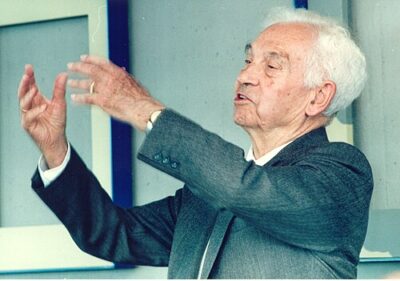
Ernst Mayr
Ernst Mayr was a German-American evolutionary biologist. Born July 5, 1904, in Kempten. Died February 3, 2005, in Bedford. Positions held include museum director. Educated at University of Greifswald. Awards include Leidy Award, Honorary Fellow of the Royal Society Te Apārangi and Darwin–Wallace Medal.
Facts
49 facts · 2 confirmed by two sources · 30 cited · 17 from one source
Where this comes from
Papalocal keeps its own record. It started from these sources; what each one said is kept here as it was copied, so a change on their side never changes this page by itself. Tap one to read its version.
What Wikidata says · copied November 13, 2026 · revision 2568844786
- Described as
- German-American evolutionary biologist (1904-2005)
- Other names
- E. Mayr, E. W. Mayr, Ernst Walter Mayr
- Born
- July 5, 1904 · 11 references
- Died
- February 3, 2005 · 12 references
- Born in
- Kempten · 3 references
- Died in
- Bedford · 1 reference
- Citizen of
- United States · 1 reference; Germany
- Occupation
- curator; ornithologist · 1 reference; philosopher; writer; university teacher; evolutionary biologist · 1 reference; museologist · 1 reference; botanical collector · 1 reference
- Positions held
- museum director · 1 reference
- Worked for
- Harvard University; Museum für Naturkunde - Leibniz Institute for Evolution and Biodiversity Science (1926–1932)
- Education
- University of Greifswald
- Member of
- Royal Society of London (1988–) · 2 references; German Academy of Sciences Leopoldina (1972–) · 2 references; American Academy of Arts and Sciences (1954–) · 2 references; American Philosophical Society (1965–) · 1 reference; Deutsche Gildenschaft; Bavarian Academy of Sciences and Humanities (1977–) · 2 references; National Academy of Sciences (1954–) · 3 references; German Ornithologists‘ Society (1941–) · 1 reference; American Society of Naturalists (1943–) · 1 reference; Zoological Society of London (1984–) · 1 reference
- Awards
- Leidy Award (1946) · 1 reference; Honorary Fellow of the Royal Society Te Apārangi (1950–) · 1 reference; Darwin–Wallace Medal (1958) · 1 reference; Brewster Medal (1965) · 1 reference; Daniel Giraud Elliot Medal (1967) · 1 reference; National Medal of Science (1969); doctor honoris causa from the Pierre and Marie Curie University (1975) · 1 reference; Linnean Medal (1977); Elliott Coues Award (1977); Gregor Mendel Medal (1980) · 1 reference; Balzan Prize (1983); Eisenmann Medal (1983); Darwin Medal (1984) · 1 reference; George Sarton Medal (1986); Foreign Member of the Royal Society (1988) · 1 reference
- Field
- systematics · 1 reference; evolutionary biology · 1 reference; ornithology · 1 reference; curating · 1 reference; natural history collection · 1 reference
- Religion
- atheism · 1 reference
- Wikipedias with a page
- 62
Wikidata item Q5354 (wikidata.org/wiki/Q5354), public domain (CC0). Copied November 13, 2026.
What Wikipedia says · copied November 13, 2026 · revision 1380750648
Ernst Walter Mayr ( MYRE; German: [ɛʁnst ˈmaɪɐ]; 5 July 1904 – 3 February 2005) was a German-American evolutionary biologist. He was also a renowned taxonomist, tropical explorer, ornithologist, philosopher of biology, and historian of science. His work contributed to the conceptual revolution that led to the modern evolutionary synthesis of Mendelian genetics, systematics, and Darwinian evolution, and to the development of the biological species concept.
Although Charles Darwin and others posited that multiple species could evolve from a single common ancestor, the mechanism by which this occurred was not understood, creating the species problem. Ernst Mayr approached the problem with a new definition for species. In his book Systematics and the Origin of Species (1942) he wrote that a species is not just a group of morphologically similar individuals, but a group that can breed only among themselves, excluding all others. When populations within a species become isolated by geography, feeding strategy, mate choice, or other means, they may start to differ from other populations through genetic drift and natural selection, and over time may evolve into new species. The most significant and rapid genetic reorganization occurs in extremely small populations that have been isolated (as on islands).
His theory of peripatric speciation (a more precise form of allopatric speciation which he advanced), based on his work on birds, is still considered a leading mode of speciation, and was the theoretical underpinning for the theory of punctuated equilibrium, proposed by Niles Eldredge and Stephen Jay Gould. Mayr is sometimes credited with inventing modern philosophy of biology, particularly the part related to evolutionary biology, which he distinguished from physics due to its introduction of (natural) history into science.
- Born, in its opening lines
- July 5, 1904
- Died, in its opening lines
- February 3, 2005
From the Wikipedia article “Ernst Mayr” (en.wikipedia.org/wiki/Ernst_Mayr), by its contributors, under CC BY-SA 4.0 (creativecommons.org/licenses/by-sa/4.0/). Copied November 13, 2026; not changed.
Confirmed Two sources agree. Cited One source, and it names where it got it. One source One source, without a reference of its own. Sources disagree The sources disagree. We show the best-supported value and keep theirs below.
