
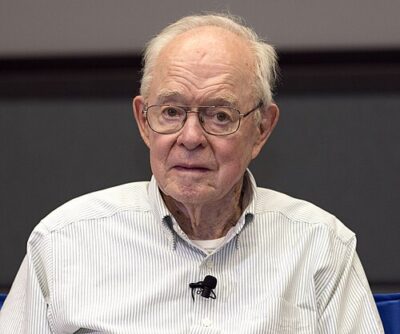
Eugene Parker
Eugene Parker was an American astronomer. Born June 10, 1927, in Houghton. Died March 15, 2022, in Chicago. Known for heliospheric current sheet. Educated at Michigan State University and California Institute of Technology. Awards include National Medal of Science, William Bowie Medal and Gold Medal of the Royal Astronomical Society.
Facts
39 facts · 2 confirmed by two sources · 22 cited · 15 from one source
Where this comes from
Papalocal keeps its own record. It started from these sources; what each one said is kept here as it was copied, so a change on their side never changes this page by itself. Tap one to read its version.
What Wikidata says · copied November 15, 2026 · revision 2568166334
- Described as
- American astronomer (1927–2022)
- Other names
- Eugene N. Parker, Eugene Newman Parker
- Born
- June 10, 1927 · 1 reference
- Died
- March 15, 2022 · 1 reference
- Born in
- Houghton · 1 reference
- Died in
- Chicago
- Name at birth
- Eugene Newman Parker
- Citizen of
- United States
- Occupation
- astronomer; astrophysicist · 1 reference; university teacher; physicist · 1 reference
- Worked for
- University of Chicago · 1 reference; University of Utah
- Education
- Michigan State University; California Institute of Technology (–1951) · 1 reference
- Member of
- Norwegian Academy of Science and Letters; National Academy of Sciences (1967–) · 1 reference; Royal Astronomical Society; American Academy of Arts and Sciences (1970–) · 1 reference; American Astronomical Society · 1 reference; American Physical Society (1962–) · 1 reference; International Astronomical Union
- Known for
- heliospheric current sheet
- Awards
- National Medal of Science (1989); William Bowie Medal (1990) · 1 reference; Gold Medal of the Royal Astronomical Society (1992); Bruce Medal (1997) · 1 reference; Henry Norris Russell Lectureship (1969); Hannes Alfvén Prize (2012); Karl Schwarzschild Medal (1990) · 1 reference; Kyoto Prize in Basic Sciences (2003) · 1 reference; Chapman Medal (1979) · 1 reference; James Clerk Maxwell Prize for Plasma Physics (2003) · 1 reference; Arctowski Medal (1969) · 1 reference; APS Medal for Exceptional Achievement in Research (2018) · 1 reference; George Ellery Hale Prize (1978) · 1 reference; John Adam Fleming Medal (1968) · 1 reference; Crafoord Prize in Astronomy (2020) · 1 reference
- Field
- plasma physics · 1 reference; solar physics · 1 reference
- Wikipedias with a page
- 28
Wikidata item Q503360 (wikidata.org/wiki/Q503360), public domain (CC0). Copied November 15, 2026.
What Wikipedia says · copied November 15, 2026 · revision 1371992539
Eugene Newman Parker (June 10, 1927 – March 15, 2022) was an American solar and plasma physicist, often called the "father" and "founder" of heliophysics. In 1958, he proposed the existence of the solar wind and predicted that the magnetic field in the outer Solar System would be in the shape of a Parker spiral—predictions initially rejected by reviewers and scientific community, but quickly confirmed by the Mariner 2 spacecraft in 1962. Multiple phenomena in solar and plasma physics bear his name, including the Parker instability, Parker equation, Sweet–Parker model of magnetic reconnection, Parker limit on magnetic monopoles, and Parker theorem. In 1988, he proposed that nanoflares could explain the coronal heating problem, a theory that remains a leading candidate.
Parker obtained his PhD from Caltech in 1951 and spent four years at the University of Utah before joining the University of Chicago in 1955, where he spent the rest of his career at the Enrico Fermi Institute. He wrote more than 400 papers, mostly without co-authors, and received multiple awards including the National Medal of Science (1989), Gold Medal of the Royal Astronomical Society (1992), Kyoto Prize (2003), and Crafoord Prize (2020). In 2017, NASA renamed its Solar Probe Plus mission to Parker Solar Probe in his honor, the first NASA spacecraft named after a living person.
- Born, in its opening lines
- June 10, 1927
- Died, in its opening lines
- March 15, 2022
From the Wikipedia article “Eugene Parker” (en.wikipedia.org/wiki/Eugene_Parker), by its contributors, under CC BY-SA 4.0 (creativecommons.org/licenses/by-sa/4.0/). Copied November 15, 2026; not changed.
Confirmed Two sources agree. Cited One source, and it names where it got it. One source One source, without a reference of its own. Sources disagree The sources disagree. We show the best-supported value and keep theirs below.
