
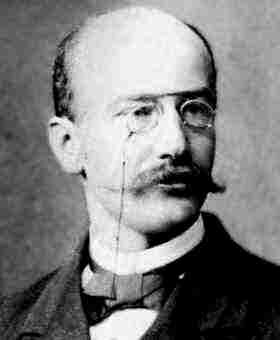
Ferdinand von Lindemann
Ferdinand von Lindemann was a German mathematician. Born April 12, 1852, in Hanover. Died March 6, 1939, in Munich. Positions held include rector (1904–1905). Known for Lindemann–Weierstrass theorem and Hermite–Lindemann Theorem. Educated at University of Göttingen and Technical University of Munich. Awards include Bavarian Maximilian Order for Science and Art and Merit Order of the Bavarian Crown.
Facts
34 facts · 2 confirmed by two sources · 18 cited · 14 from one source
Where this comes from
Papalocal keeps its own record. It started from these sources; what each one said is kept here as it was copied, so a change on their side never changes this page by itself. Tap one to read its version.
What Wikidata says · copied November 16, 2026 · revision 2568909689
- Described as
- German mathematician (1852–1939)
- Other names
- Carl Louis Ferdinand von Lindemann
- Born
- April 12, 1852 · 6 references
- Died
- March 6, 1939 · 6 references
- Born in
- Hanover · 3 references
- Died in
- Munich · 3 references
- Buried in
- Munich Waldfriedhof · 1 reference
- Name at birth
- Carl Louis Ferdinand Lindemann · 1 reference
- Citizen of
- Kingdom of Hanover; German Reich; Kingdom of Prussia
- Occupation
- mathematician · 1 reference; university teacher
- Positions held
- rector (1904–1905) · 1 reference
- Worked for
- LMU Munich (1893–1923) · 2 references; University of Freiburg (1877–1883) · 1 reference; University of Königsberg (1883–1893) · 1 reference
- Education
- University of Göttingen (1870–1871) · 1 reference; Technical University of Munich (1873–1874) · 1 reference; University of Erlangen–Nuremberg (1872–1873) · 2 references; Fridericianum Schwerin (–1870) · 1 reference; University of Würzburg (–1877) · 1 reference
- Member of
- Göttingen Academy of Sciences and Humanities in Lower Saxony; German Academy of Sciences Leopoldina; Bavarian Academy of Sciences and Humanities
- Known for
- Lindemann–Weierstrass theorem; Hermite–Lindemann Theorem
- Awards
- Bavarian Maximilian Order for Science and Art (1905); Merit Order of the Bavarian Crown (1918)
- Field
- number theory; mathematics · 1 reference; non-Euclidean geometry · 1 reference
- Spouse
- Elisabeth Küßner · 1 reference
- Father
- Ferdinand Lindemann · 1 reference
- Siblings
- Ida Auguste Karoline von Witzendorff
- Lived in
- Germany · 1 reference
- Wikipedias with a page
- 46
Wikidata item Q77203 (wikidata.org/wiki/Q77203), public domain (CC0). Copied November 16, 2026.
What Wikipedia says · copied November 16, 2026 · revision 1373709285
Carl Louis Ferdinand von Lindemann (12 April 1852 – 6 March 1939) was a German mathematician who proved in 1882 that π (pi) is a transcendental number, meaning it is not a root of any nonzero polynomial with rational coefficients.
- Born, in its opening lines
- April 12, 1852
- Died, in its opening lines
- March 6, 1939
From the Wikipedia article “Ferdinand von Lindemann” (en.wikipedia.org/wiki/Ferdinand_von_Lindemann), by its contributors, under CC BY-SA 4.0 (creativecommons.org/licenses/by-sa/4.0/). Copied November 16, 2026; not changed.
Confirmed Two sources agree. Cited One source, and it names where it got it. One source One source, without a reference of its own. Sources disagree The sources disagree. We show the best-supported value and keep theirs below.
