
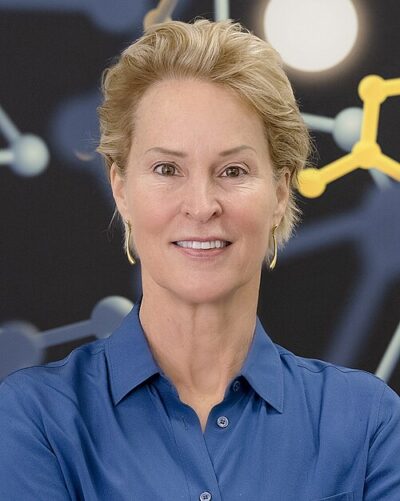
Frances Arnold
Frances Arnold is a Nobel prize winning US scientist and engineer. Born July 25, 1956, in Pittsburgh. Positions held include board of directors member (2019–). Educated at Princeton University and University of California, Berkeley. Awards include National Medal of Technology and Innovation, Charles Stark Draper Prize and Millennium Technology Prize.
Facts
43 facts · 1 confirmed by two sources · 25 cited · 17 from one source
Where this comes from
Papalocal keeps its own record. It started from these sources; what each one said is kept here as it was copied, so a change on their side never changes this page by itself. Tap one to read its version.
What Wikipedia says · copied November 13, 2026 · revision 1379081981
Frances Hamilton Arnold (born July 25, 1956) is an American chemical engineer and Nobel Laureate. She is the Linus Pauling Professor of Chemical Engineering, Bioengineering and Biochemistry at the California Institute of Technology (Caltech). In 2018, she was awarded the Nobel Prize in Chemistry for pioneering the use of directed evolution to engineer enzymes.
In 2019, Alphabet Inc. announced that Arnold had joined its board of directors. For the length of his presidency, she also served as an external co-chair of President Joe Biden's Council of Advisors on Science and Technology (PCAST).
- Born, in its opening lines
- July 25, 1956
From the Wikipedia article “Frances Arnold” (en.wikipedia.org/wiki/Frances_Arnold), by its contributors, under CC BY-SA 4.0 (creativecommons.org/licenses/by-sa/4.0/). Copied November 13, 2026; not changed.
What Wikidata says · copied November 14, 2026 · revision 2568908156
- Described as
- Nobel prize winning US scientist and engineer (born 1956)
- Other names
- Frances H. Arnold, Frances Hamilton Arnold
- Born
- July 25, 1956 · 2 references
- Born in
- Pittsburgh · 1 reference
- Name at birth
- Frances Hamilton Arnold
- Citizen of
- United States
- Occupation
- biochemist · 1 reference; inventor; university teacher; engineer
- Positions held
- board of directors member (2019–) · 1 reference
- Worked for
- California Institute of Technology · 1 reference; University of California, Berkeley (1985–1986) · 1 reference; National Institute of Solar Energy (1979–1980) · 1 reference
- Education
- Princeton University (–1979) · 1 reference; University of California, Berkeley (–1985); Taylor Allderdice High School · 1 reference
- Member of
- National Academy of Sciences (2008–) · 2 references; American Academy of Arts and Sciences (2011–) · 1 reference; National Academy of Engineering (2000–) · 1 reference; National Academy of Medicine (2004–); Royal Society of London (2020–) · 1 reference; Pontifical Academy of Sciences (2019–) · 1 reference
- Awards
- National Medal of Technology and Innovation (2011) · 1 reference; Charles Stark Draper Prize (2011) · 1 reference; Millennium Technology Prize (2016) · 2 references; Garvan–Olin Medal (2005) · 1 reference; FASEB Excellence in Science Award (2007) · 1 reference; National Inventors Hall of Fame (2014) · 1 reference; Nobel Prize in Chemistry (2018) · 1 reference; Raymond and Beverly Sackler Prize in Convergence Research (2017) · 1 reference; Society of Women Engineers Achievement Award (2017); Fellow of the Royal Academy of Engineering; BBC 100 Women (2018) · 1 reference; Fellow of the American Institute for Medical and Biological Engineering · 1 reference; Bower Award and Prize for Achievement in Science (2019) · 2 references; Fellow of the American Academy of Arts and Sciences (2011) · 1 reference; Benjamin Franklin Medal (2019) · 1 reference
- Field
- chemical engineering · 1 reference; biocatalysis; protein engineering; synthetic biology
- Spouse
- Jay Bailey (–1994)
- Father
- William Howard Arnold
- Website
- http://www.che.caltech.edu/faculty/arnold_f/index.html
- Wikipedias with a page
- 78
Wikidata item Q4273363 (wikidata.org/wiki/Q4273363), public domain (CC0). Copied November 14, 2026.
Confirmed Two sources agree. Cited One source, and it names where it got it. One source One source, without a reference of its own. Sources disagree The sources disagree. We show the best-supported value and keep theirs below.
