
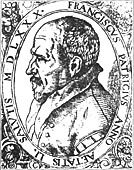
Francesco Patrizi
Francesco Patrizi was a Venetian philosopher and scientist. Born April 25, 1529, in Cres. Died February 6, 1597, in Rome. Known for La città felice, Discussiones peripateticae and Nova de universis philosophia. Educated at University of Padua.
Facts
34 facts · 2 confirmed by two sources · 28 cited · 4 from one source
What’s different
- Died: we show February 6, 1597 (Confirmed). Wikidata also lists February 7, 1597
Where this comes from
Papalocal keeps its own record. It started from these sources; what each one said is kept here as it was copied, so a change on their side never changes this page by itself. Tap one to read its version.
What Wikidata says · copied November 16, 2026 · revision 2568745094
- Described as
- Venetian philosopher and scientist (1529-1597)
- Other names
- Francesco Patrizzi, Francesco Patrizi da Cherso
- Born
- April 25, 1529 · 2 references
- Died
- February 6, 1597 · 4 references; February 7, 1597 · 2 references
- Born in
- Cres · 3 references
- Died in
- Rome · 3 references
- Citizen of
- Republic of Venice
- Occupation
- philosopher · 3 references; translator · 1 reference; poet; university teacher · 1 reference; science fiction writer; Financa negocisto · 1 reference; printer · 1 reference; humanist · 1 reference
- Worked for
- University of Ferrara (1575–1592) · 2 references; Sapienza University of Rome (1592–1597) · 2 references
- Education
- University of Padua (1547–) · 2 references
- Member of
- Accademia della Crusca · 1 reference; Accademia Veneziana · 1 reference
- Known for
- La città felice · 1 reference; Discussiones peripateticae · 1 reference; Nova de universis philosophia · 2 references; Della historia diece dialoghi · 1 reference; Della poetica · 2 references; Della nuova geometria · 1 reference; Magia philosophica · 1 reference; Paralleli militari · 1 reference; Della retorica dieci dialoghi · 1 reference; L’amorosa filosofia · 1 reference
- Religion
- Catholic Church
- Lived in
- Cres (–1538) · 1 reference; Venice · 1 reference; Ingolstadt · 1 reference; Ancona (1551–) · 1 reference; Cyprus (1562–) · 2 references
- Wikipedias with a page
- 34
Wikidata item Q435300 (wikidata.org/wiki/Q435300), public domain (CC0). Copied November 16, 2026.
What Wikipedia says · copied November 16, 2026 · revision 1385760482
Franciscus Patricius (Croatian: Franjo Petriš or Frane Petrić; Italian: Francesco Patrizi; 25 April 1529 – 6 February 1597) was a philosopher and scientist from the Republic of Venice. A native of Cres, he was a defender of Platonism and an opponent of Aristotelianism.
His national origin differs in sources, and he is described both as Croatian and as Italian. In Croatia he is mostly referred to as Franjo Petriš or Frane Petrić (sometimes Petris, Petrišević and Petričević). His family name in Cres was known as Petris.
Patricius initially dedicated his studies to Aristotelian Philosophy at the University of Padua, but turned to Platonism while still a student. He became a sharp, high-profile opponent of Aristotelianism, with whom he grappled extensively in several writings. After many years of unsuccessful efforts to secure material livelihood, he finally received an invitation in 1577 to the Ducal Court of House of Este in the Duchy of Ferrara. At the University of Ferrara, a chair for Platonic philosophy was set up especially for him. In the years that followed, he gained a reputation as a professor, but was also involved in scientific and literary controversy; he tended to polemic and was in turn violently attacked by opponents. In 1592, he accepted an invitation to Rome, where thanks to papal favor a new chair was created for him. The last years of his life were embroiled in a serious conflict with the Roman Inquisition, which banned his main work, the Nova de universis philosophia.
As one of the last Renaissance humanists, Patricius was characterized by extensive education, varied scientific activity, a strong will to innovate, and exceptional literary fertility. He critically examined established, universally recognized teachings and suggested alternatives. In particular, he wanted to replace the prevailing Aristotelian natural philosophy with his own model. He opposed the traditional view of the meaning of historical studies, which was usually restricted to moral instruction, with his concept of broad, neutral, scientific historical research. In poetry he emphasized the importance of inspiration and fought against conventional rules, which he considered to be arbitrary, unrealistic restrictions on creative freedom.
In the early modern period, Patricius's controversial philosophy of nature found sympathetic readers despite the church's condemnation, but remained an outsider position. Modern research recognizes his contributions to the constitution of modern concept of space and to historical theory.
- Born, in its opening lines
- April 25, 1529
- Died, in its opening lines
- February 6, 1597
From the Wikipedia article “Franciscus Patricius” (en.wikipedia.org/wiki/Franciscus_Patricius), by its contributors, under CC BY-SA 4.0 (creativecommons.org/licenses/by-sa/4.0/). Copied November 16, 2026; not changed.
Confirmed Two sources agree. Cited One source, and it names where it got it. One source One source, without a reference of its own. Sources disagree The sources disagree. We show the best-supported value and keep theirs below.
