
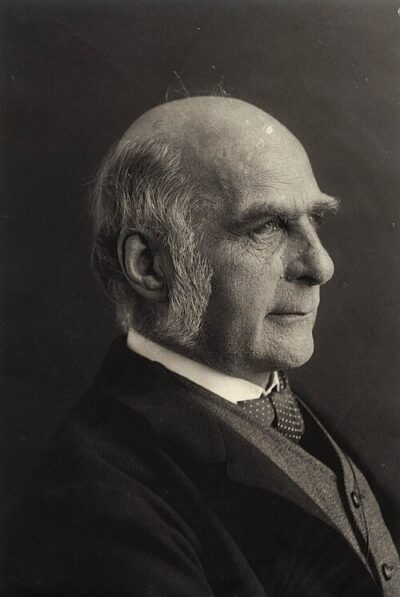
Francis Galton
Francis Galton was a British eugenist, polymath, and behavioural geneticist. Born February 16, 1822, in Sparkbrook. Died January 17, 1911, in Grayshott. Known for bean machine, Narrative of an explorer in tropical South Africa and The art of travel; or, Shifts and contrivances available in wild countries. Educated at King's College London and Trinity College. Awards include Fellow of the Royal Society, Copley Medal and Royal Medal.
Facts
46 facts · 2 confirmed by two sources · 27 cited · 17 from one source
Where this comes from
Papalocal keeps its own record. It started from these sources; what each one said is kept here as it was copied, so a change on their side never changes this page by itself. Tap one to read its version.
What Wikidata says · copied November 16, 2026 · revision 2557881953
- Described as
- British eugenist, polymath, and behavioural geneticist (1822–1911)
- Other names
- Sir Francis Galton, 1st Bt., Sir Francis Galton, F. G.
- Born
- February 16, 1822 · 14 references
- Died
- January 17, 1911 · 14 references
- Born in
- Sparkbrook · 1 reference
- Died in
- Grayshott · 1 reference
- Buried in
- Church of St Michael and All Angels · 1 reference
- Citizen of
- United Kingdom of Great Britain and Ireland
- Occupation
- mathematician; explorer; anthropologist · 2 references; geneticist; psychologist · 1 reference; geographer · 1 reference; meteorologist; statistician
- Education
- King's College London (1839–1840) · 1 reference; Trinity College (1840–1843) · 1 reference; King Edward's School (1836–1838) · 1 reference
- Member of
- Royal Society of London (1860–); Royal Geographical Society (1853–) · 1 reference
- Known for
- bean machine; Narrative of an explorer in tropical South Africa; The art of travel; or, Shifts and contrivances available in wild countries; Hereditary Genius; Natural inheritance; Finger Prints
- Awards
- Fellow of the Royal Society (1860–) · 1 reference; Copley Medal (1910) · 2 references; Royal Medal (1886) · 1 reference; Knight Bachelor (1909) · 1 reference; Huxley Memorial Medal (1901) · 1 reference; Darwin Medal (1902) · 2 references; Darwin–Wallace Medal (1908) · 1 reference; Fellow of the Royal Geographical Society (1850) · 1 reference; Founder’s Medal (1853) · 1 reference
- Field
- probability theory; anthropology · 1 reference
- Spouse
- Louisa Jane Butler (1853–) · 3 references
- Father
- Samuel Tertius Galton · 2 references
- Mother
- Frances Anne Violetta Darwin · 2 references
- Siblings
- Emma Sophia Galton · 1 reference; Lucy Harriott Galton · 1 reference; Elizabeth Anne Galton · 1 reference; Erasmus Galton · 1 reference; Millicent Adele Galton · 1 reference; Darwin Galton · 1 reference
- Website
- http://galton.org
- Wikipedias with a page
- 73
Wikidata item Q191026 (wikidata.org/wiki/Q191026), public domain (CC0). Copied November 16, 2026.
What Wikipedia says · copied November 16, 2026 · revision 1382172387
Sir Francis Galton (; 16 February 1822 – 17 January 1911) was an English polymath active as a statistician, anthropologist, psychologist, meteorologist, explorer, and geographer who was the originator of eugenics during the Victorian era, contributing extensively to the foundations of behavioural genetics.
Galton produced over 340 papers and books. He also developed the statistical concept of correlation and widely promoted regression toward the mean. He was the first to apply statistical methods to the study of human differences and inheritance of intelligence, and introduced the use of questionnaires and surveys for collecting data on human communities, which he needed for genealogical and biographical works and for his anthropometric studies. He popularised the phrase "nature versus nurture". His book Hereditary Genius (1869) was the first social scientific attempt to study genius and greatness.
As an investigator of the human mind, he founded psychometrics and differential psychology, as well as the lexical hypothesis of personality. He devised a method for classifying fingerprints that proved useful in forensic science. He also conducted research on the power of prayer, concluding it had none due to its null effects on the longevity of those prayed for. His quest for the scientific principles of diverse phenomena extended even to the optimal method for making tea. As the initiator of scientific meteorology, he devised the first weather map, proposed a theory of anticyclones, and was the first to establish a complete record of short-term climatic phenomena on a European scale. He also invented the Galton whistle for testing differential hearing ability. Galton was knighted in 1909 for his contributions to science. He was Charles Darwin's half-cousin.
He has received significant criticism for being a proponent of social Darwinism, eugenics, and biological racism; indeed he was a pioneer of eugenics, coining the term itself in 1883. Galton is credited with popularizing the phrase "nature versus nurture" to frame the academic discussion regarding the relative influence of heredity and environment on human ability and social advancement.
- Born, in its opening lines
- February 16, 1822
- Died, in its opening lines
- January 17, 1911
From the Wikipedia article “Francis Galton” (en.wikipedia.org/wiki/Francis_Galton), by its contributors, under CC BY-SA 4.0 (creativecommons.org/licenses/by-sa/4.0/). Copied November 16, 2026; not changed.
Confirmed Two sources agree. Cited One source, and it names where it got it. One source One source, without a reference of its own. Sources disagree The sources disagree. We show the best-supported value and keep theirs below.
