
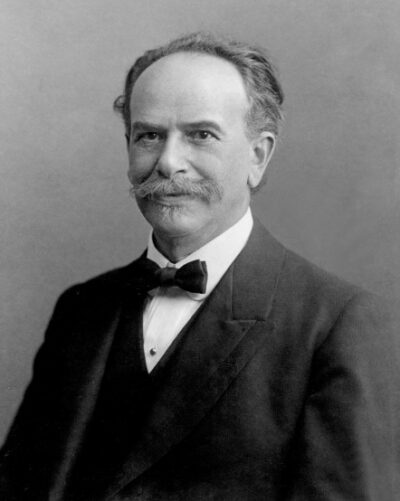
Franz Boas
Franz Boas was a German-American anthropologist. Born July 9, 1858, in Minden. Died December 21, 1942, in New York City. Positions held include president of the Linguistic Society of America (1928–1929). Known for The Mind of Primitive Man. Educated at University of Bonn and Kiel University.
Facts
43 facts · 2 confirmed by two sources · 12 cited · 29 from one source
Where this comes from
Papalocal keeps its own record. It started from these sources; what each one said is kept here as it was copied, so a change on their side never changes this page by itself. Tap one to read its version.
What Wikidata says · copied November 13, 2026 · revision 2568850811
- Described as
- German-American anthropologist
- Other names
- Franz Uri Boas, Father of American Anthropology
- Born
- July 9, 1858 · 10 references
- Died
- December 21, 1942 · 10 references
- Born in
- Minden · 2 references
- Died in
- New York City · 3 references
- Buried in
- Dale Cemetery · 1 reference
- Cause of death
- myocardial infarction
- Name at birth
- Franz Uri Boas
- Citizen of
- Kingdom of Prussia; United States · 1 reference; Germany; German Empire
- Occupation
- anthropologist · 1 reference; linguist; university teacher · 1 reference; geographer · 2 references; philosopher · 1 reference; curator; art historian · 2 references; ethnographer · 1 reference
- Positions held
- president of the Linguistic Society of America (1928–1929) · 1 reference
- Worked for
- Columbia University; Clark University; Smithsonian Institution; American Museum of Natural History
- Education
- University of Bonn; Kiel University (1881); Heidelberg University
- Member of
- Royal Prussian Academy of Sciences; German Academy of Sciences Leopoldina; Austrian Academy of Sciences; Bavarian Academy of Sciences and Humanities; National Academy of Sciences (1900–) · 1 reference; American Academy of Arts and Sciences; Royal Danish Academy of Sciences and Letters; American Antiquarian Society (1908); Linguistic Society of America; Burschenschaft Alemannia Bonn · 1 reference
- Known for
- The Mind of Primitive Man
- Field
- anthropology; particular law · 1 reference; relativism · 1 reference
- Children
- Ernst Philip Boas; Franziska Boas
- Wikipedias with a page
- 68
Wikidata item Q76857 (wikidata.org/wiki/Q76857), public domain (CC0). Copied November 13, 2026.
What Wikipedia says · copied November 13, 2026 · revision 1380538895
Franz Uri Boas (July 9, 1858 – December 21, 1942) was a German-American anthropologist and ethnomusicologist. He was a pioneer of modern anthropology who has been called the "Father of American Anthropology". His work is associated with the movements known as historical particularism and cultural relativism.
Studying in Germany, Boas was awarded a doctorate in 1881 in physics while also studying geography. He then participated in a geographical expedition to northern Canada, where he became fascinated with the culture and language of the Baffin Island Inuit. He went on to do field work with the indigenous cultures and languages of the Pacific Northwest. In 1887 he emigrated to the United States, where he first worked as a museum curator at the Smithsonian, and in 1899 became a professor of anthropology at Columbia University, where he remained for the rest of his career. Through his students, many of whom went on to found anthropology departments and research programmes inspired by their mentor, Boas profoundly influenced the development of American anthropology. Among his many significant students were A. L. Kroeber, Alexander Goldenweiser, Ruth Benedict, Edward Sapir, Margaret Mead, Zora Neale Hurston, and Gilberto Freyre.
Boas was one of the most prominent opponents of the then-popular ideologies of scientific racism, the idea that race is a biological concept and that human behavior is best understood through the typology of biological characteristics. In a series of groundbreaking studies of skeletal anatomy, he showed that cranial shape and size was highly malleable depending on environmental factors such as health and nutrition, in contrast to the claims by racial anthropologists of the day that held head shape to be a stable racial trait. Boas also worked to demonstrate that differences in human behavior are not primarily determined by innate biological dispositions but are largely the result of cultural differences acquired through social learning. In this way, Boas posed culture as the primary concept for describing differences in behavior between human groups, and as the central analytical concept of anthropology.
Among Boas's main contributions to anthropological thought was his rejection of the then-popular evolutionary approaches to the study of culture, which saw all societies progressing through a set of hierarchic technological and cultural stages, with Western European culture at the summit. Boas argued that culture developed historically through the interactions of groups of people and the diffusion of ideas and that consequently there was no process towards continuously "higher" cultural forms. Boas was a proponent of the idea of cultural relativism, which holds that cultures cannot be objectively ranked as higher or lower, or better or more correct, but that all humans see the world through the lens of their own culture, and judge it according to their own culturally acquired norms. By uniting the disciplines of archaeology, the study of material culture and history, and physical anthropology, the study of variation in human anatomy, with ethnology, the study of cultural variation of customs, and descriptive linguistics, the study of unwritten indigenous languages, Boas created the four-field subdivision of anthropology which became prominent in American anthropology in the 20th century.
- Born, in its opening lines
- July 9, 1858
- Died, in its opening lines
- December 21, 1942
From the Wikipedia article “Franz Boas” (en.wikipedia.org/wiki/Franz_Boas), by its contributors, under CC BY-SA 4.0 (creativecommons.org/licenses/by-sa/4.0/). Copied November 13, 2026; not changed.
Confirmed Two sources agree. Cited One source, and it names where it got it. One source One source, without a reference of its own. Sources disagree The sources disagree. We show the best-supported value and keep theirs below.
