
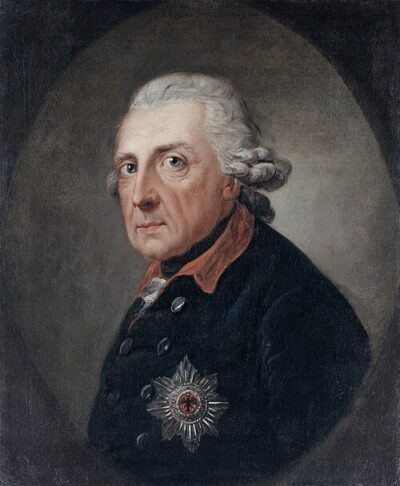
Frederick II of Prussia
Frederick II of Prussia was a King of Prussia from 1740 to 1786. Born January 24, 1712, in Berlin. Died August 17, 1786, in Potsdam. Positions held include Prince-Elector, King of Prussia (1740–1786) and Margrave of Brandenburg (1740–). Awards include Order of the Black Eagle, Order of the White Eagle (Polish–Lithuanian Commonwealth) and Order of Saint Alexander Nevsky.
Facts
45 facts · 2 confirmed by two sources · 10 cited · 33 from one source
Where this comes from
Papalocal keeps its own record. It started from these sources; what each one said is kept here as it was copied, so a change on their side never changes this page by itself. Tap one to read its version.
What Wikidata says · copied November 16, 2026 · revision 2567620161
- Described as
- King of Prussia from 1740 to 1786 (1712-1786)
- Other names
- Frederick the Great, Frederick II, Father Fritz, The Old Fritz, Friedrich der Große, Friedrich II
- Born
- January 24, 1712 · 15 references
- Died
- August 17, 1786 · 15 references
- Born in
- Berlin · 2 references
- Died in
- Potsdam · 2 references
- Buried in
- Sanssouci Palace (1991–)
- Cause of death
- disease
- Citizen of
- Kingdom of Prussia; Germany · 1 reference
- Occupation
- ruler; art collector · 1 reference; monarch; king · 1 reference; librettist; composer · 1 reference
- Positions held
- Prince-Elector; King of Prussia (1740–1786); Margrave of Brandenburg (1740–)
- Member of
- Royal Prussian Academy of Sciences (1764–1786); Russian Academy of Sciences (1776–1786); Freemasonry
- Instrument
- Western concert flute
- Awards
- Order of the Black Eagle (1740–1786); Order of the White Eagle (Polish–Lithuanian Commonwealth); Order of Saint Alexander Nevsky; Order of St. Andrew; Pour le Mérite; Royal Order of the Seraphim
- Field
- political activity · 1 reference; art · 1 reference; music · 1 reference; political science and government · 1 reference
- Spouse
- Elisabeth Christine of Brunswick-Wolfenbüttel-Bevern (1732–1786) · 1 reference
- Father
- Friedrich Wilhelm I of Prussia
- Mother
- Sophia Dorothea of Hanover
- Siblings
- Sophia Dorothea of Prussia; Princess Philippine Charlotte of Prussia; Louisa Ulrika of Prussia; Wilhelmine of Prussia, Margravine of Brandenburg-Bayreuth; Anna Amalia of Prussia, Abbess of Quedlinburg; Princess Friederike Luise of Prussia; Prince Augustus Ferdinand of Prussia; Prince Heinrich of Prussia; Prince Augustus William of Prussia; Frederick Louis, Crown Prince of Prussia · 1 reference
- Religion
- Lutheranism
- Wikipedias with a page
- 124
Wikidata item Q33550 (wikidata.org/wiki/Q33550), public domain (CC0). Copied November 16, 2026.
What Wikipedia says · copied November 16, 2026 · revision 1381248698
Frederick II (German: Friedrich II.; 24 January 1712 – 17 August 1786) was the monarch of Prussia from 1740 until his death in 1786. He was the last Hohenzollern monarch titled King in Prussia, declaring himself King of Prussia after annexing Royal Prussia from the Polish–Lithuanian Commonwealth in 1772. His most significant accomplishments include military successes in the Silesian wars, reorganisation of the Prussian Army, the First Partition of Poland, and patronage of the arts and the Enlightenment. Prussia greatly increased its territories and became a major military power in Europe under his rule. He became known as Frederick the Great (German: Friedrich der Große) and was nicknamed "Old Fritz" (German: der Alte Fritz).
In his youth, Prince Frederick was more interested in music and philosophy than war, which led to clashes with his authoritarian father, Frederick William I of Prussia. However, upon ascending to the throne, he attacked and annexed the rich Austrian province of Silesia in 1742, winning military acclaim. He became an influential military theorist, whose analyses emerged from his extensive personal battlefield experience and covered issues of strategy, tactics, mobility and logistics.
Frederick was a supporter of enlightened absolutism, stating that the ruler should be the first servant of the state. He modernised the Prussian bureaucracy and civil service, and pursued religious policies that ranged from tolerance to segregation. He reformed the judicial system and made it possible for men of lower status to become judges and senior bureaucrats. Frederick encouraged immigrants of diverse backgrounds to come to Prussia. While Protestantism remained the favored faith, he allowed religious freedom and tolerated Jews and Catholics in Prussia, although his actions were not entirely without prejudice. He supported the arts and philosophers he favoured, and allowed freedom of the press and literature. Frederick was almost certainly homosexual, and his sexuality has been the subject of much study. Because he died childless, he was succeeded by his nephew, Frederick William II. He is buried at his favourite residence, Sanssouci in Potsdam.
Nearly all 19th-century German historians made Frederick into a romantic model of a glorified warrior, praising his leadership, administrative efficiency, devotion to duty and success in building Prussia into a great power. Frederick remained an admired historical figure through Germany's defeat in World War I, and the Nazis glorified him as a great German leader prefiguring Adolf Hitler, who personally idolised him. His reputation became less favourable in Germany after World War II, partly due to being symbolically adopted by the Nazis as a historical hero. Historians in the 21st century tend to view Frederick as an outstanding military leader and capable monarch, whose commitment to enlightenment culture and administrative reform built the foundation that allowed the Kingdom of Prussia to contest the Austrian Habsburgs for leadership among the German states.
- Born, in its opening lines
- January 24, 1712
- Died, in its opening lines
- August 17, 1786
From the Wikipedia article “Frederick the Great” (en.wikipedia.org/wiki/Frederick_the_Great), by its contributors, under CC BY-SA 4.0 (creativecommons.org/licenses/by-sa/4.0/). Copied November 16, 2026; not changed.
Confirmed Two sources agree. Cited One source, and it names where it got it. One source One source, without a reference of its own. Sources disagree The sources disagree. We show the best-supported value and keep theirs below.
