
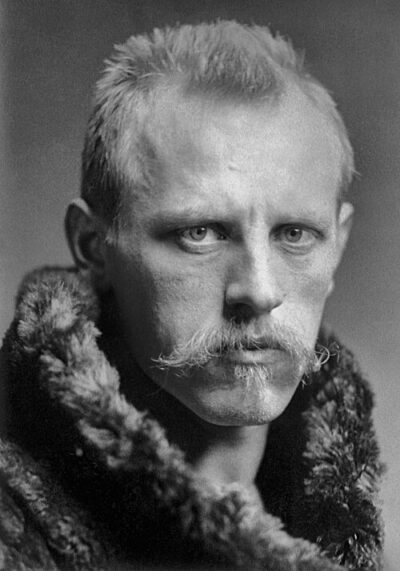
Fridtjof Nansen
Fridtjof Nansen was a Norwegian polar explorer. Born October 10, 1861, in Vestre Aker. Died May 13, 1930, in Polhøgda. Positions held include United Nations High Commissioner for Refugees (1922–1927), ambassador of Norway to the United Kingdom (1906–1908) and honorary presidency. Educated at University of Oslo. Awards include Nobel Peace Prize, Commander of the Legion of Honour and Knight Grand Cross of the Royal Victorian Order.
Facts
59 facts · 2 confirmed by two sources · 23 cited · 34 from one source
Where this comes from
Papalocal keeps its own record. It started from these sources; what each one said is kept here as it was copied, so a change on their side never changes this page by itself. Tap one to read its version.
What Wikidata says · copied November 16, 2026 · revision 2568739200
- Described as
- Norwegian polar explorer (1861–1930)
- Other names
- Fridtjof Wedel-Jarlsberg Nansen
- Born
- October 10, 1861 · 16 references
- Died
- May 13, 1930 · 15 references
- Born in
- Vestre Aker · 1 reference
- Died in
- Polhøgda · 1 reference
- Buried in
- Polhøgda Cemetery · 1 reference
- Cause of death
- myocardial infarction
- Name at birth
- Fridtjof Wedel-Jarlsberg Nansen
- Citizen of
- Norway
- Occupation
- zoologist · 2 references; polar explorer · 2 references; diplomat · 2 references; professor; politician · 3 references; photographer; speed skater · 1 reference; writer · 1 reference
- Positions held
- United Nations High Commissioner for Refugees (1922–1927); ambassador of Norway to the United Kingdom (1906–1908) · 1 reference; honorary presidency · 1 reference
- Political party
- Free-minded Liberal Party · 1 reference; Fatherland League · 1 reference
- Worked for
- University Museum of Bergen; University of Oslo · 1 reference
- Education
- University of Oslo · 1 reference
- Member of
- German Academy of Sciences Leopoldina · 1 reference; Saint Petersburg Academy of Sciences; Norwegian Academy of Science and Letters · 1 reference; Royal Norwegian Society of Sciences and Letters; Royal Prussian Academy of Sciences; Russian Academy of Sciences; Paneuropean Union; American Philosophical Society (1897–); Accademia Nazionale dei Lincei (1900–) · 1 reference
- Sport
- speed skating
- Awards
- Nobel Peace Prize (1922) · 2 references; Commander of the Legion of Honour · 1 reference; Knight Grand Cross of the Royal Victorian Order · 1 reference; Knight of the Order of the Dannebrog · 1 reference; Constantin Medal (1891) · 1 reference; Knight grand cross of the order of the crown of Italy; Vega Medal (1889) · 1 reference; Patron’s Medal (1891) · 1 reference; Order of Saint Stanislaus, 1st class; Grand Cross of the Order of Franz Joseph · 1 reference; Alexander von Humboldt Medal (1897); Carl-Ritter-Medal (1889); Grande Médaille d'Or des Explorations (1897) · 1 reference; Cullum Geographical Medal (1897) · 1 reference; Honorary Fellow of the Royal Society of Edinburgh (1897) · 1 reference
- Field
- oceanography · 1 reference
- Spouse
- Eva Nansen (1889–1907) · 3 references; Sigrun Munthe (1919–1930) · 1 reference
- Children
- Odd Nansen · 2 references; Irmelin Revold
- Father
- Baldur Fridtjof Nansen · 1 reference
- Mother
- Baronesse Adelaide Johanne Thekla Isidore Wedel Jarlsberg · 2 references
- Siblings
- Alexander Nansen; Sigrid Bølling
- Religion
- humanitarianism · 1 reference
- Wikipedias with a page
- 113
Wikidata item Q72292 (wikidata.org/wiki/Q72292), public domain (CC0). Copied November 16, 2026.
What Wikipedia says · copied November 16, 2026 · revision 1384756265
Fridtjof Wedel-Jarlsberg Nansen (Norwegian: [ˈfrɪ̂tːjɔf ˈnɑ̀nsn̩]; 10 October 1861 – 13 May 1930) was a Norwegian polymath and Nobel Peace Prize laureate. He gained prominence at various points in his life as an explorer, a scientist, a diplomat, a humanitarian, and the co-founder of the Fatherland League.
Nansen led the team that made the first crossing of the Greenland interior in 1888, traversing the island on cross-country skis. He won international fame after reaching a record northern latitude of 86°14′ during his Fram expedition of 1893–1896. Although he retired from exploration after his return to Norway, his techniques of polar travel and his innovations in equipment and clothing influenced a generation of subsequent Arctic and Antarctic expeditions. He was elected an International Member of the American Philosophical Society in 1897.
Nansen studied zoology at the Royal Frederick University in Christiania and later worked as a curator at the University Museum of Bergen where his research on the central nervous system of lower marine creatures earned him a doctorate and helped establish neuron doctrine. Later, neuroscientist Santiago Ramón y Cajal won the 1906 Nobel Prize in Medicine for his research on the same subject. After 1896 his main scientific interest switched to oceanography; in the course of his research he made many scientific cruises, mainly in the North Atlantic, and contributed to the development of modern oceanographic equipment.
As one of his country's leading citizens, in 1905 Nansen spoke out for ending Norway's union with Sweden, and was instrumental in persuading Prince Carl of Denmark to accept the throne of the newly independent Norway. Between 1906 and 1908, he served as the Norwegian representative in London, where he helped negotiate the Integrity Treaty that guaranteed Norway's independent status.
In the final decade of his life, Nansen devoted himself primarily to the League of Nations, following his appointment in 1921 as the League's High Commissioner for Refugees. In 1922 he was awarded the Nobel Peace Prize for his work on behalf of the displaced victims of World War I and related conflicts. Among the initiatives he introduced was the "Nansen passport" for stateless people, a certificate that was recognized by more than 50 countries. He worked on behalf of refugees alongside Vidkun Quisling until his sudden death in 1930, after which the League established the Nansen International Office for Refugees to ensure that his work continued. This office received the Nobel Peace Prize in 1938. His name is commemorated in numerous geographical features, particularly in the polar regions.
- Born, in its opening lines
- October 10, 1861
- Died, in its opening lines
- May 13, 1930
From the Wikipedia article “Fridtjof Nansen” (en.wikipedia.org/wiki/Fridtjof_Nansen), by its contributors, under CC BY-SA 4.0 (creativecommons.org/licenses/by-sa/4.0/). Copied November 16, 2026; not changed.
Confirmed Two sources agree. Cited One source, and it names where it got it. One source One source, without a reference of its own. Sources disagree The sources disagree. We show the best-supported value and keep theirs below.
