
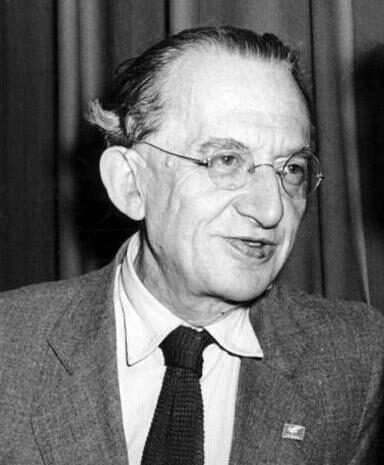
Georg Lukács
Georg Lukács was a Hungarian marxist philosopher and literary critic. Born April 13, 1885, in Budapest. Died June 4, 1971, in Budapest District XII. Positions held include member of the Provisional National Assembly (1945), Minister of Public Instruction (1956) and member of the National Assembly of Hungary (1953–1957). Educated at Humboldt-Universität zu Berlin and Eötvös Loránd University. Awards include Kossuth Prize (2 times), Goethe Prize of the City of Frankfurt and Order of the Red Banner.
Facts
41 facts · 2 confirmed by two sources · 19 cited · 19 from one source · 1 where the sources disagree
What’s different
- Cause of death: we show lung cancer (Sources disagree). Wikidata also lists brain metastasis
Where this comes from
Papalocal keeps its own record. It started from these sources; what each one said is kept here as it was copied, so a change on their side never changes this page by itself. Tap one to read its version.
What Wikidata says · copied November 16, 2026 · revision 2569995445
- Described as
- Hungarian marxist philosopher and literary critic (1885–1971)
- Other names
- Georg Lukacs, György Lukács, Lukács György
- Born
- April 13, 1885 · 17 references
- Died
- June 4, 1971 · 11 references
- Born in
- Budapest · 5 references
- Died in
- Budapest District XII · 1 reference
- Buried in
- Fiume Road Graveyard · 1 reference
- Cause of death
- lung cancer · 1 reference; brain metastasis · 1 reference
- Name at birth
- Löwinger György Bernát
- Citizen of
- Hungary · 1 reference
- Occupation
- philosopher · 3 references; politician · 1 reference; writer; university teacher; sociologist; literary critic · 2 references; art historian · 2 references; philosopher of culture · 2 references
- Positions held
- member of the Provisional National Assembly (1945) · 1 reference; Minister of Public Instruction (1956); member of the National Assembly of Hungary (1953–1957) · 1 reference
- Political party
- Communist Party of Hungary (1918–) · 1 reference; Hungarian Working People's Party · 1 reference; Hungarian Socialist Workers' Party · 1 reference; Hungarian Communist Party · 1 reference
- Worked for
- Nyugat
- Education
- Humboldt-Universität zu Berlin (–1907); Eötvös Loránd University (–1909)
- Member of
- USSR Union of Writers; German Academy of Sciences at Berlin; Hungarian Academy of Sciences (1948–1949); Polish Academy of Sciences
- Awards
- Kossuth Prize (2 times) (1948, 1955); Goethe Prize of the City of Frankfurt (1970); Order of the Red Banner (1969) · 1 reference; Jubilee Medal "In Commemoration of the 100th Anniversary of the Birth of Vladimir Ilyich Lenin" · 1 reference
- Field
- philosophy; aesthetics; history of literature
- Children
- Ferenc Jánossy; Lajos Jánossy
- Religion
- Judaism · 1 reference; Lutheranism · 1 reference
- Wikipedias with a page
- 70
Wikidata item Q151523 (wikidata.org/wiki/Q151523), public domain (CC0). Copied November 16, 2026.
What Wikipedia says · copied November 16, 2026 · revision 1385808838
György Lukács (born Bernát György Löwinger; Hungarian: Lukács György; German: Georg Bernard Lukács; 13 April 1885 – 4 June 1971) was a Hungarian Marxist philosopher, literary historian, literary critic, and aesthetician. He was one of the founders of Western Marxism, an interpretive tradition that departed from the Soviet Marxist ideological orthodoxy. He developed the theory of reification, and contributed to Marxist theory with developments of Karl Marx's theory of class consciousness. He was also a philosopher of Leninism. He ideologically developed and organised Vladimir Lenin's pragmatic revolutionary practices into the formal philosophy of vanguard-party revolution.
Lukács was especially influential as a critic due to his theoretical developments of literary realism and of the novel as a literary genre. In 1919, he was appointed the Hungarian Minister of Culture of the government of the short-lived Hungarian Soviet Republic (March–August 1919). Lukács has been described as the preeminent Marxist intellectual of the Stalinist era, though assessing his legacy can be difficult as Lukács seemed both to support Stalinism as the embodiment of Marxist thought, and yet also to champion a return to pre-Stalinist Marxism.
- Born, in its opening lines
- April 13, 1885
- Died, in its opening lines
- June 4, 1971
From the Wikipedia article “György Lukács” (en.wikipedia.org/wiki/György_Lukács), by its contributors, under CC BY-SA 4.0 (creativecommons.org/licenses/by-sa/4.0/). Copied November 16, 2026; not changed.
Confirmed Two sources agree. Cited One source, and it names where it got it. One source One source, without a reference of its own. Sources disagree The sources disagree. We show the best-supported value and keep theirs below.
