
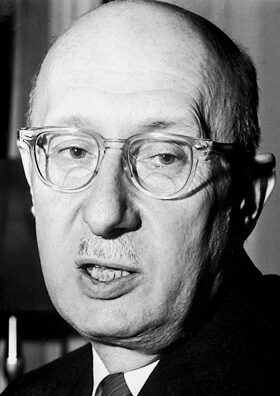
Georg von Békésy
Georg von Békésy was a Hungarian physicist. Born June 3, 1899, in Budapest. Died June 13, 1972, in Honolulu. Educated at Eötvös Loránd University and University of Bern. Awards include Nobel Prize in Physiology or Medicine, Silver Leibniz medal and honorary doctor of Semmelweis University.
Facts
30 facts · 2 confirmed by two sources · 7 cited · 21 from one source
Where this comes from
Papalocal keeps its own record. It started from these sources; what each one said is kept here as it was copied, so a change on their side never changes this page by itself. Tap one to read its version.
What Wikidata says · copied November 13, 2026 · revision 2567717543
- Described as
- Hungarian physicist (1899–1972)
- Other names
- Georg von Bekesy, György Békésy
- Born
- June 3, 1899 · 9 references
- Died
- June 13, 1972 · 9 references
- Born in
- Budapest · 2 references
- Died in
- Honolulu · 1 reference
- Citizen of
- Hungary · 1 reference; United States
- Occupation
- physicist · 2 references; neuroscientist; chemist; autobiographer; university teacher; physiologist · 2 references; biophysicist; engineer · 1 reference
- Worked for
- Harvard University; Eötvös Loránd University; University of Hawaiʻi System · 1 reference
- Education
- Eötvös Loránd University (–1923); University of Bern (–1921)
- Member of
- German Academy of Sciences Leopoldina; Hungarian Academy of Sciences (1939–1946); American Academy of Arts and Sciences; National Academy of Sciences (1956–)
- Awards
- Nobel Prize in Physiology or Medicine (1961) · 2 references; Silver Leibniz medal (1937); honorary doctor of Semmelweis University (1969); ASA Gold Medal; Howard Crosby Warren Medal (1955) · 1 reference
- Field
- biophysics
- Siblings
- Lola Békésy
- Wikipedias with a page
- 60
Wikidata item Q238716 (wikidata.org/wiki/Q238716), public domain (CC0). Copied November 13, 2026.
What Wikipedia says · copied November 13, 2026 · revision 1381481078
Georg von Békésy (Hungarian: Békésy György, pronounced [ˈbeːkeːʃi ˈɟørɟ]; 3 June 1899 – 13 June 1972) was a Hungarian-American biophysicist.
By using strobe photography and silver flakes as a marker, he was able to observe that the basilar membrane moves like a surface wave when stimulated by sound. Because of the structure of the cochlea and the basilar membrane, different frequencies of sound cause the maximum amplitudes of the waves to occur at different places on the basilar membrane along the coil of the cochlea. High frequencies cause more vibration at the base of the cochlea while low frequencies create more vibration at the apex.
He concluded that his observations showed how different sound wave frequencies are locally dispersed before exciting different nerve fibers that lead from the cochlea to the brain.
In 1961, he was awarded the Nobel Prize in Physiology or Medicine for his research on the function of the cochlea in the mammalian hearing organ.
In his last publication A. James Hudspeth and his research team – based on "a groundbreaking technological advancement" – ultimately established that also in mammals frequency analysis in the inner ear is accomplished by tuned hairs cells. This process occurs without a traveling wave (surface wave) on the basilar membrane, and the inner ear theory of Békésy was thus disproved.
- Born, in its opening lines
- June 3, 1899
- Died, in its opening lines
- June 13, 1972
From the Wikipedia article “Georg von Békésy” (en.wikipedia.org/wiki/Georg_von_Békésy), by its contributors, under CC BY-SA 4.0 (creativecommons.org/licenses/by-sa/4.0/). Copied November 13, 2026; not changed.
Confirmed Two sources agree. Cited One source, and it names where it got it. One source One source, without a reference of its own. Sources disagree The sources disagree. We show the best-supported value and keep theirs below.
