
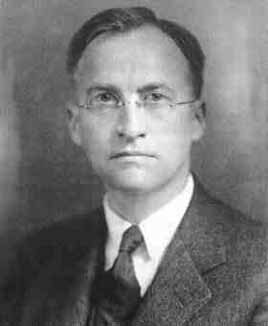
George David Birkhoff
George David Birkhoff was an American mathematician. Born March 21, 1884, in Overisel Township. Died November 12, 1944, in Cambridge. Positions held include Perkins Professorship of Astronomy and Mathematics (1933–1944). Known for ergodic theorem, Birkhoff's theorem and Poincaré–Birkhoff theorem. Educated at Harvard University and University of Chicago. Awards include Bôcher Memorial Prize, Fellow of the Royal Society of Edinburgh and Newcomb Cleveland Prize.
Facts
47 facts · 2 confirmed by two sources · 23 cited · 22 from one source
Where this comes from
Papalocal keeps its own record. It started from these sources; what each one said is kept here as it was copied, so a change on their side never changes this page by itself. Tap one to read its version.
What Wikidata says · copied November 15, 2026 · revision 2557891915
- Described as
- American mathematician (1884-1944)
- Other names
- George D. Birkhoff
- Born
- March 21, 1884 · 7 references
- Died
- November 12, 1944 · 6 references
- Born in
- Overisel Township · 2 references
- Died in
- Cambridge · 1 reference
- Buried in
- Mount Auburn Cemetery · 1 reference
- Name at birth
- George David Birkhoff
- Citizen of
- United States
- Occupation
- mathematician · 2 references; topologist; university teacher
- Positions held
- Perkins Professorship of Astronomy and Mathematics (1933–1944)
- Worked for
- Princeton University (1909–1912) · 1 reference; Harvard University (1912–1944) · 1 reference; University of Wisconsin–Madison (1907–1909) · 1 reference
- Education
- Harvard University (1903–1905) · 1 reference; University of Chicago (1902–) · 1 reference
- Member of
- National Academy of Sciences (1918–) · 1 reference; Göttingen Academy of Sciences and Humanities in Lower Saxony; Pontifical Academy of Sciences · 1 reference; American Academy of Arts and Sciences (1913–); American Philosophical Society (1921–) · 1 reference; American Association for the Advancement of Science · 1 reference; Edinburgh Mathematical Society (1927) · 1 reference; Royal Danish Academy of Sciences and Letters; Accademia Nazionale dei Lincei (1929–) · 1 reference
- Known for
- ergodic theorem · 1 reference; Birkhoff's theorem; Poincaré–Birkhoff theorem; Birkhoff–Kellogg invariant-direction theorem; Birkhoff–Grothendieck theorem; Birkhoff–Khinchin theorem; Birkhoff's representation theorem; Birkhoff's axioms; Birkhoff factorization; Birkhoff interpolation
- Awards
- Bôcher Memorial Prize (1923) · 2 references; Fellow of the Royal Society of Edinburgh (1943) · 1 reference; Newcomb Cleveland Prize (1926); doctor honoris causa from the University of Paris (1936) · 2 references; honorary doctor of the University of Poitiers (1933) · 1 reference
- Field
- topology; mathematics · 1 reference; ergodic theory · 1 reference; three-body problem · 1 reference; number theory · 1 reference
- Children
- Garrett Birkhoff; Barbara Birkhoff
- Wikipedias with a page
- 32
Wikidata item Q327301 (wikidata.org/wiki/Q327301), public domain (CC0). Copied November 15, 2026.
What Wikipedia says · copied November 15, 2026 · revision 1384711271
George David Birkhoff (March 21, 1884 – November 12, 1944) was an American mathematician. He is considered one of the top American mathematicians of his generation. He made valuable contributions to the theory of differential equations, dynamical systems, the four-color problem, the three-body problem, and general relativity. Today, Birkhoff is best remembered for the ergodic theorem. The George D. Birkhoff House, his residence in Cambridge, Massachusetts, has been designated a National Historic Landmark.
- Born, in its opening lines
- March 21, 1884
- Died, in its opening lines
- November 12, 1944
From the Wikipedia article “George David Birkhoff” (en.wikipedia.org/wiki/George_David_Birkhoff), by its contributors, under CC BY-SA 4.0 (creativecommons.org/licenses/by-sa/4.0/). Copied November 15, 2026; not changed.
Confirmed Two sources agree. Cited One source, and it names where it got it. One source One source, without a reference of its own. Sources disagree The sources disagree. We show the best-supported value and keep theirs below.
