
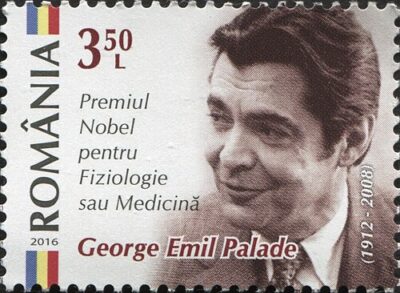
George Emil Palade
George Emil Palade was a Romanian cell biologist, physician and Nobel laureate. Born November 19, 1912, in Iași. Died October 7, 2008, in Del Mar. Educated at University of Bucharest and Bogdan Petriceicu Hasdeu National College. Awards include Nobel Prize in Physiology or Medicine, Albert Lasker Award for Basic Medical Research and Canada Gairdner International Award.
Facts
41 facts · 2 confirmed by two sources · 17 cited · 21 from one source · 1 where the sources disagree
What’s different
- Buried in: we show Bucegi Mountains (Sources disagree). Wikidata also lists Rocky Mountains
Where this comes from
Papalocal keeps its own record. It started from these sources; what each one said is kept here as it was copied, so a change on their side never changes this page by itself. Tap one to read its version.
What Wikidata says · copied November 13, 2026 · revision 2567390934
- Described as
- Romanian cell biologist, physician and Nobel laureate (1912–2008)
- Born
- November 19, 1912 · 7 references
- Died
- October 7, 2008 · 7 references
- Born in
- Iași · 1 reference
- Died in
- Del Mar · 1 reference
- Buried in
- Bucegi Mountains · 1 reference; Rocky Mountains
- Citizen of
- Romania · 1 reference; United States (1952–)
- Occupation
- physician; cell biologist; chemist; inventor; university teacher; physicist; biochemist · 1 reference
- Worked for
- Yale University · 1 reference; University of California, San Diego · 1 reference
- Education
- University of Bucharest; Bogdan Petriceicu Hasdeu National College · 1 reference
- Member of
- Royal Society of London; German Academy of Sciences Leopoldina (1973–) · 1 reference; Pontifical Academy of Sciences · 1 reference; National Academy of Sciences; Romanian Academy; American Academy of Arts and Sciences; American-Romanian Academy of Arts and Sciences
- Awards
- Nobel Prize in Physiology or Medicine (1974) · 2 references; Albert Lasker Award for Basic Medical Research (1966) · 1 reference; Canada Gairdner International Award (1967); Louisa Gross Horwitz Prize (1970) · 1 reference; Dickson Prize in Science (1972) · 1 reference; E. B. Wilson Medal (1981) · 2 references; Foreign Member of the Royal Society (1984) · 1 reference; honorary doctorate from University of Paris-XI (1984) · 1 reference; Schleiden Medal (1985); National Medal of Science (1986); Order of the Star of Romania (2007) · 1 reference; Sterling Professor; honorary doctor of the University of Vienna · 1 reference
- Field
- cell biology
- Spouse
- Marilyn Farquhar (1970–)
- Religion
- Eastern Orthodox Church · 1 reference
- Wikipedias with a page
- 60
Wikidata item Q219718 (wikidata.org/wiki/Q219718), public domain (CC0). Copied November 13, 2026.
What Wikipedia says · copied November 13, 2026 · revision 1378635790
George Emil Palade (Romanian pronunciation: [ˈdʒe̯ordʒe eˈmil paˈlade] ; November 19, 1912 – October 7, 2008) was a Romanian-American cell biologist. In 1974 he was awarded the Nobel Prize in Physiology or Medicine along with Albert Claude and Christian de Duve. The prize was granted for his innovations in electron microscopy and cell fractionation which together laid the foundations of modern molecular cell biology, the most notable discovery being the ribosomes of the endoplasmic reticulum – which he first described in 1955.
Palade also received the U.S. National Medal of Science in Biological Sciences for "pioneering discoveries of a host of fundamental, highly organized structures in living cells" in 1986, and was previously elected a Member of the U.S. National Academy of Sciences in 1961. In 1968 he was elected as an Honorary Fellow of the Royal Microscopical Society (HonFRMS) and in 1984 he became a Foreign Member of the Royal Society (ForMemRS).
- Born, in its opening lines
- November 19, 1912
- Died, in its opening lines
- October 7, 2008
From the Wikipedia article “George Emil Palade” (en.wikipedia.org/wiki/George_Emil_Palade), by its contributors, under CC BY-SA 4.0 (creativecommons.org/licenses/by-sa/4.0/). Copied November 13, 2026; not changed.
Confirmed Two sources agree. Cited One source, and it names where it got it. One source One source, without a reference of its own. Sources disagree The sources disagree. We show the best-supported value and keep theirs below.
