
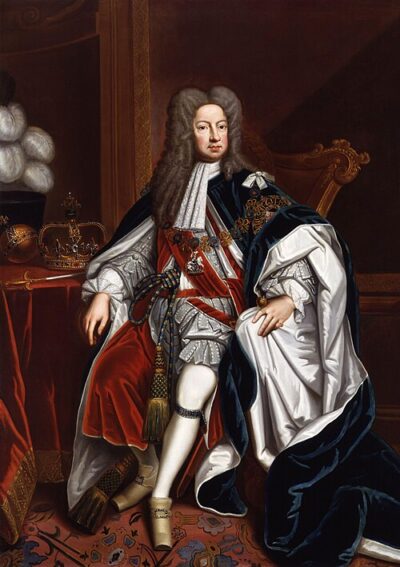
George I of Great Britain
George I of Great Britain was a King of Great Britain and Ireland from 1714 to 1727. Born June 7, 1660, in Hanover. Died June 22, 1727, in Osnabrück. Positions held include Prince-Elector (1708–1727), Monarch of Great Britain (1714–1727) and King of Ireland (1714–1727). Awards include Knight of the Garter and Knight Companion of the Order of the Thistle.
Facts
35 facts · 0 confirmed by two sources · 14 cited · 19 from one source · 2 where the sources disagree
What’s different
- Born: we show June 7, 1660 (Sources disagree). Wikipedia says May 28, 1660
- Died: we show June 22, 1727 (Sources disagree). Wikipedia says June 11, 1727
Where this comes from
Papalocal keeps its own record. It started from these sources; what each one said is kept here as it was copied, so a change on their side never changes this page by itself. Tap one to read its version.
What Wikidata says · copied November 16, 2026 · revision 2567829021
- Described as
- King of Great Britain and Ireland from 1714 to 1727
- Other names
- Georg Ludwig, George I, King of Great Britain, France and Ireland, Defender of the Faith, Duke of Brunswick-Lüneburg, Archtreasurer and Prince-Elector of the Holy Roman Empire, George I, King of Great Britain, George Louis, Archbannerbearer of the Holy Roman Empire and Prince-Elector, Duke of Brunswick-Lüneburg, George Louis, George Louis of Brunswick-Lüneburg, Duke George Louis of Brunswick-Lüneburg, George Louis of Hanover, George Louis, Elector of Hanover, George Louis Hanover, George Louis, Hereditary Prince of Brunswick-Lüneburg, George Hanover
- Born
- June 7, 1660 · 2 references
- Died
- June 22, 1727
- Born in
- Hanover · 1 reference
- Died in
- Osnabrück · 2 references
- Buried in
- Welf family mausoleum · 1 reference
- Cause of death
- stroke
- Citizen of
- Electorate of Hanover; Kingdom of Great Britain
- Occupation
- politician
- Positions held
- Prince-Elector (1708–1727); Monarch of Great Britain (1714–1727); King of Ireland (1714–1727); prince (1698–1705); Duke of Brunswick-Lüneburg (1698–1727)
- Member of
- Royal Society of London
- Awards
- Knight of the Garter (1701) · 1 reference; Knight Companion of the Order of the Thistle (1714)
- Field
- politics · 1 reference; governance · 1 reference; art patronage · 1 reference
- Spouse
- Sophia Dorothea of Celle (1682–1694) · 2 references
- Children
- George II of Great Britain · 2 references; Sophia Dorothea of Hanover · 1 reference; Luise Sophia von der Schulenburg, Countess of Dölitz · 1 reference; Melusina von der Schulenburg, Countess of Walsingham · 2 references; Margarethe Gertrud von Oeynhausen · 1 reference
- Father
- Ernest Augustus, Elector of Brunswick-Lüneburg · 1 reference
- Mother
- Sophia of Hanover · 2 references
- Siblings
- Sophia Charlotte of Hanover; Ernest Augustus, Duke of York and Albany · 1 reference; Maximilian William of Brunswick-Lüneburg; Ernst August von Platen-Hallermund; Sophia von Kielmansegg, Countess of Darlington; Friedrich August Hanover, Prince of Hanover · 1 reference
- Religion
- Lutheranism
- Wikipedias with a page
- 85
Wikidata item Q130805 (wikidata.org/wiki/Q130805), public domain (CC0). Copied November 16, 2026.
What Wikipedia says · copied November 16, 2026 · revision 1385902616
George I (George Louis; German: Georg Ludwig; 28 May 1660 – 11 June 1727) was King of Great Britain and Ireland from 1 August 1714 and ruler of the Electorate of Hanover within the Holy Roman Empire from 23 January 1698 until his death in 1727. He was the first British monarch of the House of Hanover.
Born in Hanover to Ernest Augustus and Sophia of Hanover, George inherited the titles and lands of the Duchy of Brunswick-Lüneburg from his father and uncles. In 1682, he married his cousin Sophia Dorothea of Celle, with whom he had two children; he also had three daughters with his mistress Melusine von der Schulenburg. George and Sophia Dorothea divorced in 1694. A succession of European wars expanded George's German domains during his lifetime; he was ratified as prince-elector of Hanover in 1708.
As the senior Protestant descendant of his great-grandfather James VI and I, George inherited the British throne following the deaths in 1714 of his mother, Sophia, and his second cousin Anne, Queen of Great Britain. During his reign the powers of the monarchy diminished, and Britain began a transition to the modern system of cabinet government led by a prime minister. Jacobites attempted, but failed, to depose George and replace him with James Francis Edward Stuart, Anne's Catholic half-brother. Towards the end of his reign, actual political power was held by Robert Walpole, now recognised as Britain's first de facto prime minister.
George died in 1727 on a journey to his native Hanover, where he was buried. He is the most recent British monarch to be buried outside Britain. He was succeeded by his son, George II.
- Born, in its opening lines
- May 28, 1660
- Died, in its opening lines
- June 11, 1727
From the Wikipedia article “George I of Great Britain” (en.wikipedia.org/wiki/George_I_of_Great_Britain), by its contributors, under CC BY-SA 4.0 (creativecommons.org/licenses/by-sa/4.0/). Copied November 16, 2026; not changed.
Confirmed Two sources agree. Cited One source, and it names where it got it. One source One source, without a reference of its own. Sources disagree The sources disagree. We show the best-supported value and keep theirs below.
