
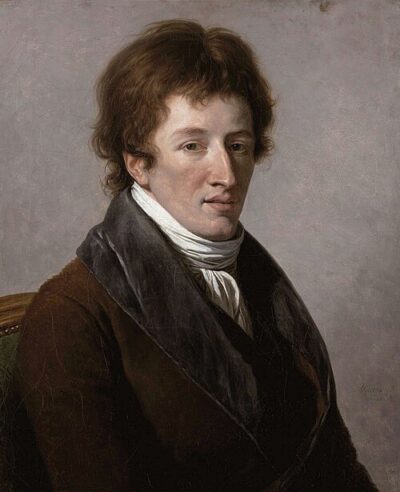
Georges Cuvier
Georges Cuvier was a French naturalist, zoologist and paleontologist. Born August 23, 1769, in Montbéliard. Died May 13, 1832, in former 12th arrondissement of Paris. Positions held include member of the Chamber of Peers (1831–1832), director of the Muséum National d'Histoire Naturelle (1808–1832) and Member of the Académie française (1818–1832). Known for Le Règne Animal. Educated at University of Stuttgart. Awards include Grand Officer of the Legion of Honour, Fellow of the American Academy of Arts and Sciences and Foreign Member of the Royal Society.
Facts
50 facts · 2 confirmed by two sources · 19 cited · 29 from one source
Where this comes from
Papalocal keeps its own record. It started from these sources; what each one said is kept here as it was copied, so a change on their side never changes this page by itself. Tap one to read its version.
What Wikidata says · copied November 16, 2026 · revision 2567780602
- Described as
- French naturalist, zoologist and paleontologist (1769–1832)
- Other names
- G. L. Cuvier, G. Cuvier, Georges-Léopold-Chrêtien-Frédéric-Dagobert Baron Cuvier, Georges de Cuvier, Georges, Baron Cuvier, Georges Leopold Cuvier, Cuvier, Baron Georges Cuvier, Georges-Leopold-Chretien-Frederic-Dagobert Baron Cuvier
- Born
- August 23, 1769 · 9 references
- Died
- May 13, 1832 · 15 references
- Born in
- Montbéliard · 2 references
- Died in
- former 12th arrondissement of Paris
- Buried in
- Père Lachaise Cemetery · 1 reference
- Cause of death
- cholera
- Name at birth
- Jean Léopold Nicolas Frédéric Cuvier
- Citizen of
- France · 1 reference
- Occupation
- paleontologist · 1 reference; politician · 1 reference; zoologist · 1 reference; ornithologist; university teacher · 1 reference; professor · 1 reference; malacologist; ichthyologist
- Positions held
- member of the Chamber of Peers (1831–1832); director of the Muséum National d'Histoire Naturelle (1808–1832); Member of the Académie française (1818–1832); vice president (1819–); chairperson (2 times) (1819–1829)
- Worked for
- Collège de France (1800–1832) · 1 reference; Muséum national d'histoire naturelle
- Education
- University of Stuttgart
- Member of
- Royal Society of London; Société Philomathique de Paris; Académie Française (1818–); Academy of Science for Public Utility; German Academy of Sciences Leopoldina; Royal Swedish Academy of Sciences; French Academy of Sciences; Saint Petersburg Academy of Sciences; American Academy of Arts and Sciences; Académie des Inscriptions et Belles-Lettres (1830–1832) · 1 reference
- Known for
- Le Règne Animal
- Awards
- Grand Officer of the Legion of Honour (1826–) · 1 reference; Fellow of the American Academy of Arts and Sciences; Foreign Member of the Royal Society (1806) · 1 reference; 72 names on the Eiffel Tower · 1 reference
- Field
- comparative anatomy; zoology · 1 reference; paleontology · 1 reference; natural science · 1 reference
- Spouse
- Anne-Marie Duvaucel (1804–) · 2 references
- Children
- Clémentine Cuvier
- Father
- Jean Georges Cuvier · 1 reference
- Mother
- Anne-Clémence Catherine Châtel · 1 reference
- Siblings
- Frédéric Cuvier · 1 reference; Georges Charles Henri Cuvier · 1 reference
- Religion
- Protestantism · 1 reference
- Wikipedias with a page
- 86
Wikidata item Q171969 (wikidata.org/wiki/Q171969), public domain (CC0). Copied November 16, 2026.
What Wikipedia says · copied November 16, 2026 · revision 1382956839
Jean Léopold Nicolas Frédéric, baron Cuvier (23 August 1769 – 13 May 1832), known as Georges Cuvier (; French: [ʒɔʁʒ(ə) kyvje]), was a French naturalist and zoologist, sometimes referred to as the "founding father of paleontology". Cuvier was a major figure in natural sciences research in the early 19th century and was instrumental in establishing the fields of comparative anatomy and paleontology through his work in comparing living animals with fossils.
Cuvier's work is considered the foundation of vertebrate paleontology, and he expanded Linnaean taxonomy by grouping classes into phyla and incorporating both fossils and living species into the classification. Cuvier is also known for establishing extinction as a scientific fact—at the time, extinction was considered by many of Cuvier's contemporaries to be merely controversial speculation. In his Essay on the Theory of the Earth (1813), Cuvier proposed that now-extinct species had been wiped out by periodic catastrophic flooding events. In this way, Cuvier became the most influential proponent of catastrophism in geology in the early 19th century. His study of the strata of the Paris basin with Alexandre Brongniart established the basic principles of biostratigraphy.
Among his other accomplishments, Cuvier established that elephant-like bones found in North America belonged to an extinct animal he later would name a "mastodon", and that a large skeleton dug up in present-day Argentina was of a giant, prehistoric ground sloth, which he named Megatherium. He also established two ungulate genera from the Paris Basin named Palaeotherium and Anoplotherium based on fragmentary remains alone, although more complete remains were later uncovered. He named the pterosaur Pterodactylus and described (but did not discover or name) the aquatic reptile Mosasaurus.
Cuvier is also remembered for strongly opposing theories of evolution, which at the time (before Darwin's theory) were mainly proposed by Jean-Baptiste de Lamarck and Geoffroy Saint-Hilaire. Cuvier believed there was no evidence for evolution but rather evidence for cyclical creations and destructions of life forms by global extinction events such as deluges. In 1830, Cuvier and Geoffroy engaged in a famous debate, which is said to exemplify the two major deviations in biological thinking at the time – whether animal structure was due to function or (evolutionary) morphology. Cuvier supported function and rejected Lamarck's thinking.
Cuvier also conducted racial studies which provided part of the foundation for scientific racism, and published work on the supposed differences between racial groups' physical properties and mental abilities. Cuvier subjected Sarah Baartman to examinations alongside other French naturalists during a period in which she was held captive in a state of neglect. Cuvier examined Baartman shortly before her death, and conducted a dissection following her death that disparagingly compared her physical features to those of monkeys.
His most famous work among the general public was the Preliminary Discourse of the Recherches sur les ossemens fossiles de 1812, which was published as a separate in 1821 and in book form in 1825, with the title Discours sur les révolutions de la surface du Globe. The evolution of his ideas on Comparative Anatomy, Paleontology, and pre-Darwinian Natural History can be seen by comparing these works in the form of a Variorum. Another important work was Le Règne Animal (1817; English: The Animal Kingdom). In 1819, he was created a peer for life in honour of his scientific contributions. Thereafter, he was known as Baron Cuvier. He died in Paris during an epidemic of cholera. Some of Cuvier's most influential followers were Louis Agassiz on the continent and in the United States, and Richard Owen in Britain. His name is one of the 72 names inscribed on the Eiffel Tower.
- Born, in its opening lines
- August 23, 1769
- Died, in its opening lines
- May 13, 1832
From the Wikipedia article “Georges Cuvier” (en.wikipedia.org/wiki/Georges_Cuvier), by its contributors, under CC BY-SA 4.0 (creativecommons.org/licenses/by-sa/4.0/). Copied November 16, 2026; not changed.
Confirmed Two sources agree. Cited One source, and it names where it got it. One source One source, without a reference of its own. Sources disagree The sources disagree. We show the best-supported value and keep theirs below.
