
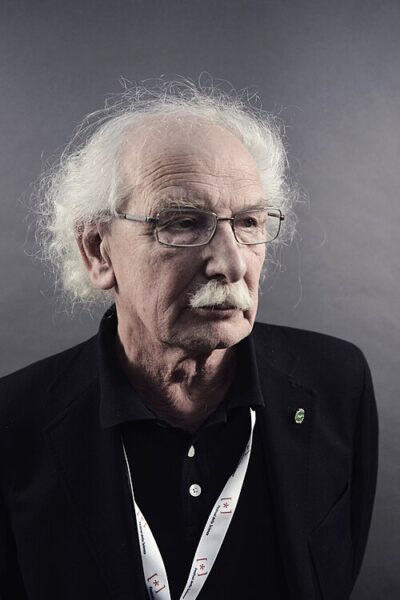
Giacomo Rizzolatti
Giacomo Rizzolatti is an Italian neuroscientist. Born April 28, 1937, in Kyiv. Educated at University of Padua. Awards include Princess of Asturias Award for Technical and Scientific Research, Feltrinelli Prize and Grawemeyer Awards.
Facts
32 facts · 1 confirmed by two sources · 11 cited · 20 from one source
Where this comes from
Papalocal keeps its own record. It started from these sources; what each one said is kept here as it was copied, so a change on their side never changes this page by itself. Tap one to read its version.
What Wikidata says · copied November 18, 2026 · revision 2545439499
- Described as
- Italian neuroscientist (born 1937)
- Other names
- G Rizzolatti, G. Rizzolatti, Rizzolatti G
- Born
- April 28, 1937 · 1 reference
- Born in
- Kyiv · 2 references
- Citizen of
- Italy
- Occupation
- neurologist; university teacher; psychologist; video artist · 1 reference; physiologist · 1 reference
- Worked for
- University of Parma
- Education
- University of Padua
- Member of
- Accademia Nazionale dei Lincei (2002–) · 1 reference; Academia Europaea (1989–) · 1 reference; National Academy of Sciences (2012–); French Academy of Sciences (2005–); American Academy of Arts and Sciences; Academy of Sciences of Turin (2012–) · 1 reference; Royal Society of London (2021–) · 1 reference; Jan Fabre & Giacomo Rizzolatti
- Awards
- Princess of Asturias Award for Technical and Scientific Research (2011); Feltrinelli Prize (2000); Grawemeyer Awards (2007); Herlitzka Prize (2005); The Brain Prize (2014) · 1 reference; Jean-Louis Signoret Prize (2010); Neuronal Plasticity Prize (2007); Fellow of the American Academy of Arts and Sciences; Foreign Member of the Royal Society (2021) · 1 reference; honorary doctorate of Claude Bernard University Lyon 1 (1999) · 2 references
- Field
- psychology; neurology; physiology · 1 reference
- Website
- https://web.archive.org/web/20090207060139/http://www.unipr.it/arpa/mirror/english/staff/rizzolat.htm · 1 reference
- Wikipedias with a page
- 21
Wikidata item Q562048 (wikidata.org/wiki/Q562048), public domain (CC0). Copied November 18, 2026.
What Wikipedia says · copied November 18, 2026 · revision 1372582586
Giacomo Rizzolatti (born 28 April 1937) is an Italian neurophysiologist who works at the University of Parma. Born in Kyiv, UkSSR, he is the Senior Scientist of the research team that discovered mirror neurons in the frontal and parietal cortex of the macaque monkey, and has written many scientific articles on the topic. He also proposed the premotor theory of attention. He is a past president of the European Brain and Behaviour Society. Rizzolatti was the 2007 co-recipient, with Leonardo Fogassi and Vittorio Gallese, for the University of Louisville Grawemeyer Award for Psychology. He is an elected member of the Academia Europaea, National Academy of Sciences, and Royal Society.
- Born, in its opening lines
- April 28, 1937
From the Wikipedia article “Giacomo Rizzolatti” (en.wikipedia.org/wiki/Giacomo_Rizzolatti), by its contributors, under CC BY-SA 4.0 (creativecommons.org/licenses/by-sa/4.0/). Copied November 18, 2026; not changed.
Confirmed Two sources agree. Cited One source, and it names where it got it. One source One source, without a reference of its own. Sources disagree The sources disagree. We show the best-supported value and keep theirs below.
