
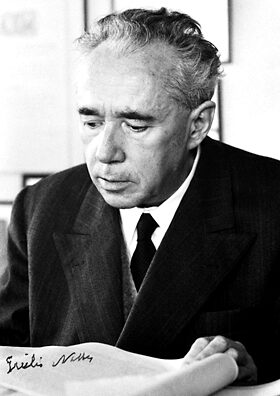
Giulio Natta
Giulio Natta was an Italian chemist. Born February 26, 1903, in Porto Maurizio. Died May 2, 1979, in Bergamo. Educated at Polytechnic University of Milan. Awards include Nobel Prize in Chemistry, Lomonosov Gold Medal and Knight Grand Cross of the Order of Merit of the Italian Republic.
Facts
29 facts · 2 confirmed by two sources · 7 cited · 20 from one source
Where this comes from
Papalocal keeps its own record. It started from these sources; what each one said is kept here as it was copied, so a change on their side never changes this page by itself. Tap one to read its version.
What Wikidata says · copied November 16, 2026 · revision 2567361721
- Described as
- Italian chemist
- Born
- February 26, 1903 · 10 references
- Died
- May 2, 1979 · 9 references
- Born in
- Porto Maurizio · 2 references
- Died in
- Bergamo · 1 reference
- Cause of death
- Parkinson's disease
- Citizen of
- Italy (1946–); Kingdom of Italy (–1946)
- Occupation
- chemist · 1 reference; inventor; university teacher
- Worked for
- Polytechnic University of Milan; Sapienza University of Rome · 1 reference; University of Pavia · 1 reference; University of Milan · 1 reference; Polytechnic University of Turin · 1 reference
- Education
- Polytechnic University of Milan
- Member of
- Academy of Sciences of the USSR; French Academy of Sciences; Russian Academy of Sciences; Accademia Nazionale delle Scienze detta dei XL; Academy of Sciences of Turin (1958–) · 1 reference; Accademia Nazionale dei Lincei (1947–) · 1 reference
- Awards
- Nobel Prize in Chemistry (1963) · 2 references; Lomonosov Gold Medal (1969) · 1 reference; Knight Grand Cross of the Order of Merit of the Italian Republic; John Scott Award (1963) · 1 reference; Lavoisier Medal (1963)
- Field
- organic chemistry
- Website
- http://www.giulionatta.it
- Wikipedias with a page
- 69
Wikidata item Q234145 (wikidata.org/wiki/Q234145), public domain (CC0). Copied November 16, 2026.
What Wikipedia says · copied November 16, 2026 · revision 1372000398
Giulio Natta (Italian: [ˈd͡ʒu.ljo ˈnat.ta]; 26 February 1903 – 2 May 1979) was an Italian chemical engineer and Nobel laureate. Natta's work at Politecnico di Milano led to the improvement of earlier work by Karl Ziegler and to the development of the Ziegler–Natta catalyst. The discoveries of Natta and Ziegler revolutionized polymer science by enabling the low-pressure, stereospecific polymerization of olefins, particularly propylene, into highly ordered, crystalline structures (isotactic polypropylene). This development allowed the production of high-strength plastics that were previously unobtainable. Natta won a Nobel Prize in Chemistry in 1963 with Karl Ziegler for his work on high density polymer. He also received a Lomonosov Gold Medal in 1969.
- Born, in its opening lines
- February 26, 1903
- Died, in its opening lines
- May 2, 1979
From the Wikipedia article “Giulio Natta” (en.wikipedia.org/wiki/Giulio_Natta), by its contributors, under CC BY-SA 4.0 (creativecommons.org/licenses/by-sa/4.0/). Copied November 16, 2026; not changed.
Confirmed Two sources agree. Cited One source, and it names where it got it. One source One source, without a reference of its own. Sources disagree The sources disagree. We show the best-supported value and keep theirs below.
