
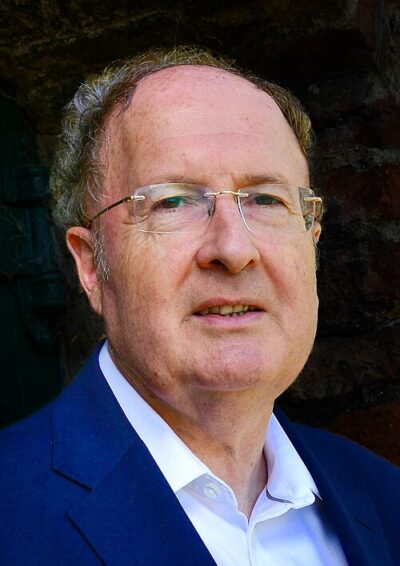
Greg Winter
Greg Winter is a British biochemist. Born April 14, 1951, in Leicester. Positions held include Master of Trinity College, Cambridge (2012–2019). Educated at Trinity College and Royal Grammar School. Awards include Commander of the Order of the British Empire, Royal Medal and Princess of Asturias Award for Technical and Scientific Research.
Facts
30 facts · 1 confirmed by two sources · 10 cited · 19 from one source
Where this comes from
Papalocal keeps its own record. It started from these sources; what each one said is kept here as it was copied, so a change on their side never changes this page by itself. Tap one to read its version.
What Wikidata says · copied November 16, 2026 · revision 2568909530
- Described as
- British biochemist (born 1951)
- Other names
- Sir Gregory Paul Winter
- Born
- April 14, 1951 · 2 references
- Born in
- Leicester · 1 reference
- Citizen of
- United Kingdom
- Occupation
- molecular biologist · 1 reference; engineer; biochemist; chemist; researcher
- Positions held
- Master of Trinity College, Cambridge (2012–2019)
- Worked for
- University of Cambridge
- Education
- Trinity College; Royal Grammar School
- Member of
- Australian Academy of Technology and Engineering; Royal Society of London (1990) · 1 reference
- Awards
- Commander of the Order of the British Empire (1996) · 1 reference; Royal Medal (2011); Princess of Asturias Award for Technical and Scientific Research (2012); Canada Gairdner International Award (2013); Emil-von-Behring-Prize (1990); William B. Coley Award (1999) · 1 reference; Wilhelm Exner Medal (2015) · 1 reference; Scheele Award (1994); King Faisal Prize in Medicine (1995); Knight Bachelor (2004) · 1 reference; Colworth Medal (1986); Nobel Prize in Chemistry (2018) · 1 reference; Fellow of the Australian Academy of Technology and Engineering (2002) · 1 reference; Fellow of the Academy of Medical Sciences (2006) · 2 references; Baly Medal (2005)
- Field
- biochemistry · 1 reference
- Wikipedias with a page
- 52
Wikidata item Q1545000 (wikidata.org/wiki/Q1545000), public domain (CC0). Copied November 16, 2026.
What Wikipedia says · copied November 16, 2026 · revision 1364582294
Sir Gregory Paul Winter (born 14 April 1951) is a Nobel Prize–winning British molecular biologist best known for his work on the therapeutic use of monoclonal antibodies. His research career has been based almost entirely at the MRC Laboratory of Molecular Biology and the MRC Centre for Protein Engineering, in Cambridge, England.
He is credited with the invention of techniques to both humanize (1986) and, later, to fully humanize using phage display, antibodies for therapeutic uses. Previously, antibodies had been derived from mice, which made them difficult to use in human therapeutics because the human immune system had anti-mouse reactions to them. For these developments Winter was awarded the 2018 Nobel Prize in Chemistry along with George Smith and Frances Arnold.
He is a Fellow of Trinity College, Cambridge and was appointed Master of Trinity College, Cambridge on 2 October 2012, remaining in office until 2019. From 2006 to 2011, he was Deputy Director of the Laboratory of Molecular Biology, Medical Research Council, acting Director from 2007 to 2008 and Head of the Division of Protein and Nucleic Acids Chemistry from 1994 to 2006. He was also Deputy Director of the MRC Centre for Protein Engineering from 1990 to its closure in 2010.
- Born, in its opening lines
- April 14, 1951
From the Wikipedia article “Gregory Winter” (en.wikipedia.org/wiki/Gregory_Winter), by its contributors, under CC BY-SA 4.0 (creativecommons.org/licenses/by-sa/4.0/). Copied November 16, 2026; not changed.
Confirmed Two sources agree. Cited One source, and it names where it got it. One source One source, without a reference of its own. Sources disagree The sources disagree. We show the best-supported value and keep theirs below.
