
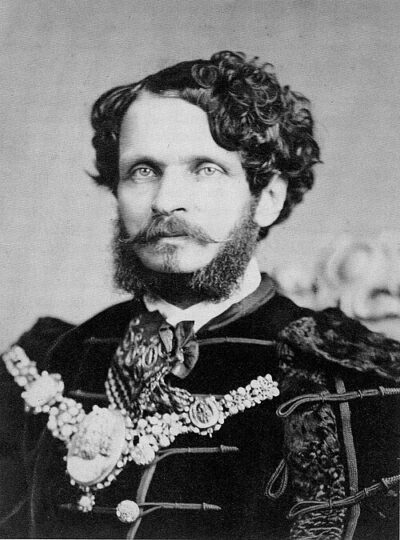
Gyula Andrássy
Gyula Andrássy was a Hungarian statesman. Born March 8, 1823, in Vlachovo. Died February 18, 1890, in Volosko. Positions held include member of the National Assembly of Hungary (1861), Prime Minister of Hungary (1867–1871) and lord-lieutenant of Zemplén County (1848–1849). Awards include Royal Order of the Seraphim, Order of St. Andrew and Knight Grand Cross of the Order of Saint Stephen of Hungary.
Facts
42 facts · 2 confirmed by two sources · 12 cited · 27 from one source · 1 where the sources disagree
What’s different
- Born in: we show Vlachovo (Sources disagree). Wikidata also lists Zemun
Where this comes from
Papalocal keeps its own record. It started from these sources; what each one said is kept here as it was copied, so a change on their side never changes this page by itself. Tap one to read its version.
What Wikidata says · copied November 16, 2026 · revision 2568730376
- Described as
- Hungarian statesman (1823–1890)
- Other names
- Gyula Count Andrássy de Csíkszentkirály et Krasznahorka, Gyula Andrassy, Gyula Count Andrassy de Csikszentkiraly et Krasznahorka, Count Andrássy, Count Andrassy
- Born
- March 8, 1823 · 4 references
- Died
- February 18, 1890 · 7 references
- Born in
- Vlachovo · 1 reference; Zemun · 1 reference
- Died in
- Volosko · 1 reference
- Buried in
- Trebišov
- Citizen of
- Hungary
- Occupation
- politician · 2 references; diplomat; economist; head of government · 1 reference; revolutionary · 1 reference; foreign minister · 1 reference
- Positions held
- member of the National Assembly of Hungary (1861) · 1 reference; Prime Minister of Hungary (1867–1871); lord-lieutenant of Zemplén County (1848–1849); foreign minister of Austria-Hungary (1871–1879); member of the lower house of Hungarian Diet (1847–1848); Finance Minister of Austria-Hungary (2 times) (1871–1876) · 1 reference
- Political party
- Deák Party
- Member of
- Hungarian Academy of Sciences (1876–); Freemasonry · 1 reference
- Awards
- Royal Order of the Seraphim; Order of St. Andrew; Knight Grand Cross of the Order of Saint Stephen of Hungary; Order of the Most Holy Annunciation; Knight Grand Cross of the Order of Saints Maurice and Lazarus; Knight grand cross of the order of the crown of Italy; Order of the Golden Fleece · 1 reference; Knight of the Order of St. Alexander Nevsky · 1 reference; Knight Grand Cross in the Order of the Netherlands Lion (1874) · 1 reference
- Spouse
- Katinka Kendeffy (1856–) · 1 reference
- Children
- Gyula Andrássy the Younger · 1 reference; Manó Andrássy · 1 reference; Tivadar Andrássy · 2 references; Ilona Andrássy · 1 reference
- Father
- Károly Andrássy · 1 reference
- Mother
- Etelka Szapáry
- Siblings
- Manó Andrássy · 1 reference; Aladár Andrássy · 1 reference; Kornélia Andrássy de Csíkszentkirály et Krasznahorka · 1 reference
- Religion
- Catholic Church
- Military rank
- general
- Wikipedias with a page
- 45
Wikidata item Q313557 (wikidata.org/wiki/Q313557), public domain (CC0). Copied November 16, 2026.
What Wikipedia says · copied November 16, 2026 · revision 1352633407
Count Gyula Andrássy de Csíkszentkirály et Krasznahorka (Hungarian: [ˈɒndraːʃi ˈɟulɒ], 8 March 1823 – 18 February 1890) was a Hungarian statesman, who served as Prime Minister of Hungary (1867–1871) and subsequently as Foreign Minister of Austria-Hungary (1871–1879). Andrássy was a conservative; his foreign policies looked to expanding the Empire into Southeast Europe, preferably with British and German support, and without alienating Turkey. He saw Russia as the main adversary, because of its own expansionist policies toward Slavic and Orthodox areas. He distrusted Slavic nationalist movements as a threat to his multi-ethnic empire.
- Born, in its opening lines
- March 8, 1823
- Died, in its opening lines
- February 18, 1890
From the Wikipedia article “Gyula Andrássy” (en.wikipedia.org/wiki/Gyula_Andrássy), by its contributors, under CC BY-SA 4.0 (creativecommons.org/licenses/by-sa/4.0/). Copied November 16, 2026; not changed.
Confirmed Two sources agree. Cited One source, and it names where it got it. One source One source, without a reference of its own. Sources disagree The sources disagree. We show the best-supported value and keep theirs below.
