
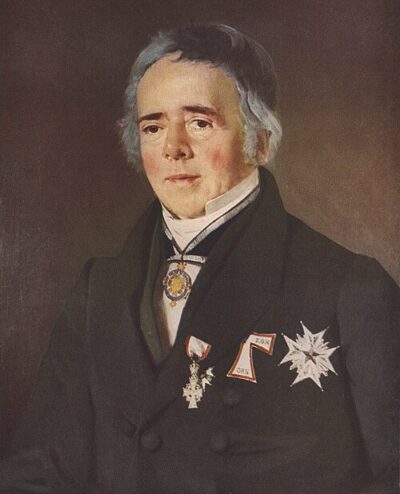
Hans Christian Ørsted
Hans Christian Ørsted was a Danish physicist and chemist. Born August 14, 1777, in Rudkøbing. Died March 9, 1851, in Copenhagen. Positions held include rector (2 times) (1825–1851). Known for electromagnetism. Educated at University of Copenhagen and University of Jena. Awards include Copley Medal, Pour le Mérite for Sciences and Arts order and Fellow of the Royal Society of Edinburgh.
Facts
45 facts · 2 confirmed by two sources · 13 cited · 30 from one source
Where this comes from
Papalocal keeps its own record. It started from these sources; what each one said is kept here as it was copied, so a change on their side never changes this page by itself. Tap one to read its version.
What Wikidata says · copied November 16, 2026 · revision 2567361864
- Described as
- Danish physicist and chemist (1777-1851)
- Other names
- Hans Christian Oersted
- Born
- August 14, 1777 · 10 references
- Died
- March 9, 1851 · 9 references
- Born in
- Rudkøbing
- Died in
- Copenhagen · 1 reference
- Buried in
- Assistens Cemetery · 1 reference
- Citizen of
- Kingdom of Denmark · 1 reference
- Occupation
- physicist · 1 reference; chemist · 1 reference; inventor; university teacher; engineer; pharmacist · 1 reference
- Positions held
- rector (2 times) (1825–1851)
- Worked for
- University of Copenhagen; Technical University of Denmark
- Education
- University of Copenhagen · 1 reference; University of Jena · 1 reference
- Member of
- Royal Society of London (1821–); Royal Swedish Academy of Sciences; Bavarian Academy of Sciences and Humanities; American Academy of Arts and Sciences; Royal Prussian Academy of Sciences; Royal Society of Edinburgh; Accademia Nazionale delle Scienze detta dei XL; Royal Danish Academy of Sciences and Letters (1808–1851); Göttingen Academy of Sciences and Humanities in Lower Saxony
- Known for
- electromagnetism · 1 reference
- Awards
- Copley Medal (1820) · 1 reference; Pour le Mérite for Sciences and Arts order; Fellow of the Royal Society of Edinburgh; Fellow of the American Academy of Arts and Sciences; Foreign Member of the Royal Society (1821) · 1 reference; Knight of the Order of the Dannebrog (1815) · 1 reference; Decoration of the Cross of Honour of the Dannebrog (1824) · 1 reference; commander of the Order of the Dannebrog (1836) · 1 reference; Grand Cross of the Order of the Dannebrog (1847) · 1 reference; honorary member of the Physics Association (Frankfurt am Main, Germany) (1839)
- Field
- physics · 2 references
- Spouse
- Inger Birgitte Ørsted (1814–1851)
- Children
- Karen Scharling; Albert Nicolai Ørsted; Anders Sandøe Ørsted · 1 reference
- Siblings
- Anders Sandøe Ørsted · 1 reference; Jacob Albert Ørsted
- Religion
- Eastern Orthodoxy
- Wikipedias with a page
- 99
Wikidata item Q44412 (wikidata.org/wiki/Q44412), public domain (CC0). Copied November 16, 2026.
What Wikipedia says · copied November 16, 2026 · revision 1372002843
Hans Christian Ørsted (Danish: [ˈɶɐ̯steð] ; 14 August 1777 – 9 March 1851), sometimes transliterated as Oersted ( UR-sted), was a Danish chemist and physicist who discovered that electric currents create magnetic fields. This phenomenon is known as Oersted's law. He also discovered aluminium, a chemical element.
A leader of the Danish Golden Age, Ørsted was a close friend of Hans Christian Andersen and the brother of politician and jurist Anders Sandøe Ørsted, who served as Prime Minister of Denmark from 1853 to 1854.
- Born, in its opening lines
- August 14, 1777
- Died, in its opening lines
- March 9, 1851
From the Wikipedia article “Hans Christian Ørsted” (en.wikipedia.org/wiki/Hans_Christian_Ørsted), by its contributors, under CC BY-SA 4.0 (creativecommons.org/licenses/by-sa/4.0/). Copied November 16, 2026; not changed.
Confirmed Two sources agree. Cited One source, and it names where it got it. One source One source, without a reference of its own. Sources disagree The sources disagree. We show the best-supported value and keep theirs below.
