
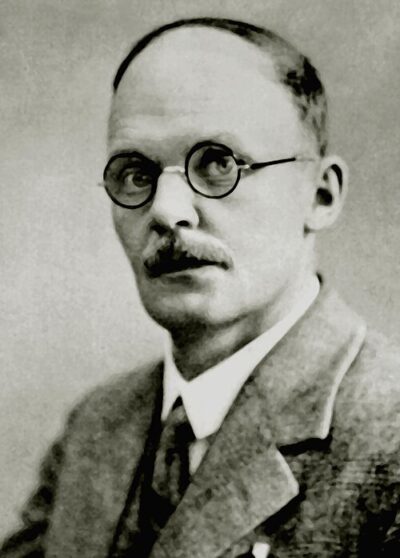
Hans Geiger
Hans Geiger was a German physicist. Born September 30, 1882, in Neustadt an der Weinstraße. Died September 24, 1945, in Potsdam. Known for Geiger counter. Educated at University of Erlangen–Nuremberg. Awards include Hughes Medal and Dennis Gabor Medal and Prize.
Facts
34 facts · 2 confirmed by two sources · 16 cited · 15 from one source · 1 where the sources disagree
What’s different
- Buried in: we show Grünwald Woodland Cemetery (Sources disagree). Wikidata also lists New Cemetery, Potsdam
Where this comes from
Papalocal keeps its own record. It started from these sources; what each one said is kept here as it was copied, so a change on their side never changes this page by itself. Tap one to read its version.
What Wikidata says · copied November 16, 2026 · revision 2569004126
- Described as
- German physicist (1882–1945)
- Other names
- H. Geiger, Johannes Wilhelm Geiger, Hans Gengar
- Born
- September 30, 1882 · 9 references
- Died
- September 24, 1945 · 8 references
- Born in
- Neustadt an der Weinstraße · 1 reference
- Died in
- Potsdam · 1 reference
- Buried in
- New Cemetery, Potsdam; Grünwald Woodland Cemetery · 1 reference
- Name at birth
- Johannes Wilhelm Geiger
- Citizen of
- German Empire; Weimar Republic (1918–1933); Nazi Germany (1933–)
- Occupation
- physicist · 1 reference; inventor; university teacher · 1 reference; nuclear physicist; laboratory director (1936–) · 1 reference; scientist · 1 reference
- Worked for
- University of Tübingen (1929–); Kiel University (1925–); Technische Universität Berlin (1936–) · 1 reference; Humboldt-Universität zu Berlin · 1 reference; Physikalisch-Technische Reichsanstalt (1912–); University of Manchester (1907–) · 1 reference; Physikalisch-Technische Bundesanstalt
- Education
- University of Erlangen–Nuremberg
- Member of
- Saxon Academy of Sciences and Humanities (1932–); German Academy of Sciences Leopoldina (1935–) · 1 reference; Royal Prussian Academy of Sciences (1936–) · 1 reference; German nuclear program during World War II (1939–) · 1 reference; Göttingen Academy of Sciences and Humanities in Lower Saxony
- Known for
- Geiger counter · 1 reference
- Awards
- Hughes Medal (1929) · 1 reference; Dennis Gabor Medal and Prize (1937) · 1 reference
- Field
- physics
- Father
- Wilhelm Geiger · 1 reference
- Siblings
- Rudolf Geiger · 1 reference
- Wikipedias with a page
- 58
Wikidata item Q57189 (wikidata.org/wiki/Q57189), public domain (CC0). Copied November 16, 2026.
What Wikipedia says · copied November 16, 2026 · revision 1378728691
Johannes "Hans" Wilhelm Geiger (30 September 1882 – 24 September 1945) was a German experimental physicist. He is known as the inventor of the Geiger counter, a device used to detect ionizing radiation, and for carrying out the Rutherford scattering experiments, which led to the discovery of the atomic nucleus. He also performed the Bothe–Geiger coincidence experiment, which confirmed the conservation of energy in light-particle interactions.
He was the brother of meteorologist and climatologist Rudolf Geiger.
- Born, in its opening lines
- September 30, 1882
- Died, in its opening lines
- September 24, 1945
From the Wikipedia article “Hans Geiger” (en.wikipedia.org/wiki/Hans_Geiger), by its contributors, under CC BY-SA 4.0 (creativecommons.org/licenses/by-sa/4.0/). Copied November 16, 2026; not changed.
Confirmed Two sources agree. Cited One source, and it names where it got it. One source One source, without a reference of its own. Sources disagree The sources disagree. We show the best-supported value and keep theirs below.
