
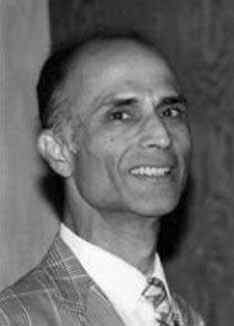
Harish-Chandra
Harish-Chandra was an Indian American mathematician and physicist. Born October 11, 1923, in Kanpur. Died October 16, 1983, in Princeton. Known for Harish-Chandra homomorphism, Harish-Chandra character and Harish-Chandra module. Educated at Christ Church College, Kanpur and University of Allahabad. Awards include Cole Prize in Algebra, Guggenheim Fellowship and Fellow of the Royal Society.
Facts
40 facts · 2 confirmed by two sources · 19 cited · 19 from one source
Where this comes from
Papalocal keeps its own record. It started from these sources; what each one said is kept here as it was copied, so a change on their side never changes this page by itself. Tap one to read its version.
What Wikidata says · copied November 15, 2026 · revision 2567382728
- Described as
- Indian American mathematician and physicist (1923–1983)
- Other names
- Harish-Chandra Mehrotra
- Born
- October 11, 1923 · 2 references
- Died
- October 16, 1983 · 1 reference
- Born in
- Kanpur
- Died in
- Princeton · 1 reference
- Name at birth
- हरीश चंद्र महरोत्रा
- Citizen of
- British Raj (–1947); India (1950–); United States (1980–); Dominion of India (1947–1950)
- Occupation
- mathematician · 1 reference; physicist; university teacher
- Worked for
- Institute for Advanced Study (2 times) (1947–1983) · 1 reference; Harvard University (1949–1950) · 1 reference; Columbia University (1950–1963) · 1 reference
- Education
- Christ Church College, Kanpur (1932–1939) · 1 reference; University of Allahabad (1939–1943) · 1 reference; Indian Institute of Science, Bengaluru (1943–1944) · 1 reference; Gonville and Caius College (1945–1947) · 1 reference; University of Cambridge (–1947) · 1 reference
- Member of
- Royal Society of London (1973–); National Academy of Sciences
- Known for
- Harish-Chandra homomorphism; Harish-Chandra character; Harish-Chandra module; Harish-Chandra integral; Harish-Chandra class; Harish-Chandra transform; Borel-Harish-Chandra theorem; Harish-Chandra isomorphism
- Awards
- Cole Prize in Algebra (1954) · 1 reference; Guggenheim Fellowship (1957) · 1 reference; Fellow of the Royal Society (1973) · 1 reference; Srinivasa Ramanujan Medal (1974) · 1 reference; Padma Bhushan (1977) · 1 reference
- Field
- representation theory · 1 reference; harmonic analysis · 1 reference; Lie group · 1 reference
- Siblings
- Satish Chandra · 1 reference
- Lived in
- Princeton · 1 reference
- Wikipedias with a page
- 27
Wikidata item Q1585395 (wikidata.org/wiki/Q1585395), public domain (CC0). Copied November 15, 2026.
What Wikipedia says · copied November 15, 2026 · revision 1378810733
Harish-Chandra (né Harishchandra) FRS (11 October 1923 – 16 October 1983) was an Indian-American mathematician and physicist who did fundamental work in representation theory, especially harmonic analysis on semisimple Lie groups.
- Born, in its opening lines
- October 11, 1923
- Died, in its opening lines
- October 16, 1983
From the Wikipedia article “Harish-Chandra” (en.wikipedia.org/wiki/Harish-Chandra), by its contributors, under CC BY-SA 4.0 (creativecommons.org/licenses/by-sa/4.0/). Copied November 15, 2026; not changed.
Confirmed Two sources agree. Cited One source, and it names where it got it. One source One source, without a reference of its own. Sources disagree The sources disagree. We show the best-supported value and keep theirs below.
