
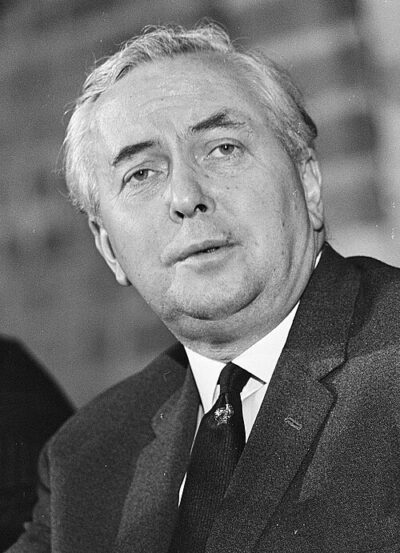
Harold Wilson
Harold Wilson was a Prime Minister of the United Kingdom from 1964-1970 and 1974-1976. Born March 11, 1916, in Huddersfield. Died May 24, 1995, in London. Positions held include Prime Minister of the United Kingdom (2 times) (1964–1976), Leader of the Opposition (2 times) (1963–1974) and Leader of the Labour Party (1963–1976). Educated at Jesus College and Wirral Grammar School for Boys. Awards include Officer of the Order of the British Empire, honorary doctor of the Bar-Ilan University and Order of the Garter.
Facts
44 facts · 1 confirmed by two sources · 16 cited · 25 from one source · 2 where the sources disagree
What’s different
- Died: we show May 24, 1995 (Sources disagree). Wikipedia says May 23, 1995
- Cause of death: we show colorectal cancer (Sources disagree). Wikidata also lists Alzheimer's disease
Where this comes from
Papalocal keeps its own record. It started from these sources; what each one said is kept here as it was copied, so a change on their side never changes this page by itself. Tap one to read its version.
What Wikidata says · copied November 16, 2026 · revision 2562947473
- Described as
- Prime Minister of the United Kingdom from 1964-1970 and 1974-1976 (1916–1995)
- Other names
- James Harold Wilson, James Harold Wilson, Baron Wilson of Rievaulx
- Born
- March 11, 1916 · 10 references
- Died
- May 24, 1995 · 9 references
- Born in
- Huddersfield · 2 references
- Died in
- London · 1 reference
- Buried in
- Cornwall
- Cause of death
- colorectal cancer; Alzheimer's disease
- Citizen of
- United Kingdom
- Occupation
- politician · 2 references; Esperantist; statistician
- Positions held
- Prime Minister of the United Kingdom (2 times) (1964–1976); Leader of the Opposition (2 times) (1963–1974); Leader of the Labour Party (1963–1976); Shadow Foreign Secretary (1961–1963); Shadow Chancellor of the Exchequer (1955–1961); President of the Board of Trade (1947–1951); Secretary for Overseas Trade (1947); Member of the Privy Council of the United Kingdom; member of the 48th Parliament of the United Kingdom (1979–1983) · 1 reference; member of the 47th Parliament of the United Kingdom (1974–1979) · 1 reference; member of the 46th Parliament of the United Kingdom (1974) · 1 reference; member of the 45th Parliament of the United Kingdom (1970–1974) · 1 reference; member of the 44th Parliament of the United Kingdom (1966–1970) · 1 reference; member of the 43rd Parliament of the United Kingdom (1964–1966) · 1 reference; member of the 42nd Parliament of the United Kingdom (1959–1964) · 1 reference
- Political party
- Labour Party
- Worked for
- University of Oxford
- Education
- Jesus College; Wirral Grammar School for Boys · 1 reference
- Member of
- Royal Society of London; Royal Statistical Society
- Awards
- Officer of the Order of the British Empire; honorary doctor of the Bar-Ilan University; Order of the Garter; Financial Times Person of the Year (1974); honorary doctorate (1974) · 1 reference
- Field
- politics · 1 reference
- Spouse
- Mary Wilson, Baroness Wilson of Rievaulx (1940–1995) · 1 reference
- Children
- Robin Wilson; Giles Wilson · 1 reference
- Father
- James Herbert Wilson · 1 reference
- Mother
- Ethel Seddon · 1 reference
- Religion
- Congregational churches; congregationalist polity
- Wikipedias with a page
- 94
Wikidata item Q128956 (wikidata.org/wiki/Q128956), public domain (CC0). Copied November 16, 2026.
What Wikipedia says · copied November 16, 2026 · revision 1385362945
James Harold Wilson, Baron Wilson of Rievaulx (11 March 1916 – 23 May 1995), was a British statesman who served as Prime Minister of the United Kingdom from 1964 to 1970 and from 1974 to 1976, the most recent person to serve in the position for two non-consecutive terms. He was Leader of the Labour Party from 1963 to 1976, Leader of the Opposition twice — from 1963 to 1964 and from 1970 to 1974 — and a Member of Parliament (MP) from 1945 to 1983. Wilson is the only Labour leader to have formed a government after a general election four separate times.
Born in Huddersfield, West Riding of Yorkshire, to a politically active lower middle-class family, Wilson studied philosophy, politics and economics at Jesus College, Oxford. He was later an Economic History lecturer at New College, Oxford, and a research fellow at University College, Oxford. Elected to Parliament in 1945, Wilson was appointed to the Attlee government as a Parliamentary secretary; he became Secretary for Overseas Trade in 1947, and was elevated to the Cabinet shortly thereafter as President of the Board of Trade. Following Labour's defeat at the 1955 election, Wilson joined the Shadow Cabinet as Shadow Chancellor, and was moved to the role of Shadow Foreign Secretary in 1961. When Labour leader Hugh Gaitskell died in January 1963, Wilson won the leadership election to replace him, becoming Leader of the Opposition.
Wilson led Labour first to a narrow victory in the 1964 election, and then with an increased majority in 1966. During this period, Britain enjoyed low unemployment and economic prosperity, but also a persistent balance of payments deficit that forced Wilson to devalue the pound in 1967. His government oversaw significant societal changes, abolishing both capital punishment and theatre censorship, partially decriminalising male homosexuality in England and Wales, relaxing divorce laws, limiting immigration, outlawing racial discrimination, and liberalising birth control and abortion law. Meanwhile, the steel sector was effectively nationalised and the Ministry of Technology established to promote science in industry. In response to the intensifying sectarian violence in Northern Ireland, Wilson sent over British troops to contain the violence in 1969, which contributed to escalating the Troubles.
After unexpectedly losing the 1970 election to Edward Heath's Conservatives, Wilson remained as leader of the party, resuming the role of Leader of the Opposition for another four years. The February 1974 election resulted in a hung parliament, and after coalition talks failed between the Conservatives and Liberal Party Wilson was appointed prime minister for a second time on 4 March. He called a snap election eight months later, which gave Labour a small majority. During his second government, he oversaw the referendum that confirmed the UK's membership of the European Communities, the creation of the Northern Ireland Constitutional Convention as a step toward devolution, and the refusal to commit British troops in the Vietnam War, but also worsening economic conditions and rising pressure on sterling. On 5 April 1976, Wilson suddenly stepped down as prime minister, citing his steadily worsening mental and physical health. He was succeeded by Foreign Secretary James Callaghan. Wilson remained in the House of Commons until retiring in 1983, when he was elevated to the House of Lords as Lord Wilson of Rievaulx. Suffering from Alzheimer's disease, he maintained a relatively low profile in his later years until his death in May 1995.
While seen by admirers as leading the Labour Party through difficult political issues with considerable skill, Wilson's reputation was low when he left office, and is still disputed in historiography. Some scholars praise his unprecedented electoral success for a Labour prime minister and holistic approach to governance, while others criticise his political style and handling of economic issues. His stated ambitions of substantially improving Britain's long-term economic performance, reducing inequality and applying technology more democratically were to some extent unfulfilled.
- Born, in its opening lines
- March 11, 1916
- Died, in its opening lines
- May 23, 1995
From the Wikipedia article “Harold Wilson” (en.wikipedia.org/wiki/Harold_Wilson), by its contributors, under CC BY-SA 4.0 (creativecommons.org/licenses/by-sa/4.0/). Copied November 16, 2026; not changed.
Confirmed Two sources agree. Cited One source, and it names where it got it. One source One source, without a reference of its own. Sources disagree The sources disagree. We show the best-supported value and keep theirs below.
