
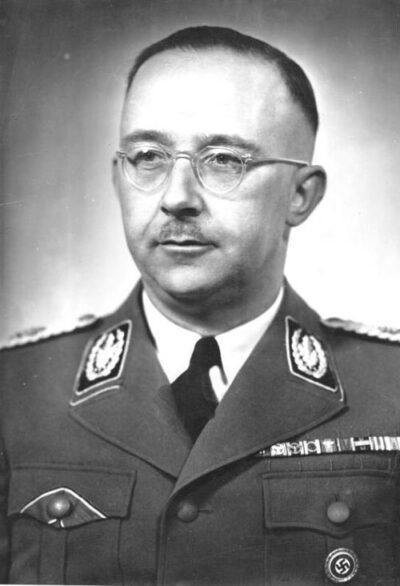
Heinrich Himmler
Heinrich Himmler was a German Nazi politician; leader of the German SS & main architect of the Holocaust. Born October 7, 1900, in Munich. Died May 23, 1945, in Lüneburg. Positions held include Reichsführer-SS (1934–), member of the Reichstag of the Weimar Republic and member of the Reichstag of Nazi Germany. Educated at Technical University of Munich and Wilhelmsgymnasium. Awards include Grand Cross of the Imperial Order of the Red Arrows, Knight grand cross of the order of the crown of Italy and Order of the Sacred Treasure, 1st Class.
Facts
71 facts · 2 confirmed by two sources · 26 cited · 43 from one source
Where this comes from
Papalocal keeps its own record. It started from these sources; what each one said is kept here as it was copied, so a change on their side never changes this page by itself. Tap one to read its version.
What Wikidata says · copied November 16, 2026 · revision 2568712650
- Described as
- German Nazi politician; leader of the German SS & main architect of the Holocaust (1900-1945)
- Other names
- Heinrich Hitzinger, Himmler, Heinrich Luitpold Himmler Yaker
- Born
- October 7, 1900 · 15 references
- Died
- May 23, 1945 · 15 references
- Born in
- Munich · 4 references
- Died in
- Lüneburg · 3 references
- Buried in
- Lüneburg Heath · 3 references
- Cause of death
- cyanide poisoning · 2 references
- Name at birth
- Heinrich Luitpold Himmler · 1 reference
- Citizen of
- Nazi Germany (1923–); Weimar Republic (1915–1937); German Empire (–1918)
- Occupation
- politician · 2 references; farmer · 2 references; occultist; laboratory technician; Gestapo employee; Holocaust perpetrator · 1 reference; Diplomlandwirt · 1 reference; Fahnenjunker · 1 reference
- Positions held
- Reichsführer-SS (1934–) · 1 reference; member of the Reichstag of the Weimar Republic; member of the Reichstag of Nazi Germany; chief of police (1933–); Chief of Army Equipment and Commander of the Replacement Army (1944–); Reichsminister des Innern (1943–1945); Chief of Staff; Chef der Sicherheitspolizei und des SD (1942–1943)
- Political party
- Nazi Party (1923–1945) · 1 reference; National Socialist Freedom Movement (1924–1925); Bavarian People's Party (1919–1923)
- Worked for
- Gestapo
- Education
- Technical University of Munich (1919–1922); Wilhelmsgymnasium; Hans-Carossa-Gymnasium (–1919)
- Member of
- Sturmabteilung (1925); Thule Society; Schutzstaffel (1925–); Bund Reichskriegsflagge; Münchener Burschenschaft Franco-Bavaria (1919–) · 1 reference; Freikorps Oberland · 1 reference; Artaman League; Altreichsflagge (–1926); Dirksen-Stiftung (1933–); Academy for German Law (1933–)
- Awards
- Grand Cross of the Imperial Order of the Red Arrows (1939) · 2 references; Knight grand cross of the order of the crown of Italy; Order of the Sacred Treasure, 1st Class · 1 reference; Rad kniežaťa Pribinu vojnovej SR 1939-45 · 1 reference; Order of the Crown of King Zvonimir · 1 reference; Grand Cross of the Order of the Cross of Liberty (2 times) (1940, 1942) · 1 reference; Golden Hitler Youth Badge with Oakleaves (1939) · 1 reference; German Legion of Honor (1920) · 1 reference; Nuremberg Party Day Badge (2 times) (1927, 1929) · 1 reference; Brunswick Rally Badge · 1 reference; SS-Ehrenring (1933) · 1 reference; Honour Chevron for the Old Guard (1934) · 1 reference; Blood Order (1934) · 1 reference; Golden Party Badge (1934) · 1 reference; Honour Cross of the World War 1914/1918 (1934) · 1 reference
- Spouse
- Margarete Himmler (1928–1945) · 3 references
- Children
- Gudrun Burwitz · 2 references
- Father
- Joseph Gebhard Himmler · 1 reference
- Mother
- Anna Heyder · 1 reference
- Siblings
- Gebhard Ludwig Himmler · 1 reference; Ernst Hermann Himmler
- Religion
- lapsed Catholic
- Military branch
- Imperial German Army
- Military rank
- Reichsführer-SS
- Lived in
- Maxvorstadt; Amalienstraße (–1913); Landshut (1913–)
- Height
- 1.76 m (5 ft 9 in)
- Wikipedias with a page
- 121
Wikidata item Q43067 (wikidata.org/wiki/Q43067), public domain (CC0). Copied November 16, 2026.
What Wikipedia says · copied November 16, 2026 · revision 1382018314
Heinrich Luitpold Himmler (German: [ˈhaɪnʁɪç ˈluːɪtpɔlt ˈhɪmlɐ] ; 7 October 1900 – 23 May 1945) was a German Nazi politician, police administrator, and military leader. He was the fourth and longest-serving Reichsführer of the Schutzstaffel (Protection Squadron; SS), serving from 1929 to 1945. He was a leading member of the Nazi Party and one of the most powerful figures in Nazi Germany. He was also one of the main architects of the Holocaust, the genocide of European Jews during World War II.
After serving in a reserve battalion during World War I without seeing combat, Himmler joined the Nazi Party in 1923. In 1925, he joined the SS, which was initially a small paramilitary arm of the Nazi Party that served as a bodyguard unit for Adolf Hitler. Himmler rose steadily through the SS's ranks to become Reichsführer-SS by 1929. Under Himmler's leadership, the SS grew from a 290-man battalion into one of the most powerful institutions in Nazi Germany. Over the course of his career, Himmler acquired a reputation for good organisational skills and for selecting highly competent subordinates, such as Reinhard Heydrich. From 1943 onwards, he was both Chief of the Kriminalpolizei (Criminal Police) and Minister of the Interior, which gave him oversight of all police and security forces (including the Gestapo). He also controlled the Waffen-SS, a branch of the SS that served in combat alongside the Wehrmacht (Germany's armed forces) in World War II.
As the principal enforcer of the Nazis' racial policies, Himmler was responsible for operating concentration and extermination camps as well as forming the Einsatzgruppen death squads in German-occupied Europe. In this capacity, he played a central role in the genocide of an estimated 5.5–6 million Jews and the deaths of millions of other victims during the Holocaust. A day before the launch of Operation Barbarossa in June 1941, Himmler commissioned the drafting of Generalplan Ost, which was approved by Hitler in May 1942 and implemented by the Nazi regime, resulting in the deaths of approximately 14 million people in Eastern Europe.
In the last years of World War II, Hitler appointed Himmler as Commander of the Replacement Army and General Plenipotentiary for the administration of the Third Reich (Generalbevollmächtigter für die Verwaltung). He was later given command of the Army Group Upper Rhine and the Army Group Vistula. He failed to achieve his assigned objectives, and Hitler replaced him in these posts. Realising the war was lost, Himmler attempted, without Hitler's knowledge, to open peace talks with the western Allies in March 1945. When Hitler learned of this on 28 April, he dismissed Himmler from all his posts and ordered his arrest. Himmler attempted to go into hiding but was captured by British forces. He committed suicide in British custody on 23 May 1945.
- Born, in its opening lines
- October 7, 1900
- Died, in its opening lines
- May 23, 1945
From the Wikipedia article “Heinrich Himmler” (en.wikipedia.org/wiki/Heinrich_Himmler), by its contributors, under CC BY-SA 4.0 (creativecommons.org/licenses/by-sa/4.0/). Copied November 16, 2026; not changed.
Confirmed Two sources agree. Cited One source, and it names where it got it. One source One source, without a reference of its own. Sources disagree The sources disagree. We show the best-supported value and keep theirs below.
