
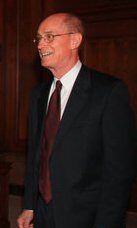
Henry Eyring
Henry Eyring was a Mexican-born American theoretical chemist. Born February 20, 1901, in Colonia Juárez. Died December 26, 1981, in Salt Lake City. Educated at University of Arizona and University of California, Berkeley. Awards include Bingham Medal, William H. Nichols Medal and Remsen Award.
Facts
36 facts · 2 confirmed by two sources · 18 cited · 16 from one source
Where this comes from
Papalocal keeps its own record. It started from these sources; what each one said is kept here as it was copied, so a change on their side never changes this page by itself. Tap one to read its version.
What Wikidata says · copied November 16, 2026 · revision 2567143824
- Described as
- Mexican-born American theoretical chemist (1901-1981)
- Other names
- Henry D Eyring, Henry D. Eyring, H. D. Eyring, H D Eyring, H. Eyring, H Eyring, Eyring, Eyring H, Eyring H., Eyring H. E., Eyring HE
- Born
- February 20, 1901 · 4 references
- Died
- December 26, 1981 · 3 references
- Born in
- Colonia Juárez · 2 references
- Died in
- Salt Lake City · 2 references
- Buried in
- Berlin
- Citizen of
- United States · 2 references
- Occupation
- chemist · 3 references; university teacher · 1 reference
- Worked for
- Princeton University; University of Utah
- Education
- University of Arizona; University of California, Berkeley; Eastern Arizona College
- Member of
- German Academy of Sciences Leopoldina · 1 reference; International Academy of Quantum Molecular Science; American Academy of Arts and Sciences; National Academy of Sciences; American Philosophical Society (1941–)
- Awards
- Bingham Medal (1949) · 1 reference; William H. Nichols Medal (1951) · 1 reference; Remsen Award (1960) · 1 reference; Peter Debye Award in Physical Chemistry (1964) · 1 reference; National Medal of Science (1966); Willard Gibbs Award (1968) · 1 reference; Irving Langmuir Award in Chemical Physics (1968) · 1 reference; Linus Pauling Award (1969) · 1 reference; Elliott Cresson Medal (1969) · 1 reference; Priestley Medal (1975) · 1 reference; honorary doctorate from University of Paris-XI (1978) · 2 references; Wolf Prize in Chemistry (1980) · 1 reference
- Field
- physical chemistry
- Children
- Henry B. Eyring; Ted Eyring · 1 reference
- Lived in
- El Paso; United States; Chihuahua
- Wikipedias with a page
- 23
Wikidata item Q574810 (wikidata.org/wiki/Q574810), public domain (CC0). Copied November 16, 2026.
What Wikipedia says · copied November 16, 2026 · revision 1366941225
Henry Eyring (February 20, 1901 – December 26, 1981) was a Mexico-born United States theoretical chemist whose primary contribution was in the study of chemical reaction rates and intermediates.
Eyring developed the absolute rate theory or transition state theory (TST) of chemical reactions, connecting the fields of chemistry and physics through atomic theory, quantum theory, and statistical mechanics.
- Born, in its opening lines
- February 20, 1901
- Died, in its opening lines
- December 26, 1981
From the Wikipedia article “Henry Eyring (chemist)” (en.wikipedia.org/wiki/Henry_Eyring_(chemist)), by its contributors, under CC BY-SA 4.0 (creativecommons.org/licenses/by-sa/4.0/). Copied November 16, 2026; not changed.
Confirmed Two sources agree. Cited One source, and it names where it got it. One source One source, without a reference of its own. Sources disagree The sources disagree. We show the best-supported value and keep theirs below.
