
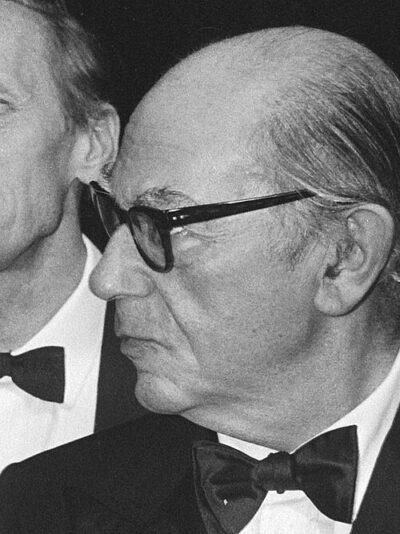
Isaiah Berlin
Isaiah Berlin was a Russo-British-Latvian Jewish social and political theorist, philosopher and historian of ideas. Born June 6, 1909, in Riga. Died November 5, 1997, in Acland Hospital. Known for Two Concepts of Liberty. Educated at Corpus Christi College and St Paul's School. Awards include Commander of the Order of the British Empire, Erasmus Prize and Jerusalem Prize.
Facts
40 facts · 2 confirmed by two sources · 15 cited · 23 from one source
Where this comes from
Papalocal keeps its own record. It started from these sources; what each one said is kept here as it was copied, so a change on their side never changes this page by itself. Tap one to read its version.
What Wikidata says · copied November 16, 2026 · revision 2559784683
- Described as
- Russo-British-Latvian Jewish social and political theorist, philosopher and historian of ideas (1909–1997)
- Other names
- Sir Isaiah Berlin, Isaiah Mendelevich Berlin
- Born
- June 6, 1909 · 9 references
- Died
- November 5, 1997 · 9 references
- Born in
- Riga · 3 references
- Died in
- Acland Hospital · 1 reference
- Buried in
- Wolvercote Cemetery
- Name at birth
- Jesaja Berlins
- Citizen of
- United Kingdom (1929–) · 2 references; Russian Empire (1909–)
- Occupation
- philosopher · 3 references; historian; university teacher · 2 references; diplomat; historian of ideas · 1 reference; sociologist · 2 references; political scientist · 2 references
- Worked for
- University of Oxford
- Education
- Corpus Christi College; St Paul's School · 1 reference
- Member of
- American Academy of Arts and Sciences; British Academy (1957–) · 1 reference; American Philosophical Society (1975–)
- Known for
- Two Concepts of Liberty
- Awards
- Commander of the Order of the British Empire; Erasmus Prize (1983) · 1 reference; Jerusalem Prize (1979); honorary doctor of Tel Aviv University; honorary doctorate from the University of Cambridge; Honorary doctor of the University of Oxford; honorary doctor of Harvard University (1979) · 1 reference; Honorary doctor of the University of Bologna; honorary doctor of the University of Athens; Honorary doctorate from University of Toronto; Fellow of the British Academy; Fellow of the American Academy of Arts and Sciences; Knight Bachelor; Order of Merit; Benjamin E. Lippincott Award (1984) · 1 reference
- Field
- philosophy
- Father
- Menachem Mendel Berlin · 1 reference
- Mother
- Marie Moosa Berlin · 1 reference
- Wikipedias with a page
- 80
Wikidata item Q205162 (wikidata.org/wiki/Q205162), public domain (CC0). Copied November 16, 2026.
What Wikipedia says · copied November 16, 2026 · revision 1384356757
Sir Isaiah Berlin (6 June 1909 – 5 November 1997) was a British social and political theorist, philosopher, and historian of ideas.
Born into a Russian-Jewish family in Riga, he moved to Petrograd at the age of six, where he witnessed the Russian Revolution. In 1921, his family moved to England, and he was educated at St Paul's School, London, and Corpus Christi College, Oxford. In 1932, at the age of 23, Berlin was elected to a prize fellowship at All Souls College, Oxford. In addition to his own output, he translated works by Ivan Turgenev from Russian into English. During the Second World War he worked for the British Diplomatic Service.
From 1957 to 1967 Berlin was Chichele Professor of Social and Political Theory at the University of Oxford. He was the president of the Aristotelian Society from 1963 to 1964. In 1966 he played a role in creating Wolfson College, Oxford, and became its founding president. Berlin was appointed a CBE in 1946, knighted in 1957, and appointed to the Order of Merit in 1971. He was the president of the British Academy from 1974 to 1978. He also received the 1979 Jerusalem Prize for his lifelong defence of civil liberties, and in 1994 he received the honorary degree of Doctor of Laws at the University of Toronto, for which occasion he prepared a "short credo" (as he called it in a letter to a friend), now known as "A Message to the Twenty-First Century", to be read on his behalf at the ceremony.
Although he became increasingly averse to writing for publication, his improvised lectures and talks were sometimes recorded and transcribed, and many of his spoken words were converted into published essays and books, both by himself and by others, especially by his principal editor from 1974, Henry Hardy. Annual Isaiah Berlin Lectures are held, in Oxford, at Hampstead Synagogue, at Wolfson College, Oxford and at the Taylor Institute (organised by Italian Studies at Oxford), at the British Academy, and in Riga. Berlin's work on liberal theory and on value pluralism, as well as his opposition to Marxism and communism, has had a lasting influence.
- Born, in its opening lines
- June 6, 1909
- Died, in its opening lines
- November 5, 1997
From the Wikipedia article “Isaiah Berlin” (en.wikipedia.org/wiki/Isaiah_Berlin), by its contributors, under CC BY-SA 4.0 (creativecommons.org/licenses/by-sa/4.0/). Copied November 16, 2026; not changed.
Confirmed Two sources agree. Cited One source, and it names where it got it. One source One source, without a reference of its own. Sources disagree The sources disagree. We show the best-supported value and keep theirs below.
