
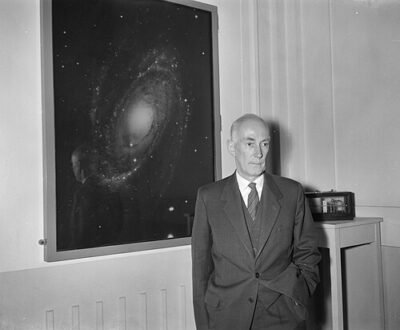
Jan Hendrik Oort
Jan Hendrik Oort was a Dutch astronomer. Born April 28, 1900, in Franeker. Died November 5, 1992, in Leiden. Educated at University of Groningen. Awards include Bruce Medal, Gold Medal of the Royal Astronomical Society and Janssen Medal.
Facts
35 facts · 2 confirmed by two sources · 16 cited · 17 from one source
Where this comes from
Papalocal keeps its own record. It started from these sources; what each one said is kept here as it was copied, so a change on their side never changes this page by itself. Tap one to read its version.
What Wikidata says · copied November 16, 2026 · revision 2565604710
- Described as
- Dutch astronomer (1900–1992)
- Other names
- J. Oort, Jan Oort, J.H. Oort
- Born
- April 28, 1900 · 10 references
- Died
- November 5, 1992 · 10 references
- Born in
- Franeker · 3 references
- Died in
- Leiden · 3 references
- Citizen of
- Kingdom of the Netherlands · 2 references
- Occupation
- astronomer · 2 references; physicist; university teacher · 2 references
- Worked for
- Leiden University (1930–) · 1 reference
- Education
- University of Groningen
- Member of
- Royal Society of London (1959–); Academy of Sciences of the USSR; Royal Swedish Academy of Sciences; Royal Netherlands Academy of Arts and Sciences; Pontifical Academy of Sciences · 1 reference; American Academy of Arts and Sciences; Russian Academy of Sciences; German Academy of Sciences Leopoldina · 1 reference; International Astronomical Union · 1 reference; National Academy of Sciences (1953–)
- Awards
- Bruce Medal (1942) · 1 reference; Gold Medal of the Royal Astronomical Society (1946); Janssen Medal (1946); Prix Jules Janssen (1947); Henry Norris Russell Lectureship (1951); Foreign Member of the Royal Society (1959) · 1 reference; De Gouden Ganzenveer (1960); honorary doctor of the University of Bordeaux (1961) · 1 reference; Vetlesen Prize (1966) · 1 reference; Karl G. Jansky Lectureship (1967); Karl Schwarzschild Medal (1972) · 1 reference; Balzan Prize (1984); Kyoto Prize in Basic Sciences (1987) · 1 reference
- Field
- astronomy; radio astronomy · 1 reference
- Wikipedias with a page
- 60
Wikidata item Q309861 (wikidata.org/wiki/Q309861), public domain (CC0). Copied November 16, 2026.
What Wikipedia says · copied November 16, 2026 · revision 1381738935
Jan Hendrik Oort ( or ; 28 April 1900 – 5 November 1992) was a Dutch astronomer who made significant contributions to the understanding of the Milky Way and who was a pioneer in the field of radio astronomy. The New York Times called him "one of the century's foremost explorers of the universe"; the European Space Agency website describes him as "one of the greatest astronomers of the 20th century" and states that he "revolutionised astronomy through his ground-breaking discoveries." In 1955, Oort's name appeared in Life magazine's list of the 100 most famous living people. He has been described as "putting the Netherlands in the forefront of postwar astronomy".
Oort determined that the Milky Way rotates and overturned the idea that the Sun was at its center. He also analyzed the vertical motions of stars near the Sun, using this data to estimate the local gravitational field. He calculated how much mass must be present to account for the stellar motions perpendicular to the Galactic plane. Comparing this mass to the visible stars and gas, in 1932, he wrote, "This leads to the conclusion that there must be considerable amounts of invisible matter." The following year, Fritz Zwicky called this invisible matter “dunkle Materie”, German for dark matter. It is now believed that dark matter makes up approximately 84.5% of the total mass in the Universe, and its gravitational pull is responsible for "the clustering of stars into galaxies and galaxies into connecting strings of galaxies".
However, Oort's data have been challenged and his discovery may have been spurious.
Oort discovered the galactic halo, a group of stars orbiting the Milky Way but outside the main disk. Additionally Oort is responsible for a number of important insights about comets, including the realization that their orbits "implied there was a lot more solar system than the region occupied by the planets."
The Oort cloud, the Oort constants, Oort Limit, an impact crater on Pluto (Oort), and the asteroid 1691 Oort were all named after him.
- Born, in its opening lines
- April 28, 1900
- Died, in its opening lines
- November 5, 1992
From the Wikipedia article “Jan Oort” (en.wikipedia.org/wiki/Jan_Oort), by its contributors, under CC BY-SA 4.0 (creativecommons.org/licenses/by-sa/4.0/). Copied November 16, 2026; not changed.
Confirmed Two sources agree. Cited One source, and it names where it got it. One source One source, without a reference of its own. Sources disagree The sources disagree. We show the best-supported value and keep theirs below.
