
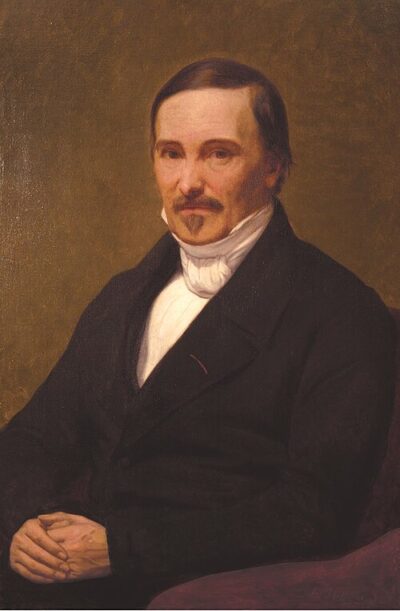
Jean-Victor Poncelet
Jean-Victor Poncelet was a French engineer and mathematician. Born July 1, 1788, in Metz. Died December 22, 1867, in Paris. Positions held include Member of the 1848 Constituent Assembly (1848–1849), president of the French Academy of Sciences (2 times) (1840–1842) and director (1848–1850). Known for Mémoire sur les centres de moyennes harmoniques; pour faire suite au traité des propriétés projectives des figures, et servir d'introduction à la Théorie générale des propriétés projectives des courbes et surfaces géométriques., Traité des propriétés projectives des figures and Poncelet's closure theorem. Educated at École polytechnique and Lycée Fabert. Awards include Knight of the Legion of Honour, Officer of the Legion of Honour and Commander of the Legion of Honour.
Facts
51 facts · 2 confirmed by two sources · 26 cited · 23 from one source
Where this comes from
Papalocal keeps its own record. It started from these sources; what each one said is kept here as it was copied, so a change on their side never changes this page by itself. Tap one to read its version.
What Wikidata says · copied November 16, 2026 · revision 2557958719
- Described as
- French engineer and mathematician (1788-1867)
- Born
- July 1, 1788 · 12 references
- Died
- December 22, 1867 · 9 references
- Born in
- Metz · 4 references
- Died in
- Paris · 4 references
- Buried in
- Montparnasse Cemetery · 1 reference
- Citizen of
- France · 1 reference
- Occupation
- mathematician · 1 reference; politician; physicist · 1 reference; professor; engineer · 1 reference; military engineer; university teacher · 1 reference
- Positions held
- Member of the 1848 Constituent Assembly (1848–1849) · 1 reference; president of the French Academy of Sciences (2 times) (1840–1842) · 1 reference; director (1848–1850) · 1 reference
- Worked for
- École polytechnique (1848–1850) · 1 reference; Engineering Arm (1812–) · 1 reference; École d'application de l'artillerie et du génie in Metz (1815–1834) · 1 reference; University of Paris (1835–1848)
- Education
- École polytechnique (1807–1810) · 1 reference; Lycée Fabert (–1807) · 1 reference; École d'application de l'artillerie et du génie in Metz (1810–1812) · 1 reference
- Member of
- Société Philomathique de Paris; French Academy of Sciences (1834–) · 1 reference; Hungarian Academy of Sciences; Royal Society of London (1842–) · 1 reference; American Academy of Arts and Sciences (1865–) · 1 reference; Russian Academy of Sciences (1857–) · 1 reference; Royal Prussian Academy of Sciences (1832–) · 1 reference; Academy of Sciences of Turin (1841–) · 1 reference
- Known for
- Mémoire sur les centres de moyennes harmoniques; pour faire suite au traité des propriétés projectives des figures, et servir d'introduction à la Théorie générale des propriétés projectives des courbes et surfaces géométriques.; Traité des propriétés projectives des figures; Poncelet's closure theorem; Poncelet–Steiner theorem; Poncelet point
- Awards
- Knight of the Legion of Honour · 1 reference; Officer of the Legion of Honour · 1 reference; Commander of the Legion of Honour (1850); Grand Officer of the Legion of Honour (1853) · 1 reference; Pour le Mérite for Sciences and Arts order (1863) · 1 reference; Montyon Science Award (1825) · 1 reference; Fellow of the American Academy of Arts and Sciences (1865) · 1 reference; Foreign Member of the Royal Society (1842) · 1 reference; 72 names on the Eiffel Tower · 1 reference
- Field
- mathematics; mechanics; projective geometry · 1 reference
- Military rank
- brigadier general (1848); lieutenant (1812) · 1 reference; captain (1815)
- Wikipedias with a page
- 53
Wikidata item Q168452 (wikidata.org/wiki/Q168452), public domain (CC0). Copied November 16, 2026.
What Wikipedia says · copied November 16, 2026 · revision 1379430856
Jean-Victor Poncelet (French pronunciation: [ʒɑ̃ viktɔʁ pɔ̃slɛ]; 1 July 1788 – 22 December 1867) was a French engineer and mathematician who served most notably as the Commanding General of the École Polytechnique. He is considered a reviver of projective geometry, and his work Traité des propriétés projectives des figures is considered the first definitive text on the subject since Gérard Desargues' work on it in the 17th century. He later wrote an introduction to it: Applications d'analyse et de géométrie.
As a mathematician, his most notable work was in projective geometry, although an early collaboration with Charles Julien Brianchon provided a significant contribution to Feuerbach's theorem. He also made discoveries about projective harmonic conjugates; relating these to the poles and polar lines associated with conic sections. He developed the concept of parallel lines meeting at a point at infinity and defined the circular points at infinity that are on every circle of the plane. These discoveries led to the principle of duality, and the principle of continuity and also aided in the development of complex numbers.
As a military engineer, he served in Napoleon's campaign against the Russian Empire in 1812, in which he was captured and held prisoner until 1814. Later, he served as a professor of mechanics at the École d'application in his home town of Metz, during which time he published Introduction à la mécanique industrielle, a work he is famous for, and improved the design of turbines and water wheels. While a professor of applied mechanics, he also, independently from Coriolis, pioneered the use of work in mechanics and the work-energy theorem, including coining the term "mechanical work". In 1837, a tenured 'Chaire de mécanique physique et expérimentale' was specially created for him at the Sorbonne (the University of Paris). In 1848, he became the commanding general of his alma mater, the École Polytechnique. He is honoured by having his name listed among notable French engineers and scientists displayed around the first stage of the Eiffel tower.
- Born, in its opening lines
- July 1, 1788
- Died, in its opening lines
- December 22, 1867
From the Wikipedia article “Jean-Victor Poncelet” (en.wikipedia.org/wiki/Jean-Victor_Poncelet), by its contributors, under CC BY-SA 4.0 (creativecommons.org/licenses/by-sa/4.0/). Copied November 16, 2026; not changed.
Confirmed Two sources agree. Cited One source, and it names where it got it. One source One source, without a reference of its own. Sources disagree The sources disagree. We show the best-supported value and keep theirs below.
