
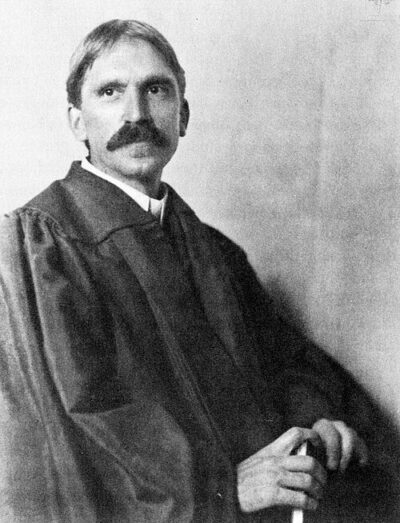
John Dewey
John Dewey was an American philosopher, psychologist, and educational reformer. Born October 20, 1859, in Burlington. Died June 1, 1952, in New York City. Positions held include President of the American Psychological Association (1899). Known for The School and Society, Democracy and Education and Experience and Education. Educated at Johns Hopkins University and University of Vermont. Awards include Honorary Doctorate from the National Autonomous University of Mexico, Carus Lectures and doctor honoris causa from the University of Paris.
Facts
43 facts · 2 confirmed by two sources · 13 cited · 28 from one source
Where this comes from
Papalocal keeps its own record. It started from these sources; what each one said is kept here as it was copied, so a change on their side never changes this page by itself. Tap one to read its version.
What Wikidata says · copied November 13, 2026 · revision 2562486421
- Described as
- American philosopher, psychologist, and educational reformer (1859–1952)
- Other names
- Dewey
- Born
- October 20, 1859 · 14 references
- Died
- June 1, 1952 · 13 references
- Born in
- Burlington · 2 references
- Died in
- New York City · 3 references
- Buried in
- University of Vermont · 1 reference
- Citizen of
- United States
- Occupation
- philosopher · 2 references; psychologist · 2 references; pedagogue · 1 reference; professor; sociologist; trade unionist; aesthetician · 1 reference; teacher · 1 reference
- Positions held
- President of the American Psychological Association (1899) · 1 reference
- Worked for
- University of Chicago; University of Michigan; Teachers College · 1 reference; University of Minnesota · 1 reference
- Education
- Johns Hopkins University; University of Vermont; Burlington High School
- Member of
- American Philosophical Society; American Psychological Association; Phi Beta Kappa Society; National Academy of Sciences (1910–)
- Known for
- The School and Society; Democracy and Education; Experience and Education; The Public and its Problems; Art as Experience
- Awards
- Honorary Doctorate from the National Autonomous University of Mexico (1951); Carus Lectures (1925) · 1 reference; doctor honoris causa from the University of Paris (1930) · 1 reference
- Field
- philosophy; philosophy of education
- Spouse
- Alice Chipman Dewey; Estelle Roberta Lowitz Grant
- Children
- Evelyn Dewey
- Father
- Capt. Archibald Sprague Dewey · 1 reference
- Siblings
- Davis Rich Dewey
- Religion
- religious humanism · 1 reference
- Lived in
- United States · 1 reference
- Wikipedias with a page
- 111
Wikidata item Q131805 (wikidata.org/wiki/Q131805), public domain (CC0). Copied November 13, 2026.
What Wikipedia says · copied November 13, 2026 · revision 1383583932
John Dewey (; October 20, 1859 – June 1, 1952) was an American philosopher, psychologist, and educational reformer. He was one of the most prominent American scholars in the first half of the twentieth century.
The overriding theme of Dewey's works was his profound belief in democracy, be it in politics, education, or communication and journalism. As Dewey himself stated in 1888, while still at the University of Michigan, "Democracy and the one, ultimate, ethical ideal of humanity are to my mind synonymous." Dewey considered two fundamental elements—schools and civil society—to be major topics needing attention and reconstruction to encourage experimental intelligence and plurality. He asserted that complete democracy was to be obtained not just by extending voting rights but also by ensuring that there exists a fully formed public opinion, accomplished by communication among citizens, experts, and politicians.
Dewey was one of the primary figures associated with the philosophy of pragmatism and is considered one of the founding thinkers of functional psychology. His paper "The Reflex Arc Concept in Psychology", published in 1896, is regarded as the first major work in the (Chicago) functionalist school of psychology. A Review of General Psychology survey, published in 2002, ranked Dewey as the 93rd-most-cited psychologist of the 20th century.
Dewey was also a major educational reformer for the 20th century. A well-known public intellectual, he was a major voice of progressive education and liberalism. While a professor at the University of Chicago, he founded the University of Chicago Laboratory Schools, where he was able to apply and test his progressive ideas on pedagogical method. From 1904 until his retirement in 1930 he was professor of philosophy at Teachers College, Columbia University.
Although Dewey is known best for his publications about education, he also wrote about many other topics, including epistemology, metaphysics, aesthetics, art, logic, social theory, and ethics.
- Born, in its opening lines
- October 20, 1859
- Died, in its opening lines
- June 1, 1952
From the Wikipedia article “John Dewey” (en.wikipedia.org/wiki/John_Dewey), by its contributors, under CC BY-SA 4.0 (creativecommons.org/licenses/by-sa/4.0/). Copied November 13, 2026; not changed.
Confirmed Two sources agree. Cited One source, and it names where it got it. One source One source, without a reference of its own. Sources disagree The sources disagree. We show the best-supported value and keep theirs below.
