
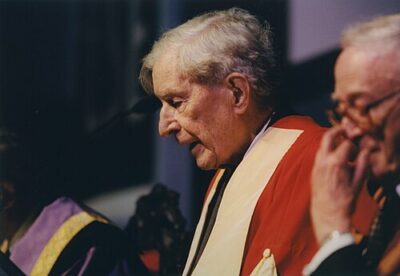
John Kenneth Galbraith
John Kenneth Galbraith was a Canadian-American economist and diplomat. Born October 15, 1908, in Iona Station. Died April 29, 2006, in Cambridge. Positions held include United States Ambassador to India (1961–1963). Known for History of Economics: The Past as the Present. Educated at University of Toronto and University of California, Berkeley. Awards include Guggenheim Fellowship, The Hillman Prize for Book Journalism and honorary doctor of the Katholieke Universiteit Leuven.
Facts
52 facts · 2 confirmed by two sources · 23 cited · 27 from one source
Where this comes from
Papalocal keeps its own record. It started from these sources; what each one said is kept here as it was copied, so a change on their side never changes this page by itself. Tap one to read its version.
What Wikidata says · copied November 13, 2026 · revision 2565530336
- Described as
- Canadian-American economist and diplomat (1908–2006)
- Other names
- John K. Galbraith, John Galbraith, Ken Galbraith, J. K. Galbraith
- Born
- October 15, 1908 · 15 references
- Died
- April 29, 2006 · 15 references
- Born in
- Iona Station · 1 reference
- Died in
- Cambridge · 2 references
- Buried in
- Indian Hill Cemetery · 1 reference
- Citizen of
- Canada; United States (1937–)
- Occupation
- economist · 1 reference; diplomat · 1 reference; politician; university teacher; non-fiction writer; writer · 1 reference; ambassador · 2 references; novelist · 1 reference
- Positions held
- United States Ambassador to India (1961–1963)
- Political party
- Democratic Party
- Worked for
- Princeton University (1939–1940); Harvard University; Office of Price Administration (1941–1943); Fortune (1943–1949)
- Education
- University of Toronto; University of California, Berkeley (–1934); Ontario Agricultural College · 1 reference
- Member of
- American Academy of Arts and Letters; Academy of Sciences of the USSR; American Academy of Arts and Sciences; Russian Academy of Sciences; American Philosophical Society (1980–) · 1 reference
- Known for
- History of Economics: The Past as the Present
- Awards
- Guggenheim Fellowship (1955) · 1 reference; The Hillman Prize for Book Journalism (1959) · 1 reference; honorary doctor of the Katholieke Universiteit Leuven (1972); honorary doctorate from University of Paris-II (1974) · 3 references; Humanist of the Year (1985); Lomonosov Gold Medal (1993); Lysenko Prize (1994) · 2 references; Presidential Medal of Freedom (2000) · 1 reference; Library of Congress Living Legend (2000–) · 1 reference; Leontief Prize for Advancing the Frontiers of Economic Thought (2000) · 1 reference; Officer of the Order of Canada; Four Freedoms Award – Freedom from Want (1985) · 1 reference; honorary citizenship · 1 reference; Padma Vibhushan in Literature & Education; Distinguished Fellow of the American Economic Association
- Field
- economics · 1 reference; creative and professional writing · 1 reference; non-fiction literature · 1 reference; diplomacy · 1 reference
- Spouse
- Catherine Galbraith · 1 reference
- Children
- Peter W. Galbraith · 1 reference; James K. Galbraith · 1 reference
- Wikipedias with a page
- 76
Wikidata item Q186042 (wikidata.org/wiki/Q186042), public domain (CC0). Copied November 13, 2026.
What Wikipedia says · copied November 13, 2026 · revision 1383414621
John Kenneth Galbraith (October 15, 1908 – April 29, 2006) was a Canadian-American economist, diplomat, public official, and intellectual. His books on economic topics were bestsellers from the 1950s through the 2000s. As an economist, he leaned toward post-Keynesian economics from an institutionalist perspective. He served as the deputy director of the powerful Office of Price Administration (OPA) during World War II in charge of stabilizing all prices, wages and rents in the American economy, to combat the threat of inflation and hoarding during a time of shortages and rationing, a task which was successfully accomplished.
Galbraith was a long-time Harvard faculty member and stayed with Harvard University for half a century as a professor of economics. He was a prolific author and wrote four dozen books, including several novels, and published more than a thousand articles and essays on various subjects. Among his works was a trilogy on economics, American Capitalism (1952), The Affluent Society (1958), and The New Industrial State (1967).
Galbraith was active in Democratic Party politics, serving in the administrations of Franklin D. Roosevelt, Harry S. Truman, John F. Kennedy, and Lyndon B. Johnson. He served as United States Ambassador to India under the Kennedy administration. His political activism, literary output and outspokenness brought him wide fame during his lifetime. Galbraith was one of the few to receive both the World War II Medal of Freedom (1946) and the Presidential Medal of Freedom (2000) for his public service and contributions to science. During the Watergate scandal, Galbraith discovered that he had been placed on the master list of Nixon's political opponents.
- Born, in its opening lines
- October 15, 1908
- Died, in its opening lines
- April 29, 2006
From the Wikipedia article “John Kenneth Galbraith” (en.wikipedia.org/wiki/John_Kenneth_Galbraith), by its contributors, under CC BY-SA 4.0 (creativecommons.org/licenses/by-sa/4.0/). Copied November 13, 2026; not changed.
Confirmed Two sources agree. Cited One source, and it names where it got it. One source One source, without a reference of its own. Sources disagree The sources disagree. We show the best-supported value and keep theirs below.
