
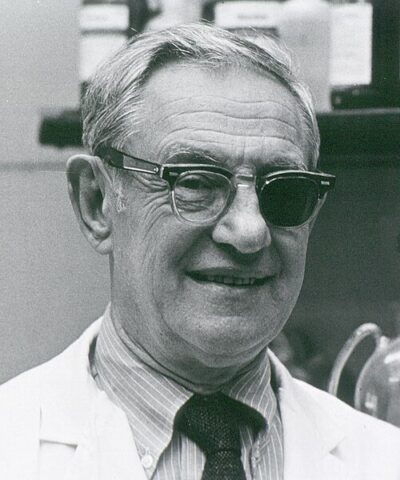
Julius Axelrod
Julius Axelrod was an American biochemist. Born May 30, 1912, in New York City. Died December 29, 2004, in Bethesda. Educated at City College of New York and New York University. Awards include Canada Gairdner International Award, Nobel Prize in Physiology or Medicine and Schmiedeberg Plaque.
Facts
38 facts · 2 confirmed by two sources · 16 cited · 20 from one source
Where this comes from
Papalocal keeps its own record. It started from these sources; what each one said is kept here as it was copied, so a change on their side never changes this page by itself. Tap one to read its version.
What Wikipedia says · copied November 13, 2026 · revision 1381481624
Julius Axelrod (May 30, 1912 – December 29, 2004) was an American biochemist. He won a share of the Nobel Prize in Physiology or Medicine in 1970 along with Bernard Katz and Ulf von Euler. The Nobel Committee honored him for his work on the release and reuptake of catecholamine neurotransmitters, a class of chemicals in the brain that include epinephrine, norepinephrine, and, as was later discovered, dopamine. Axelrod also made major contributions to the understanding of the pineal gland and how it is regulated during the sleep-wake cycle.
- Born, in its opening lines
- May 30, 1912
- Died, in its opening lines
- December 29, 2004
From the Wikipedia article “Julius Axelrod” (en.wikipedia.org/wiki/Julius_Axelrod), by its contributors, under CC BY-SA 4.0 (creativecommons.org/licenses/by-sa/4.0/). Copied November 13, 2026; not changed.
What Wikidata says · copied November 14, 2026 · revision 2569164297
- Described as
- American biochemist (1912–2004)
- Other names
- J. Axelrod, J Axelrod
- Born
- May 30, 1912 · 10 references
- Died
- December 29, 2004 · 12 references
- Born in
- New York City · 6 references
- Died in
- Bethesda · 1 reference
- Buried in
- Judean Memorial Gardens · 1 reference
- Citizen of
- United States · 2 references; Poland
- Occupation
- chemist; neuroscientist; pharmacologist; scientist · 2 references; biochemist
- Worked for
- United States National Institutes of Health (1949–1984) · 1 reference
- Education
- City College of New York; New York University; George Washington University Medical School; Seward Park High School · 1 reference
- Member of
- Royal Society of London; German Academy of Sciences at Berlin; American Academy of Arts and Sciences; National Academy of Sciences · 1 reference; American Association for the Advancement of Science · 1 reference; American Philosophical Society (1995–)
- Awards
- Canada Gairdner International Award (1967); Nobel Prize in Physiology or Medicine (1970) · 2 references; Schmiedeberg Plaque (1978); Foreign Member of the Royal Society (1979) · 1 reference; honorary doctorate from University of Paris-XI (1982) · 1 reference; Bristol-Myers Squibb Award for Distinguished Achievement in Neuroscience Research (1989) · 1 reference; Ralph W. Gerard Prize (1992) · 1 reference; Fellow of the American Academy of Arts and Sciences
- Field
- biochemistry · 1 reference; pharmacology; neuroscience · 1 reference; neurochemistry · 1 reference
- Religion
- atheism
- Lived in
- Bethesda; New York City
- Wikipedias with a page
- 56
Wikidata item Q110106 (wikidata.org/wiki/Q110106), public domain (CC0). Copied November 14, 2026.
Confirmed Two sources agree. Cited One source, and it names where it got it. One source One source, without a reference of its own. Sources disagree The sources disagree. We show the best-supported value and keep theirs below.
