
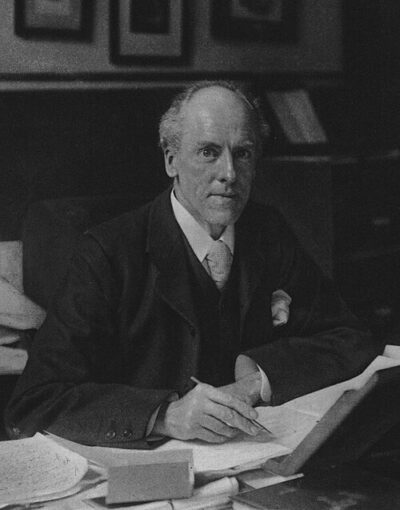
Karl Pearson
Karl Pearson was an English mathematician, biometrician, and eugenicist. Born March 27, 1857, in London. Died April 27, 1936, in Coldharbour. Positions held include editor (1901–1936). Educated at King's College and University College London. Awards include Fellow of the Royal Society, Huxley Memorial Medal and Darwin Medal.
Facts
40 facts · 2 confirmed by two sources · 15 cited · 23 from one source
Where this comes from
Papalocal keeps its own record. It started from these sources; what each one said is kept here as it was copied, so a change on their side never changes this page by itself. Tap one to read its version.
What Wikidata says · copied November 16, 2026 · revision 2566631193
- Described as
- English mathematician, biometrician, and eugenicist (1857–1936)
- Other names
- Carl Pearson
- Born
- March 27, 1857 · 7 references
- Died
- April 27, 1936 · 7 references
- Born in
- London · 1 reference
- Died in
- Coldharbour · 1 reference
- Buried in
- Church of St Michael · 1 reference
- Name at birth
- Carl Pearson · 1 reference
- Citizen of
- United Kingdom
- Occupation
- mathematician · 1 reference; historian of mathematics; statistician · 1 reference; historian; philosopher; biographer; psychologist · 1 reference; eugenicist · 1 reference
- Positions held
- editor (1901–1936) · 1 reference
- Worked for
- University College London; Gresham College; King's College London
- Education
- King's College (1875–1879) · 1 reference; University College London; King's College London; Heidelberg University · 1 reference; University of Cambridge · 1 reference; University College School · 1 reference
- Member of
- Royal Society of London; American Academy of Arts and Sciences (1928–)
- Awards
- Fellow of the Royal Society (1896) · 1 reference; Huxley Memorial Medal (1903) · 1 reference; Darwin Medal (1898) · 1 reference; Weldon Memorial Prize (1912)
- Field
- mathematical statistics; statistics; biology; eugenics · 1 reference
- Spouse
- Maria Sharpe · 1 reference
- Children
- Egon Pearson · 1 reference; Helga Sharpe Pearson
- Father
- William Pearson · 1 reference
- Religion
- Quakers
- Wikipedias with a page
- 55
Wikidata item Q310794 (wikidata.org/wiki/Q310794), public domain (CC0). Copied November 16, 2026.
What Wikipedia says · copied November 16, 2026 · revision 1384710972
Karl Pearson (; 27 March 1857 – 27 April 1936) was an English biostatistician and mathematician. He has been credited with establishing the discipline of mathematical statistics. He founded the world's first university statistics department at University College London in 1911, and contributed significantly to the field of biometrics. Pearson was also a proponent of Social Darwinism and eugenics, and his thought is an example of what is today described as scientific racism. Pearson was a protégé and biographer of Sir Francis Galton. He edited and completed both William Kingdon Clifford's Common Sense of the Exact Sciences (1885) and Isaac Todhunter's History of the Theory of Elasticity, Vol. 1 (1886–1893) and Vol. 2 (1893), following their deaths.
- Born, in its opening lines
- March 27, 1857
- Died, in its opening lines
- April 27, 1936
From the Wikipedia article “Karl Pearson” (en.wikipedia.org/wiki/Karl_Pearson), by its contributors, under CC BY-SA 4.0 (creativecommons.org/licenses/by-sa/4.0/). Copied November 16, 2026; not changed.
Confirmed Two sources agree. Cited One source, and it names where it got it. One source One source, without a reference of its own. Sources disagree The sources disagree. We show the best-supported value and keep theirs below.
