
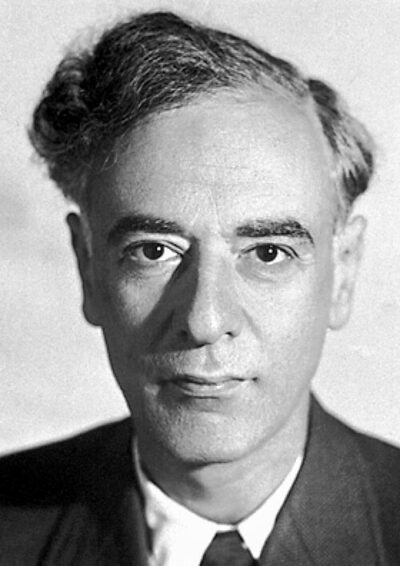
Lev Landau
Lev Landau was a Soviet theoretical physicist. Born January 9, 1908, in Baku. Died April 1, 1968, in Moscow. Known for Course of Theoretical Physics, Landau theory and Landau damping. Educated at Faculty of Physics and Mathematics of the Saint Petersburg University and Baku State University. Awards include Nobel Prize in Physics, Stalin Prize and Order of Lenin (2 times).
Facts
59 facts · 1 confirmed by two sources · 15 cited · 42 from one source · 1 where the sources disagree
What’s different
- Born: we show January 9, 1908 (Sources disagree). Wikipedia says January 22, 1908
Where this comes from
Papalocal keeps its own record. It started from these sources; what each one said is kept here as it was copied, so a change on their side never changes this page by itself. Tap one to read its version.
What Wikidata says · copied November 16, 2026 · revision 2563195875
- Described as
- Soviet theoretical physicist (1908–1968)
- Other names
- L. D. Landau, Lev Davydovitch Landau, Lev Davidovich Landau, Лев Давидович Ландау
- Born
- January 9, 1908 · 2 references
- Died
- April 1, 1968 · 11 references
- Born in
- Baku · 2 references
- Died in
- Moscow · 2 references
- Buried in
- Novodevichy Cemetery · 1 reference
- Cause of death
- intestinal disease · 1 reference
- Name at birth
- Лев Давидович Ландау
- Citizen of
- Russian Empire; Azerbaijan Democratic Republic; Soviet Union
- Occupation
- physicist · 6 references; inventor; non-fiction writer; university teacher; theoretical physicist; mathematician · 1 reference
- Worked for
- National University of Kharkiv (1935–1937) · 1 reference; Kharkiv Institute of Physics and Technology (1932–1935) · 1 reference; P.L. Kapitza Institute for Physical Problems RAS (1939–1962) · 1 reference; Ioffe Institute (1931–1932); Lomonosov Moscow State University (1943–1947); Moscow Institute of Physics and Technology (1937–1938) · 1 reference
- Education
- Faculty of Physics and Mathematics of the Saint Petersburg University (1924–1927); Baku State University (1922–1924); Baku Polytechnicum (1921–1922) · 1 reference
- Member of
- Royal Society of London (1960–); German Academy of Sciences Leopoldina (1956–) · 1 reference; National Academy of Sciences (1960–) · 1 reference; Russian Academy of Sciences (1946–) · 1 reference; Royal Danish Academy of Sciences and Letters (1951–); Royal Netherlands Academy of Arts and Sciences (1956–) · 1 reference; American Academy of Arts and Sciences (1960–) · 1 reference; Academy of Sciences of the USSR · 1 reference
- Known for
- Course of Theoretical Physics; Landau theory; Landau damping; Landau distribution; Landau pole; Landau quantization; Landau–Squire jet; Landau–Levich problem; Landau–Hopf theory of turbulence; Ginzburg–Landau–Abrikosov–Gor'kov theory
- Awards
- Nobel Prize in Physics (1962) · 2 references; Stalin Prize (1949); Order of Lenin (2 times) (1949, 1968); Hero of Socialist Labour (1954); Order of the Badge of Honour (1943) · 1 reference; Max Planck Medal (1960); Order of the Red Banner of Labour (1945); Fritz London Award (1960); Lenin Prize (1968); Foreign Member of the Royal Society (1960); Stalin Prize, 2nd degree (1946) · 1 reference; State Stalin Prize, 1st degree · 1 reference
- Field
- theoretical physics
- Spouse
- Konkordija Terentʹevna Landau-Drobanceva
- Mother
- Lyubov Garkavi-Landau
- Religion
- atheism
- Wikipedias with a page
- 99
Wikidata item Q133267 (wikidata.org/wiki/Q133267), public domain (CC0). Copied November 16, 2026.
What Wikipedia says · copied November 16, 2026 · revision 1383790071
Lev Davidovich Landau (Russian: Лев Дави́дович Ланда́у; 22 January 1908 – 1 April 1968) was a Soviet physicist who made fundamental contributions to many areas of theoretical physics. He was considered as one of the last scientists who were universally well-versed and made seminal contributions to all branches of physics. He is credited with laying the foundations of twentieth century condensed matter physics, and is also considered arguably the greatest Soviet theoretical physicist.
His accomplishments include the independent co-discovery of the density matrix method in quantum mechanics (alongside John von Neumann), the quantum mechanical theory of diamagnetism, the theory of superfluidity, the theory of second-order phase transitions, invention of order parameter technique, the Ginzburg–Landau theory of superconductivity, the theory of Fermi liquids, the explanation of Landau damping in plasma physics, the Landau pole in quantum electrodynamics, the two-component theory of neutrinos, and Landau's equations for S-matrix singularities. He received the 1962 Nobel Prize in Physics for his development of a mathematical theory of superfluidity that accounts for the properties of liquid helium II at a temperature below 2.17 K (−270.98 °C).
- Born, in its opening lines
- January 22, 1908
- Died, in its opening lines
- April 1, 1968
From the Wikipedia article “Lev Landau” (en.wikipedia.org/wiki/Lev_Landau), by its contributors, under CC BY-SA 4.0 (creativecommons.org/licenses/by-sa/4.0/). Copied November 16, 2026; not changed.
Confirmed Two sources agree. Cited One source, and it names where it got it. One source One source, without a reference of its own. Sources disagree The sources disagree. We show the best-supported value and keep theirs below.
