
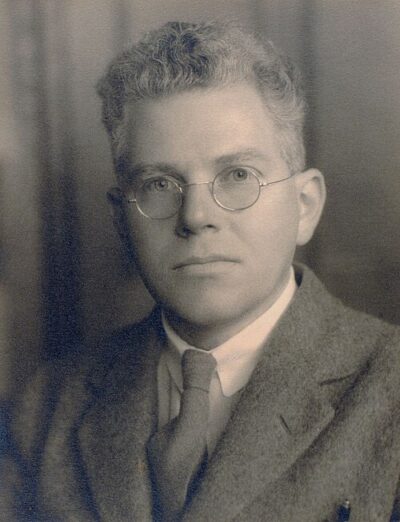
Mark Oliphant
Mark Oliphant was a nuclear physicist, Governor of South Australia. Born October 8, 1901, in Adelaide. Died July 14, 2000, in Canberra. Positions held include Governor of South Australia (1971–1976). Educated at University of Adelaide and University of Cambridge. Awards include Knight Commander of the Order of the British Empire, Hughes Medal and Rutherford Medal and Prize.
Facts
38 facts · 2 confirmed by two sources · 14 cited · 22 from one source
Where this comes from
Papalocal keeps its own record. It started from these sources; what each one said is kept here as it was copied, so a change on their side never changes this page by itself. Tap one to read its version.
What Wikidata says · copied November 15, 2026 · revision 2564935844
- Described as
- nuclear physicist, Governor of South Australia (1901–2000)
- Other names
- Marcus Laurence Elwin Oliphant, Marcus 'Mark' Laurence Elwin Oliphant, Mark Laurence Oliphant, Mark L. Oliphant
- Born
- October 8, 1901 · 3 references
- Died
- July 14, 2000 · 4 references
- Born in
- Adelaide
- Died in
- Canberra · 4 references
- Buried in
- Ascension Parish Burial Ground · 1 reference
- Citizen of
- Australia · 2 references; United States · 3 references
- Occupation
- physicist · 4 references; governor; nuclear physicist
- Positions held
- Governor of South Australia (1971–1976)
- Political party
- Australian Democrats (1977–); Australia Party (–1977)
- Worked for
- University of Birmingham; Australian National University; University of Adelaide · 1 reference
- Education
- University of Adelaide (–1922); University of Cambridge · 1 reference; Unley High School
- Member of
- Royal Society of London; Australian Academy of Science
- Awards
- Knight Commander of the Order of the British Empire (1959) · 1 reference; Hughes Medal (1943); Rutherford Medal and Prize (1946) · 1 reference; Faraday Medal (1948); Royal Society Bakerian Medal (1955) · 1 reference; James Cook Medal (1974) · 1 reference; ANZAAS Medal (1979); Fellow of the Australian Academy of Technology and Engineering (1976) · 1 reference; Fellow of the Australian Academy of Science (1953) · 1 reference; Companion of the Order of Australia (1977) · 1 reference; Royal Society Bakerian Medal; Australian National Living Treasure; Matthew Flinders Medal and Lecture (1961) · 1 reference; Honorary Fellow of the Royal Society Te Apārangi (1960–) · 1 reference
- Field
- physics
- Lived in
- Government House; Hughes (1977)
- Wikipedias with a page
- 33
Wikidata item Q727443 (wikidata.org/wiki/Q727443), public domain (CC0). Copied November 15, 2026.
What Wikipedia says · copied November 15, 2026 · revision 1381940819
Sir Marcus Laurence Elwin Oliphant (8 October 1901 – 14 July 2000) was an Australian physicist and humanitarian who played an important role in the first experimental demonstration of nuclear fusion and in the development of nuclear weapons.
Born and raised in Adelaide, South Australia, Oliphant graduated from the University of Adelaide in 1922. He was awarded an 1851 Exhibition Scholarship in 1927 on the strength of the research he had done on mercury, and went to England where he studied under Sir Ernest Rutherford at the University of Cambridge's Cavendish Laboratory. There, he discovered the respective nuclei of helium-3 (helions) and of tritium (tritons). He also discovered that when they reacted with each other, the particles that were released had far more energy than they started with. Energy had been liberated from inside the nucleus, and he realised that this was a result of nuclear fusion.
Oliphant left the Cavendish Laboratory in 1937 to become the Poynting Professor of Physics at the University of Birmingham. He attempted to build a 60-inch (150 cm) cyclotron at the university, but its completion was postponed by the outbreak of the Second World War in Europe in 1939. He became involved with the development of radar, heading a group at the University of Birmingham that included John Randall and Harry Boot. They created a radical new design, the cavity magnetron, that made microwave radar possible. Oliphant also formed part of the MAUD Committee, which reported in July 1941, that an atomic bomb was not only feasible, but might be produced as early as 1943. Oliphant was instrumental in spreading the word of this finding in the United States, thereby starting what became the Manhattan Project. Later in the war, he worked on it with his friend Ernest Lawrence at the Radiation Laboratory in Berkeley, California, developing electromagnetic isotope separation, which provided the fissile component of the Little Boy atomic bomb used in the atomic bombing of Hiroshima in August 1945.
After the war, Oliphant returned to Australia as the first director of the Research School of Physical Sciences and Engineering at the new Australian National University (ANU), where he initiated the design and construction of the world's largest (500 megajoule) homopolar generator. He retired in 1967, but was appointed Governor of South Australia on the advice of the premier, Don Dunstan. He became the first South Australian-born governor of South Australia. He assisted in the founding of the Australian Democrats political party and was chairman of the meeting in Melbourne in 1977 at which the party was launched. Late in life he witnessed his wife, Rosa, suffer before her death in 1987, and he became an advocate for voluntary euthanasia. He died in Canberra in 2000.
- Born, in its opening lines
- October 8, 1901
- Died, in its opening lines
- July 14, 2000
From the Wikipedia article “Mark Oliphant” (en.wikipedia.org/wiki/Mark_Oliphant), by its contributors, under CC BY-SA 4.0 (creativecommons.org/licenses/by-sa/4.0/). Copied November 15, 2026; not changed.
Confirmed Two sources agree. Cited One source, and it names where it got it. One source One source, without a reference of its own. Sources disagree The sources disagree. We show the best-supported value and keep theirs below.
