
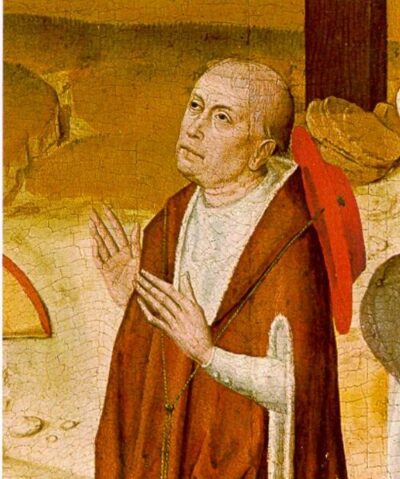
Nicholas of Cusa
Nicholas of Cusa was a German philosopher. Born 1401, in Bernkastel-Kues. Died August 11, 1464, in Todi. Positions held include Camerlengo of the Sacred College of Cardinals (1463–1464), cardinal (1448–) and Roman Catholic Bishop of Brixen (1450–1464). Known for De auctoritate praesidendi in concilio generali, Reparatio calendarii and De concordantia catholica. Educated at University of Padua and Heidelberg University.
Facts
39 facts · 2 confirmed by two sources · 19 cited · 16 from one source · 2 where the sources disagree
What’s different
- Buried in: we show San Pietro in Vincoli (Sources disagree). Wikidata also lists tomb of the cardinal Nicholas of Cusa
- Name at birth: we show Nikolaus Krebs (Sources disagree). Wikidata also lists Nicolaus Cusanus
Where this comes from
Papalocal keeps its own record. It started from these sources; what each one said is kept here as it was copied, so a change on their side never changes this page by itself. Tap one to read its version.
What Wikidata says · copied November 16, 2026 · revision 2569996410
- Described as
- German philosopher (1401 – 1464)
- Other names
- Cusanus bem foda, Nikolaus Krebs, Nikolaus von Kues, Nikolaus Cusanus, Nikolaus Cryfftz, Nikolaus von Cusa, Nicholas of Kues, P. Nicolavm Cvsanvm, Cardinal Nicholas of Cusa, Nicolaus Cusanus, Nicolas of Cusa, Nikolay kuzalik
- Born
- 1401 · 6 references
- Died
- August 11, 1464 · 3 references
- Born in
- Bernkastel-Kues · 1 reference
- Died in
- Todi · 3 references
- Buried in
- San Pietro in Vincoli · 1 reference; tomb of the cardinal Nicholas of Cusa · 1 reference
- Name at birth
- Nikolaus Krebs · 1 reference; Nicolaus Cusanus · 1 reference
- Citizen of
- Holy Roman Empire · 1 reference
- Occupation
- mathematician · 1 reference; astronomer · 1 reference; diplomat · 1 reference; philosopher · 1 reference; writer · 1 reference; Catholic priest (1436–) · 1 reference; theologian · 1 reference; jurist · 1 reference
- Positions held
- Camerlengo of the Sacred College of Cardinals (1463–1464); cardinal (1448–) · 1 reference; Roman Catholic Bishop of Brixen (1450–1464) · 2 references; cardinal priest of Saint-Pierre-aux-Liens (1449–1464)
- Education
- University of Padua (1417–1423) · 1 reference; Heidelberg University (1416–1417) · 1 reference; University of Cologne (1426–) · 2 references
- Known for
- De auctoritate praesidendi in concilio generali; Reparatio calendarii; De concordantia catholica; De docta ignorantia; Dialogus concludens Amedistarum errorem; De coniecturis; De deo abscondito; De quaerendo deum; De dato patris luminum; De transmutationibus geometricis
- Field
- philosophy; Christian theology · 1 reference; Renaissance philosophy · 1 reference; astronomy · 1 reference; mathematics · 1 reference; diplomacy · 1 reference
- Religion
- Catholic Church · 1 reference
- Wikipedias with a page
- 83
Wikidata item Q154751 (wikidata.org/wiki/Q154751), public domain (CC0). Copied November 16, 2026.
What Wikipedia says · copied November 16, 2026 · revision 1385889728
Nicholas of Cusa (1401 – 11 August 1464), also referred to as Nicholas of Kues and Nicolaus Cusanus (), was a German Catholic bishop and polymath active as a philosopher, theologian, jurist, mathematician, and astronomer. One of the first German proponents of Renaissance humanism, he made spiritual and political contributions to European culture. A notable example of this is his mystical or spiritual writings on "learned ignorance", as well as his participation in power struggles between Rome and the German states of the Holy Roman Empire.
As papal legate to Germany from 1446, he was appointed cardinal for his merits by Pope Nicholas V in 1448 and Prince-Bishop of Brixen two years later. In 1459, he became vicar general in the Papal States. Nicholas has remained an influential figure. In 2001, the sixth centennial of his birth was celebrated on four continents and commemorated by publications on his life and work.
- Born, in its opening lines
- 1401
- Died, in its opening lines
- August 11, 1464
From the Wikipedia article “Nicholas of Cusa” (en.wikipedia.org/wiki/Nicholas_of_Cusa), by its contributors, under CC BY-SA 4.0 (creativecommons.org/licenses/by-sa/4.0/). Copied November 16, 2026; not changed.
Confirmed Two sources agree. Cited One source, and it names where it got it. One source One source, without a reference of its own. Sources disagree The sources disagree. We show the best-supported value and keep theirs below.
