
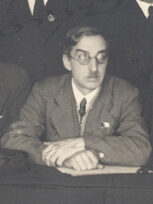
Nikoloz Muskhelishvili
Nikoloz Muskhelishvili was a Georgian mathematician. Born February 16, 1891, in Tbilisi. Died July 15, 1976, in Tbilisi. Positions held include deputy of the Supreme Soviet of the Soviet Union (1937–1976), chairperson (1941–1972) and director (1941–1976). Educated at Faculty of Physics and Mathematics of the Saint Petersburg University and Saint Petersburg State University. Awards include Stalin Prize, Order of Lenin (2 times) and Hero of Socialist Labour.
Facts
44 facts · 2 confirmed by two sources · 17 cited · 25 from one source
What’s different
- Born: we show February 16, 1891 (Confirmed). Wikidata also lists February 4, 1891
- Died: we show July 15, 1976 (Confirmed). Wikidata also lists July 16, 1976
Where this comes from
Papalocal keeps its own record. It started from these sources; what each one said is kept here as it was copied, so a change on their side never changes this page by itself. Tap one to read its version.
What Wikidata says · copied November 18, 2026 · revision 2553952364
- Described as
- Georgian mathematician (1891-1976)
- Other names
- Nikolai Ivanovich Muskhelishvili, Nikolay I. Muskhelishvili
- Born
- February 4, 1891 · 1 reference; February 16, 1891 · 1 reference
- Died
- July 15, 1976 · 2 references; July 16, 1976 · 1 reference
- Born in
- Tbilisi · 1 reference
- Died in
- Tbilisi
- Buried in
- Mtatsminda Pantheon · 1 reference
- Citizen of
- Russian Empire; Transcaucasian Democratic Federative Republic; Democratic Republic of Georgia; Soviet Union
- Occupation
- mathematician · 3 references; physicist · 2 references; university teacher; politician
- Positions held
- deputy of the Supreme Soviet of the Soviet Union (1937–1976) · 1 reference; chairperson (1941–1972) · 1 reference; director (1941–1976)
- Political party
- Communist Party of the Soviet Union
- Worked for
- Academy of Sciences of the USSR (1939–); Tbilisi State University · 1 reference; Georgian Technical University; Georgian National Academy of Sciences (1941–1972) · 1 reference
- Education
- Faculty of Physics and Mathematics of the Saint Petersburg University; Saint Petersburg State University · 1 reference
- Member of
- Russian Academy of Sciences (1933–) · 1 reference; German Academy of Sciences at Berlin (1967–); Polish Academy of Sciences (1960–); Georgian National Academy of Sciences (1941–); National Academy of Sciences of Armenia · 1 reference
- Awards
- Stalin Prize (1941); Order of Lenin (2 times) (1941, 1945) · 1 reference; Hero of Socialist Labour (1945) · 1 reference; Order of the October Revolution (1971) · 1 reference; Order of the Red Banner of Labour (1944) · 1 reference; Medal "For the Defence of the Caucasus" (1944) · 1 reference; Lomonosov Gold Medal (1972) · 2 references; Medal "For Valiant Labour in the Great Patriotic War 1941–1945" (1946) · 1 reference; Medal "For Labour Valour" (1960) · 1 reference; Panetti Ferrari Award (1969) · 2 references; honorary member of the National Academy of Sciences of Azerbaijan · 1 reference; Stalin Prize, 2nd degree (1947) · 1 reference; "Hammer and Sickle" gold medal (1945) · 1 reference
- Field
- integral equation; function theory; applied mechanics · 1 reference
- Wikipedias with a page
- 20
Wikidata item Q695002 (wikidata.org/wiki/Q695002), public domain (CC0). Copied November 18, 2026.
What Wikipedia says · copied November 18, 2026 · revision 1375164366
Nikoloz (Niko) Muskhelishvili (Georgian: ნიკოლოზ (ნიკო) მუსხელიშვილი; 16 February [O.S. 4 February] 1891 – 15 July 1976) was a Soviet Georgian mathematician, physicist and engineer who was one of the founders and first President (1941–1972) of the Georgian SSR Academy of Sciences (now Georgian National Academy of Sciences).
- Born, in its opening lines
- February 16, 1891
- Died, in its opening lines
- July 15, 1976
From the Wikipedia article “Nikoloz Muskhelishvili” (en.wikipedia.org/wiki/Nikoloz_Muskhelishvili), by its contributors, under CC BY-SA 4.0 (creativecommons.org/licenses/by-sa/4.0/). Copied November 18, 2026; not changed.
Confirmed Two sources agree. Cited One source, and it names where it got it. One source One source, without a reference of its own. Sources disagree The sources disagree. We show the best-supported value and keep theirs below.
