
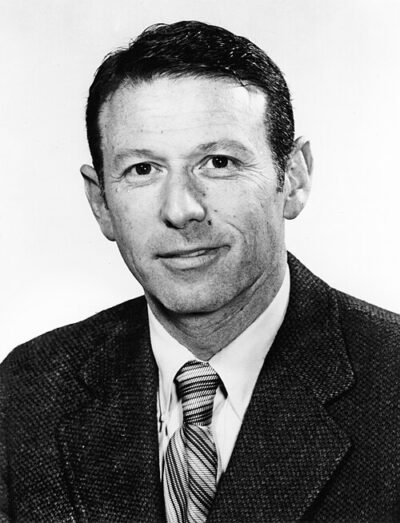
Paul Berg
Paul Berg was an American biochemist, Professor emeritus at Stanford University & Nobel laureate in Chemistry. Born June 30, 1926, in Brooklyn. Died February 15, 2023, in Stanford. Educated at Case Western Reserve University and Pennsylvania State University. Awards include Albert Lasker Award for Basic Medical Research, Nobel Prize in Chemistry and AAAS Award for Scientific Freedom and Responsibility.
Facts
38 facts · 2 confirmed by two sources · 25 cited · 11 from one source
Where this comes from
Papalocal keeps its own record. It started from these sources; what each one said is kept here as it was copied, so a change on their side never changes this page by itself. Tap one to read its version.
What Wikidata says · copied November 13, 2026 · revision 2567914032
- Described as
- American biochemist, Professor emeritus at Stanford University & Nobel laureate in Chemistry (1926–2023)
- Other names
- Paul Timmy Berg, Paul Naim Berg, Berg
- Born
- June 30, 1926 · 8 references
- Died
- February 15, 2023 · 3 references
- Born in
- Brooklyn · 2 references
- Died in
- Stanford · 1 reference
- Citizen of
- United States · 2 references
- Occupation
- biochemist · 1 reference; molecular biologist · 1 reference; chemist · 3 references; researcher; university teacher · 1 reference; biologist · 1 reference
- Worked for
- Stanford University
- Education
- Case Western Reserve University (–1952); Pennsylvania State University (–1948); Abraham Lincoln High School (–1943) · 1 reference; Clare Hall
- Member of
- Royal Society of London (1992–) · 1 reference; Pontifical Academy of Sciences (1996–) · 1 reference; National Academy of Sciences (1966–) · 1 reference; French Academy of Sciences (1981–) · 1 reference; American Academy of Arts and Sciences (1966–) · 1 reference; European Molecular Biology Organization (1984–) · 1 reference; American Philosophical Society (1983–) · 1 reference; American Association for the Advancement of Science (1966–) · 1 reference; European Academy of Sciences (2006–) · 1 reference
- Awards
- Albert Lasker Award for Basic Medical Research (1980) · 1 reference; Nobel Prize in Chemistry (1980) · 2 references; AAAS Award for Scientific Freedom and Responsibility (1982) · 1 reference; Canada Gairdner International Award (1980) · 1 reference; National Medal of Science (1983) · 1 reference; Max Delbrück Medal (1999) · 2 references; ASCB Public Service Award (2003); Biotechnology Heritage Award (2005) · 1 reference; Foreign Member of the Royal Society (1992) · 1 reference; American Institute of Chemists Gold Medal (2008) · 1 reference; Carl Sagan Prize for Science Popularization (2006) · 1 reference
- Field
- biochemistry
- Spouse
- Mildred Berg · 1 reference
- Wikipedias with a page
- 67
Wikidata item Q102379 (wikidata.org/wiki/Q102379), public domain (CC0). Copied November 13, 2026.
What Wikipedia says · copied November 13, 2026 · revision 1371982062
Paul Berg (June 30, 1926 – February 15, 2023) was an American biochemist and professor at Stanford University.
He received the 1980 Nobel Prize in Chemistry "for his fundamental studies of the biochemistry of nucleic acids, with particular regard to recombinant-DNA".
Berg received his undergraduate education at Penn State University, where he majored in biochemistry. He received his PhD in biochemistry from Case Western Reserve University in 1952. Berg worked as a professor at Washington University School of Medicine and Stanford University School of Medicine, in addition to serving as the director of the Beckman Center for Molecular and Genetic Medicine.
In addition to the Nobel Prize, Berg was presented with the National Medal of Science in 1983 and the National Library of Medicine Medal in 1986. Berg was a member of the Board of Sponsors for the Bulletin of the Atomic Scientists.
- Born, in its opening lines
- June 30, 1926
- Died, in its opening lines
- February 15, 2023
From the Wikipedia article “Paul Berg” (en.wikipedia.org/wiki/Paul_Berg), by its contributors, under CC BY-SA 4.0 (creativecommons.org/licenses/by-sa/4.0/). Copied November 13, 2026; not changed.
Confirmed Two sources agree. Cited One source, and it names where it got it. One source One source, without a reference of its own. Sources disagree The sources disagree. We show the best-supported value and keep theirs below.
